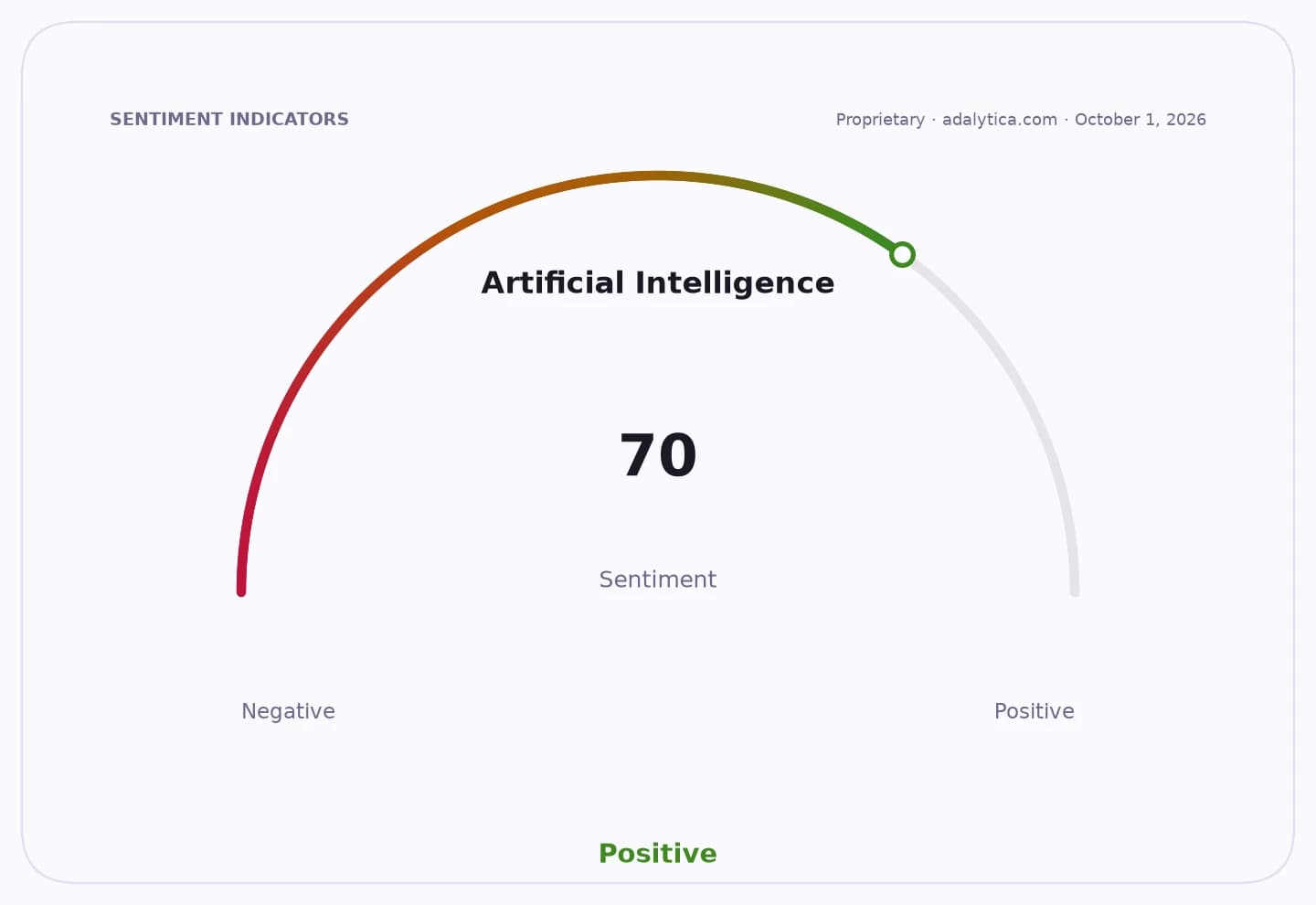
Melania Trump is helping put artificial intelligence at the center of the classroom debate just as new research raises a blunt warning: too much reliance on chatbots may make children worse at thinking, remembering and learning on their own.
AI in Education Faces Learning Risk Debate
That matters because AI is no longer a niche experiment in education. It is moving into schools, universities and teacher-training programs with backing from major technology companies, while Washington treats AI as a strategic priority in the race with China. For investors, that creates a familiar long-term setup: a fast-growing market, rising policy support and a serious risk that public backlash could force schools to slow adoption or tighten rules.
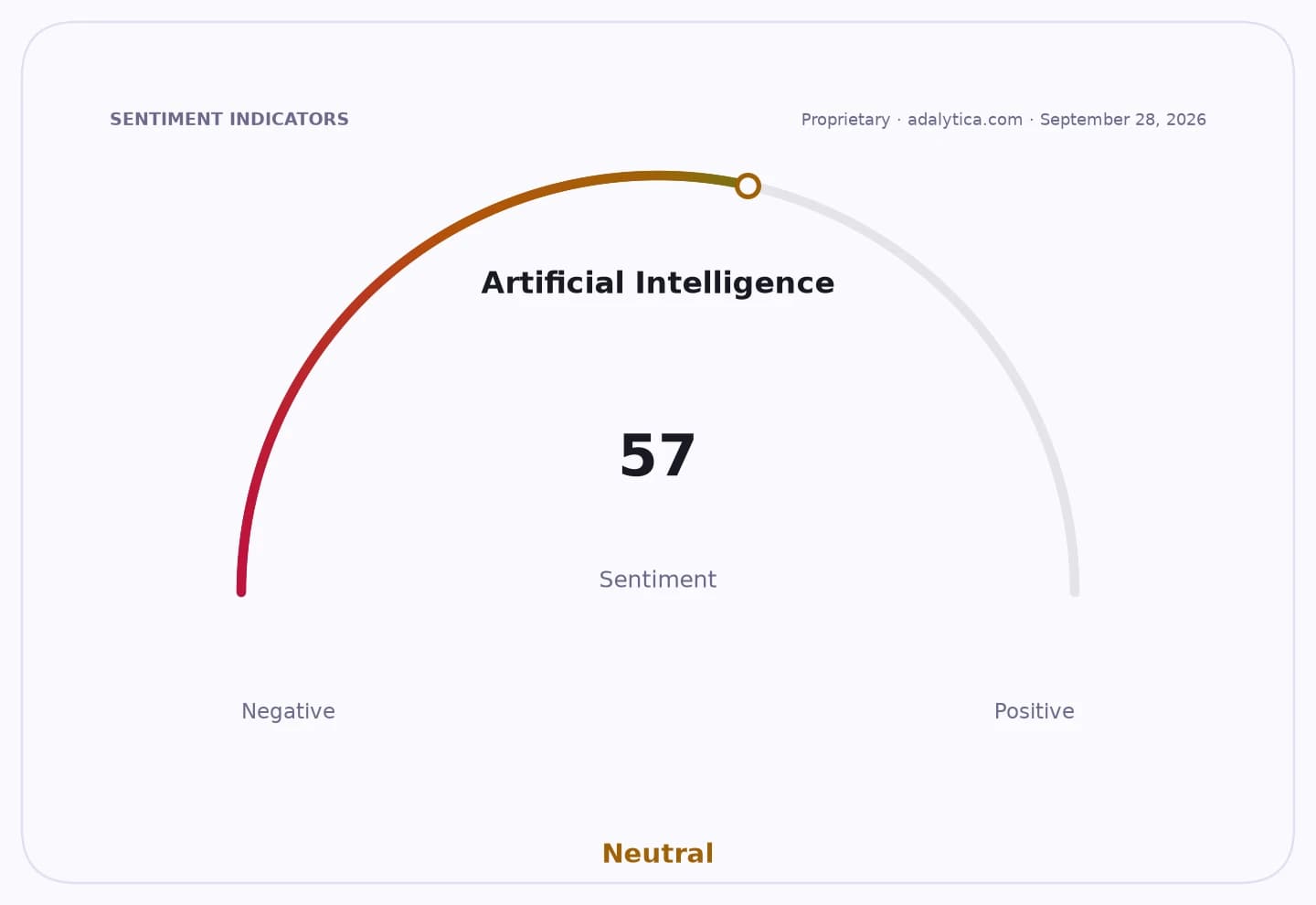
Sentiment IndicatorsⓘProprietary · adalytica.com · September 28, 2026
This is a snapshot — live sentiment, awareness and momentum for 130+ markets update continuously in the dashboard.Open AlphaPulse
Speaking in New York alongside the United Nations General Assembly, the first lady promoted her “Fostering the Future Together” initiative, which is designed to expand children’s access to technology, education and digital skills. Adobe, Amazon, Google, Intel, N50, Starlink and Zoom have joined the effort, which the State Department says now spans at least 57 countries.
The business angle is straightforward. Education has become one of the most attractive frontiers for AI vendors because schools are a natural gateway to long-term software subscriptions, cloud usage and device ecosystems. Google is committing $4 million to expand AI educator training, Amazon is widening free access to its Kiro software-engineering agent through 132 universities, Adobe is extending free AI study tools for students and Zoom is adding $2.75 million in grants tied to education and AI readiness. Those are not huge numbers for these companies individually, but they show how AI is becoming embedded across the products investors already own.
For the broader economy, the pitch is about productivity and digital skills. Supporters argue that students need AI literacy to compete in a labor market increasingly shaped by automation, data tools and software agents. That aligns with President Donald Trump’s push to accelerate AI development as a national-security and economic priority, rather than slow it down with broad restrictions.
But the push is running into a real credibility problem. Researchers and educators are warning that AI can create what one MIT professor called “the illusion of learning.” An MIT committee found early evidence that overreliance on chatbots may be associated with weaker critical thinking, poorer memory, lower confidence and less mastery. Other studies cited in the report found that people who used AI for problem-solving performed worse once the tool was removed, while students writing essays with large language models showed weaker brain connectivity than peers who worked without AI.
That is exactly the kind of trade-off investors should watch. If schools embrace AI cautiously, the market expands over time. If they conclude the tools are undermining learning, adoption could shift from rapid rollout to compliance-heavy, teacher-led use, favoring companies that can offer guardrails, monitoring and classroom management rather than just raw model access.
It also helps explain why the AI trade remains powerful but volatile. Microsoft, Alphabet and Nvidia have all benefited from the broader AI buildout, and their stock moves show how quickly sentiment can swing around the theme. Microsoft’s shares have climbed back above $500 after a sharp spring selloff, while Alphabet has stabilized near the mid-$340s and Nvidia has stayed near $225. The message for long-term investors is that the AI story is still intact, but the winners will be the firms that can turn enthusiasm into durable, regulated adoption.
For now, Melania Trump’s campaign and the research push in opposite directions: one argues AI should be given to children as a tool for empowerment, while the other warns that the tool may weaken the very skills schools are supposed to build. That tension is likely to define the next phase of AI in education, and it could decide which companies capture the sector’s growth and which face tighter scrutiny. For patient investors, it is worth watching closely rather than chasing the hype.
| Entity | Gains | Losses |
|---|---|---|
| Tech vendors | ▲Higher AI education adoption | ▼More scrutiny on products |
| Schools and teachers | ▲Training and digital tools | ▼Added oversight burden |
| Students | ▲Access to new skills | ▼Risk of weaker learning |
| Investors in AI leaders | ▲New long-term use case | ▼Policy and adoption risk |