AI is moving from a software story to a statecraft story, and that shift is what investors should care about most.
AI Infrastructure Gains From Digital Diplomacy

At a major African technology conference framed around AI and digital diplomacy, the message was clear: governments want access to compute, cloud infrastructure and the policy frameworks that make AI deployable at scale. That matters because the next phase of AI adoption will be driven less by consumer apps than by public-sector procurement, cross-border alliances and infrastructure buildouts across emerging markets. In that environment, the market underestimates how much long-duration demand flows back to the picks-and-shovels of the AI economy.
Sentiment IndicatorsⓘProprietary · adalytica.com · July 21, 2026
This is a snapshot — live sentiment, awareness and momentum for 130+ markets update continuously in the dashboard.Open AlphaPulse

Nvidia is the obvious beneficiary. The stock’s recent climb back above its 50-day moving average, with the shares closing at $206.98 on July 21 and the 50-day near $209.64, shows the market is still willing to pay for the compute franchise even after a volatile stretch. The technical picture is improving too: RSI readings in the mid-50s and a MACD crossover suggest momentum is stabilizing rather than breaking down. That is important because the real thesis is not a one-off conference headline. It is that AI adoption is broadening into regions where digital sovereignty, cloud capacity and inference infrastructure are becoming national priorities.
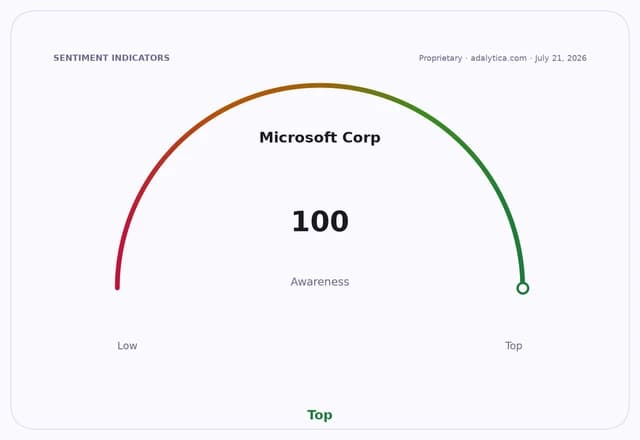
The economic logic is straightforward. Africa does not need to become the next Silicon Valley to matter for AI equities. It needs data centers, networks, energy, sovereign cloud partnerships and hardware supply. Every one of those layers expands the addressable market for Nvidia, Microsoft and the broader infrastructure stack. Microsoft, which has spent heavily to build and maintain AI and cloud capacity, remains a core enabler of this shift even as its shares have recovered to just under $400 from a deep June selloff. The company’s rebound, paired with stronger readings in conventional technical indicators, reflects a market that still sees AI infrastructure spending as durable, even if margins remain pressured.
The real mispricing is at the second order. Investors tend to view AI growth as concentrated in the U.S. hyperscaler cycle, but digital diplomacy is how the opportunity globalizes. If African governments and institutions move toward shared AI governance, multilingual models, public cloud frameworks and cross-border data rules, the result is a longer runway for enterprise software, cybersecurity, networking and semiconductor demand. That is the kind of secular capex cycle that can run for years, not quarters.
There is also a geopolitical layer. China’s push for a World AI Cooperation Organization, and the broader international competition over AI standards, reinforces the idea that AI infrastructure is becoming part of diplomatic influence. For investors, that raises the strategic value of companies that can sell into multiple jurisdictions, provide compliant infrastructure and help governments localize AI deployment. In other words, the winners are not just model builders. They are the toll roads of the AI age.
The market is still treating AI as a trade. I believe it is becoming a global infrastructure buildout. If that is right, dips in Nvidia and Microsoft remain buying opportunities, while smaller AI-linked names with weak balance sheets or unclear paths to scale are likely to be left behind. The next leg of returns should come from the companies that control compute, cloud and the plumbing of digital sovereignty.
| Entity | Gains | Losses |
|---|---|---|
| Nvidia | ▲More global compute demand | ▼AI hardware skeptics |
| Microsoft | ▲Cloud and sovereign-AI deals | ▼Margin-focused bears |
| African governments | ▲AI access and digital leverage | ▼Legacy analog systems |
| Smaller AI vendors | ▲Niche partnerships | ▼Scale and pricing power |




