Wall Street’s search for the next winners is moving beyond the biggest names in artificial intelligence, and that shift is creating room for a new group of stocks to outperform as investors look for cheaper ways to own the same secular boom.
AI Infrastructure Stocks Gain as Mega-Cap AI Valuations Stretch
That matters because the AI trade is no longer just about owning the mega-cap platforms at any price. With Nvidia, Microsoft and Apple all trading near elevated levels after violent swings, the market is starting to reward companies with direct exposure to AI infrastructure, enterprise software, cloud spending and the broader buildout around the technology, but without the same valuation strain. In other words, the money is rotating from obvious winners to the second-order beneficiaries that can still compound.
Sentiment IndicatorsⓘProprietary · adalytica.com · August 8, 2026
This is a snapshot — live sentiment, awareness and momentum for 130+ markets update continuously in the dashboard.Open AlphaPulse
Nvidia remains the clearest barometer of the trade. The stock closed at $223.96 on Friday, up from $170.07 in mid-September, and has reclaimed momentum with its 50-day moving average at $206.05 and its 200-day average at $193.80. But the move has not come in a straight line. Nvidia’s RSI readings have swung from oversold levels near 30 in November to 65.6 now, while the MACD has turned decisively positive, a sign the rally is intact even as the easy money in the name gets harder to find.
Microsoft and Apple show the same pattern: strong businesses, but increasingly demanding entry points. Microsoft finished at $499.99, well above its 50-day average of $407.01, while Apple ended at $313.33, just above its 50-day line of $309.79. Both are still market leaders, but their recent surges leave less room for multiple expansion than the broader AI ecosystem now offers.
Artificial Intelligence vs NVDAadalytica.com
Explore this data interactively — full history, time series and cross-market comparisons.Open AlphaPulse
That is why the more interesting opportunities may lie outside the headline trio. The market underestimates how much capital is still flowing into the AI buildout itself — chips, networking, power, storage, data centers and the software stack needed to monetize it. As long as hyperscalers keep spending, the beneficiaries are not limited to the companies designing the models. Suppliers, infrastructure providers and enterprise software vendors can all capture the same capex cycle with less concentration risk.
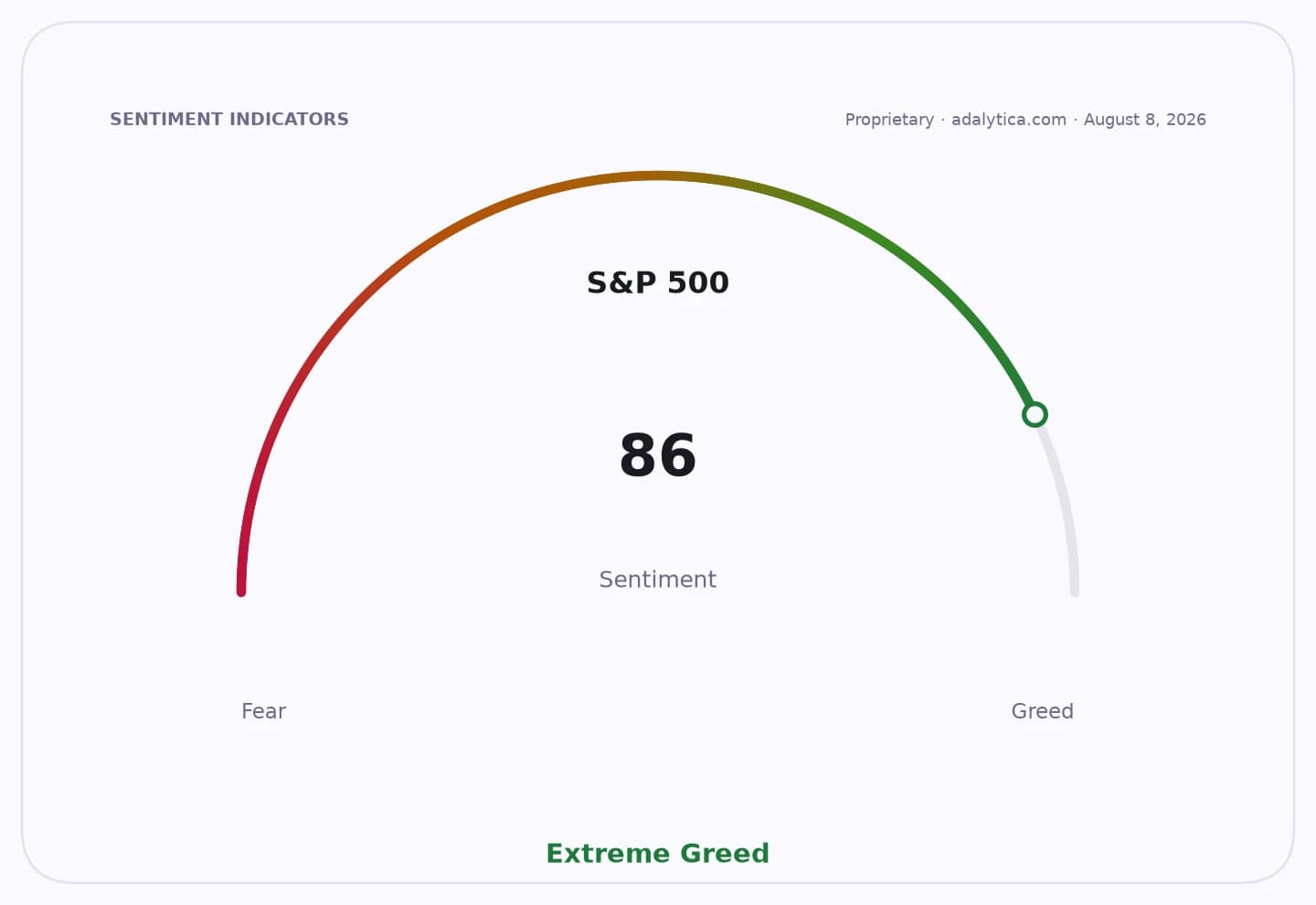
The broader tape supports that view. The S&P 500 is still flashing extreme greed in Adalytica’s sentiment gauge, while the US dollar also shows extreme greed, a combination that usually favors selective stock picking rather than blind index exposure. Meanwhile, smaller and mid-cap names continue to draw interest, and recent gains in growth stocks outside the largest names suggest investors are already broadening their hunt for alpha.
The real opportunity is to own the picks-and-shovels names before the consensus catches up. That means focusing on companies tied to compute demand, cloud migration, networking, data-center expansion and enterprise adoption of AI, not just the firms that dominate the headlines. In a market where the best-known AI stocks have already rerated, the asymmetric upside is increasingly in the supporting cast.
Our thesis is straightforward: the next leg of the AI trade will be less about proving AI matters and more about figuring out who gets paid every time another dollar of capital spending moves through the system. Investors who position early in the infrastructure layer and the adjacent software stack are more likely to capture the next multi-year compounding cycle than those chasing the most crowded names at the top of the market.
| Entity | Gains | Losses |
|---|---|---|
| AI infrastructure stocks | ▲More capex flow | ▼Less valuation discount |
| Mega-cap Big Tech | ▲Continued AI demand | ▼Lower relative upside |
| Hyperscalers | ▲Monetization leverage | ▼Rising spending burden |
| Late AI chasers | ▲Exposure to theme | ▼Poorer entry points |