AI is making newsrooms faster, but it is also making verification more expensive and more important, forcing publishers and technology firms to confront a basic question: who can the public still trust?
AI Newsrooms: Verification Costs Rise
That tension is now one of the defining economic risks of the AI boom. Generative systems can translate, search and sift data at a speed that has obvious value for media companies, but they can also manufacture convincing false quotes, fabricated images and confident but wrong answers. Once that material is published, or even recycled into new models, it can spread faster than human fact-checking teams can contain it.
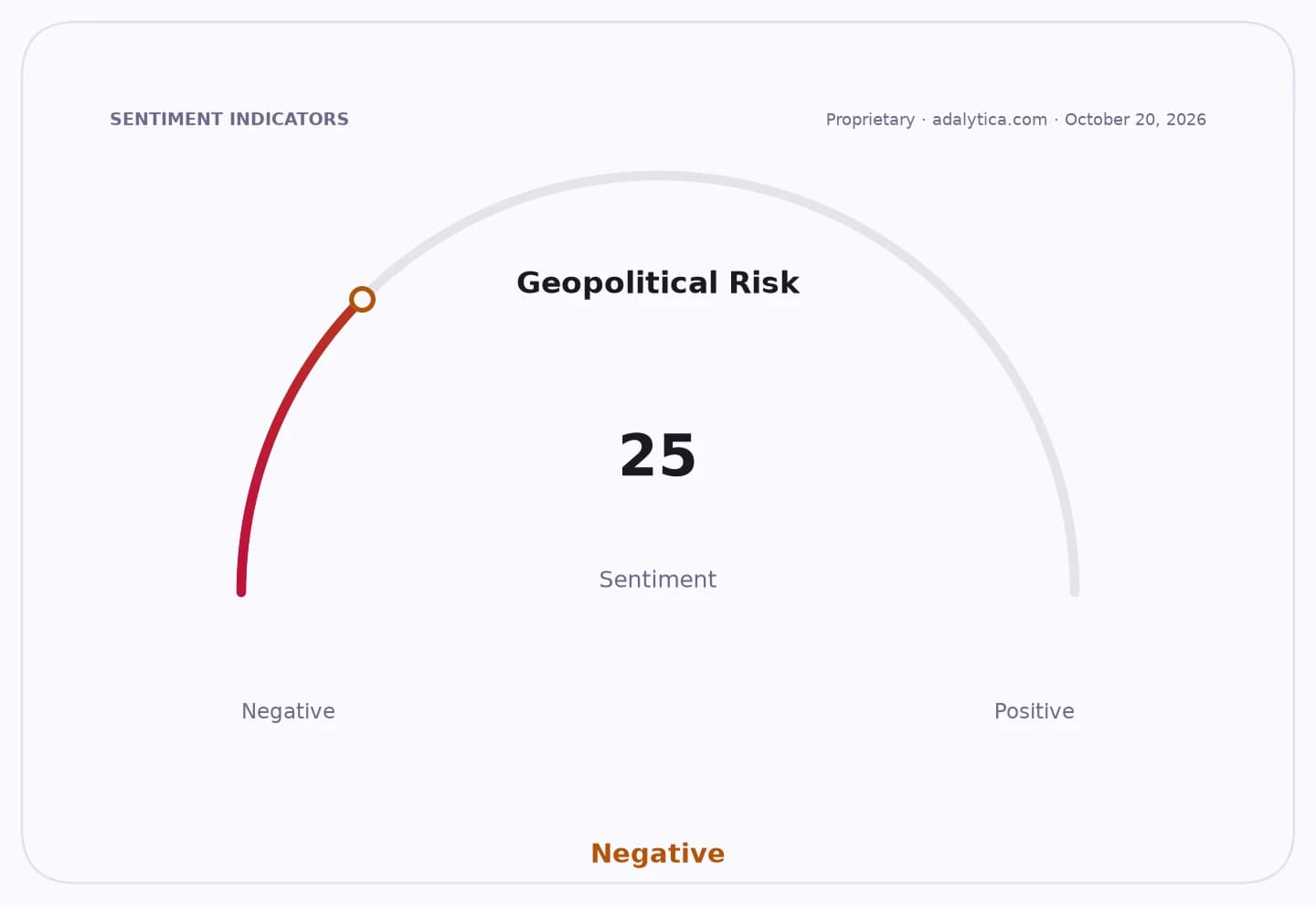
Sentiment IndicatorsⓘProprietary · adalytica.com · October 22, 2026
This is a snapshot — live sentiment, awareness and momentum for 130+ markets update continuously in the dashboard.Open AlphaPulse
The result is not just a journalism problem. It is a balance-sheet issue for platforms, software makers and advertisers that depend on credible information flows. If readers lose confidence in what they see online, engagement becomes less valuable, ad inventory becomes riskier and brands face greater exposure to false or misleading content. That raises the premium on moderation, provenance tools and human oversight at a time when AI budgets are already climbing.
The warning is increasingly shared across the industry. Nvidia chief executive Jensen Huang has said people cannot fully trust AI-generated answers, while media leaders including The Guardian’s Katharine Viner and The New York Times’ Arthur Gregg Sulzberger have stressed that AI cannot replace original reporting, on-the-ground investigation or accountable editorial judgment. Their concern goes beyond accuracy: it goes to liability, reputation and the legal exposure that follows when machine-generated errors are passed off as fact.
For investors, the key implication is that AI adoption will not be judged only by productivity gains. It will also be measured by the cost of verification, compliance and brand protection. Companies that can build reliable content pipelines, watermarking, source tracing and audit trails may gain share as trust becomes a product feature. Those that move too quickly, or rely too heavily on automated output, risk reputational damage and regulatory scrutiny.
The challenge is sharpened by the feedback loop in which AI-generated content is used to train other AI systems. That can amplify errors across the internet and make misinformation harder to root out over time. In that environment, the winners are likely to be publishers and platforms that can prove what is real, not just produce more of it.
| Entity | Gains | Losses |
|---|---|---|
| Trusted publishers | ▲Higher credibility premium | ▼Slower, costlier workflows |
| AI platform providers | ▲More enterprise demand for safety tools | ▼Reputational and legal risk |
| Advertisers/brands | ▲Safer media environments | ▼Exposure to misleading content |
| Readers/public | ▲Better verification standards | ▼More low-quality AI noise |