Borrowing costs are moving up just as the biggest US technology companies are financing an AI buildout that increasingly looks like a capital-intensive infrastructure race, forcing investors to reassess how much debt markets can absorb before returns on that spending are tested.
Alphabet, Amazon and Meta borrow for AI buildout

Alphabet, Amazon and Meta have together tapped bond investors for nearly $220 billion, a striking figure that underscores how the sector’s AI ambitions are no longer being funded solely from cash flow. The shift matters because these firms still generate enormous operating cash, but the scale of spending on data centers, chips and energy is now big enough to alter balance sheets, financing strategies and ultimately valuation multiples.
Sentiment IndicatorsⓘProprietary · adalytica.com · August 15, 2026
This is a snapshot — live sentiment, awareness and momentum for 130+ markets update continuously in the dashboard.Open AlphaPulse

The timing is what makes the story economically significant. The US 10-year Treasury was around 4.65%, near its highest levels in years, while the average high-yield credit spread sat at about 2.7 percentage points, a reminder that capital is pricier across the curve. The Treasury’s recent 30-year auction at 5.22% — the highest borrowing cost since 2001 — reinforces the same message: long-dated funding is expensive, and it is likely to stay that way if inflation and fiscal concerns keep pressure on yields.
For the tech giants, that creates a second-order risk. Their AI spending is being priced against a funding environment that is no longer near-zero and may not return there soon. Amazon’s filings say higher rates affect the fair value of its debt and that it is already putting substantial capital into technology infrastructure to support AWS. Google parent Alphabet disclosed $242.5 billion in cash, cash equivalents and short-term securities at the end of June, yet it too has used the bond market to help finance expansion. Meta has likewise been pouring money into AI infrastructure while carrying market and regulatory risks that could complicate future cash generation.
Investors have so far been willing to finance the buildout because the earnings power of the mega-cap cohort remains formidable. Amazon’s shares have recovered to the mid-$260s, above the 50-day moving average, while Alphabet has held above both its 50-day and 200-day moving averages, indicating the market still gives it the benefit of the doubt. Meta, by contrast, has been more volatile, with its share price still below its 200-day moving average, suggesting investors are more skeptical about how quickly AI spending will translate into durable returns.
That split matters. Bullish investors argue that cheap relative access to the bond market, even at higher nominal rates, is preferable to sacrificing growth, and that the winners in AI will capture network effects and cloud demand that justify the borrowing. The bear case is that these companies are funding a long-duration bet at precisely the moment when debt service costs are climbing, Treasury issuance is heavy and credit markets are becoming less forgiving.
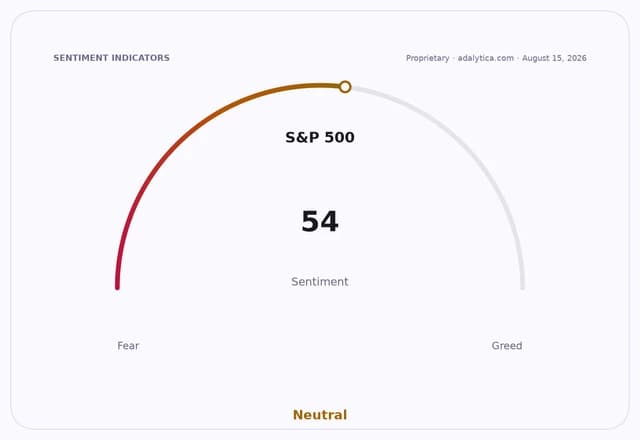
The broader market backdrop is similarly mixed. Adalytica’s S&P 500 trade signals show neutral sentiment but elevated awareness, while the dollar has weakened over the past month, a combination that suggests investors are alert to macro risk without fully abandoning risk assets. For credit markets, however, the message is clearer: when even the strongest issuers are borrowing in size, it raises the benchmark for everyone else, especially companies trying to refinance maturing debt or compete for AI-related capital.
The key question now is not whether Alphabet, Amazon and Meta can borrow — they clearly can — but whether the returns on AI spending will outrun a higher cost of capital. If they do, today’s borrowing spree may look like prudent front-loading of strategic investment. If they do not, the market could eventually reprice not just the debt but the equity story behind the AI capex boom.
| Entity | Gains | Losses |
|---|---|---|
| Alphabet, Amazon, Meta | ▲Lock in funding for AI capex | ▼Higher interest expense |
| Bond investors | ▲Earn higher yields | ▼Take duration and credit risk |
| Treasury / borrowers broadly | ▲None | ▼Higher benchmark borrowing costs |
| Equity holders in mega-cap tech | ▲Potential AI upside | ▼Margin pressure if returns lag |




