Amazon shares are being judged less on ecommerce and more on whether AWS can justify a surge that has already pushed the stock sharply higher and left it vulnerable to any sign of slowing cloud momentum.
Amazon Rests on AWS Growth and Sentiment
That matters because AWS remains the main engine of Amazon’s valuation rerating. The market has been willing to pay for evidence that cloud demand, AI infrastructure spending and operating leverage can keep expanding at a pace that supports both earnings growth and margin recovery. But after a powerful rebound in the stock, the next leg higher is likely to depend on whether AWS can continue to deliver growth that outpaces the broader market’s expectations, rather than merely meet them.
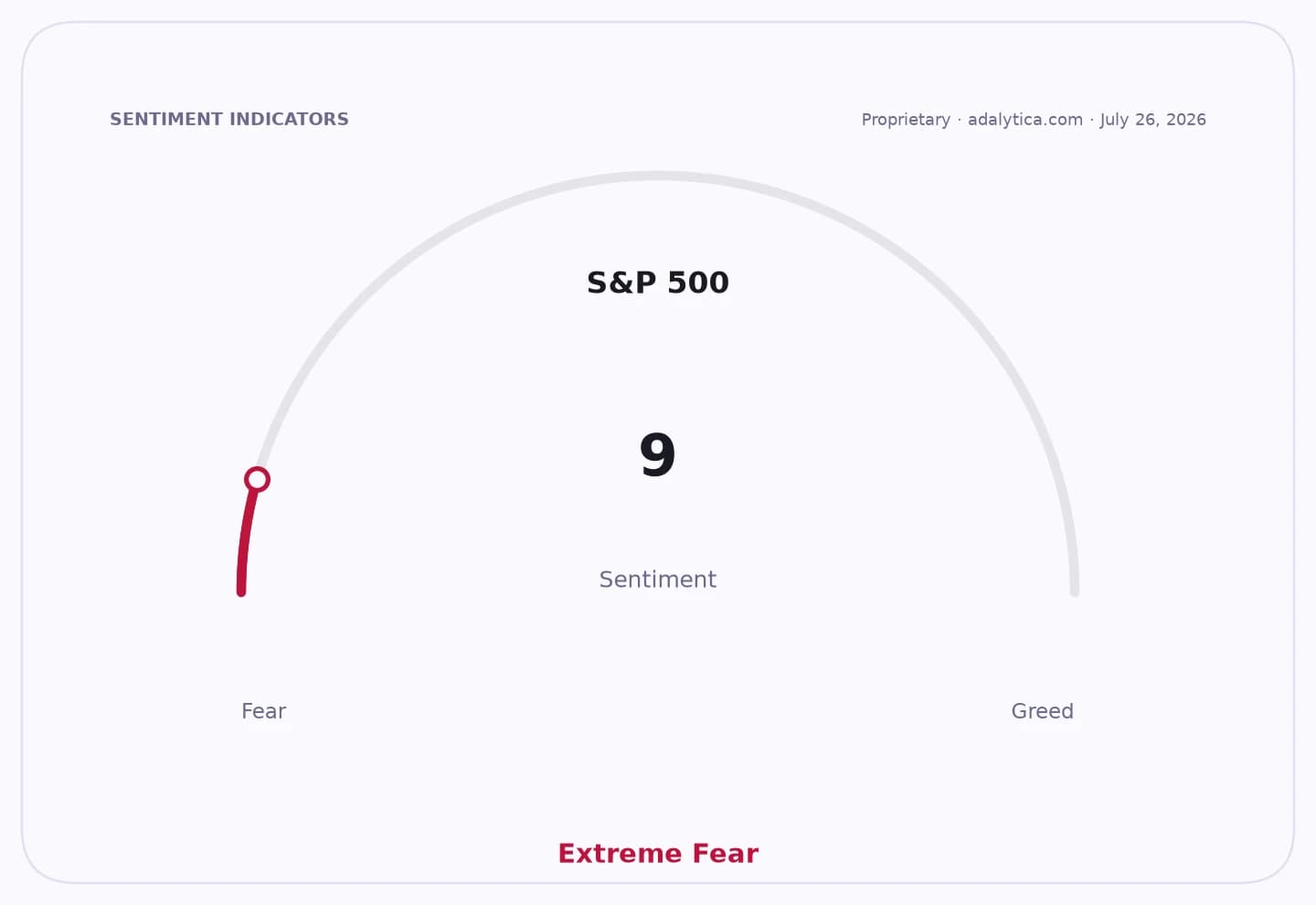
Sentiment IndicatorsⓘProprietary · adalytica.com · July 26, 2026
This is a snapshot — live sentiment, awareness and momentum for 130+ markets update continuously in the dashboard.Open AlphaPulse
The setup is especially delicate given the broader equity backdrop. Adalytica’s S&P 500 trade signals show extreme fear in the market, with the gauge at 9 and awareness at 0, underscoring how quickly sentiment has deteriorated across US equities. In that kind of tape, investors tend to punish crowded winners and reward only the clearest earnings beats. Amazon’s recent trading pattern reflects that sensitivity: the shares have swung from a sharp run-up to a pullback, with price action now sitting below the 50-day moving average and momentum indicators softening. That is less a verdict on Amazon’s fundamentals than a warning that the stock is no longer being priced for mediocrity.
AWS is central to the investment case because it remains Amazon’s highest-quality profit pool and the cleanest way for the company to monetize AI demand. The bullish argument is straightforward: cloud customers are still shifting workloads, AI inference and training demand is rising, and Amazon has the scale to defend share while monetizing new services across infrastructure, data and software. There is also support from the broader enterprise software cycle, with ServiceNow recently lifting guidance and Microsoft and Google both pointing to continued cloud demand in their latest filings. That suggests the cloud market is still expanding, even if investors are becoming more selective about who gets paid for it.
The bear case is more about valuation and pace. Amazon’s shares have already priced in a lot of optimism around AWS, Alexa and AI initiatives, and the stock’s recent volatility shows how quickly expectations can reset if growth or margins disappoint. Technical indicators show the shares have retreated from overbought levels and are no longer trading with the same momentum as earlier in the year. That does not change the long-term thesis, but it does mean the market may be demanding a cleaner beat, stronger guidance or evidence of accelerating AWS adoption before it grants another major rerating.
Capital spending is another key piece of the story. Amazon’s recent debt issuance points to continued investment in infrastructure, which is consistent with the AI buildout but also highlights the cash demands of competing in cloud. For investors, that creates a trade-off: more capacity can support future AWS revenue, but it also keeps free cash flow under pressure in the near term. If AWS growth accelerates, the market will likely view that spending as justified. If not, the financing burden could weigh on sentiment.
For now, the most important question is whether AWS can keep outperforming enough to offset a more cautious market. A strong quarter would reinforce Amazon’s status as one of the best ways to play enterprise cloud and AI spending. A merely solid one may not be enough to sustain the stock’s premium, especially with broader risk appetite brittle and investors quick to rotate out of momentum names.
| Entity | Gains | Losses |
|---|---|---|
| AWS bulls | ▲AI/cloud upside | ▼Need flawless execution |
| Amazon shareholders | ▲Higher earnings leverage | ▼Multiple compression risk |
| Enterprise cloud rivals | ▲Sector demand growth | ▼Share gains harder to defend |
| Short-term traders | ▲Volatility opportunities | ▼Get squeezed on strong print |




