Anthropic’s own workplace data is offering one of the clearest signs yet that AI is no longer just speeding up tasks — it is changing who gets hired, how companies are organized and where the labor market is headed.
Anthropic report shows fewer junior hires
That matters because the shift is economic, not merely technological. If agent hours are already running six to one versus employee hours inside one of the most AI-native firms in the market, the next question is not whether productivity rises, but how much human labor gets displaced, what kinds of jobs survive and where the spending migrates. The early evidence points to a labor market that rewards AI orchestration, judgment and systems design while compressing demand for routine junior work.
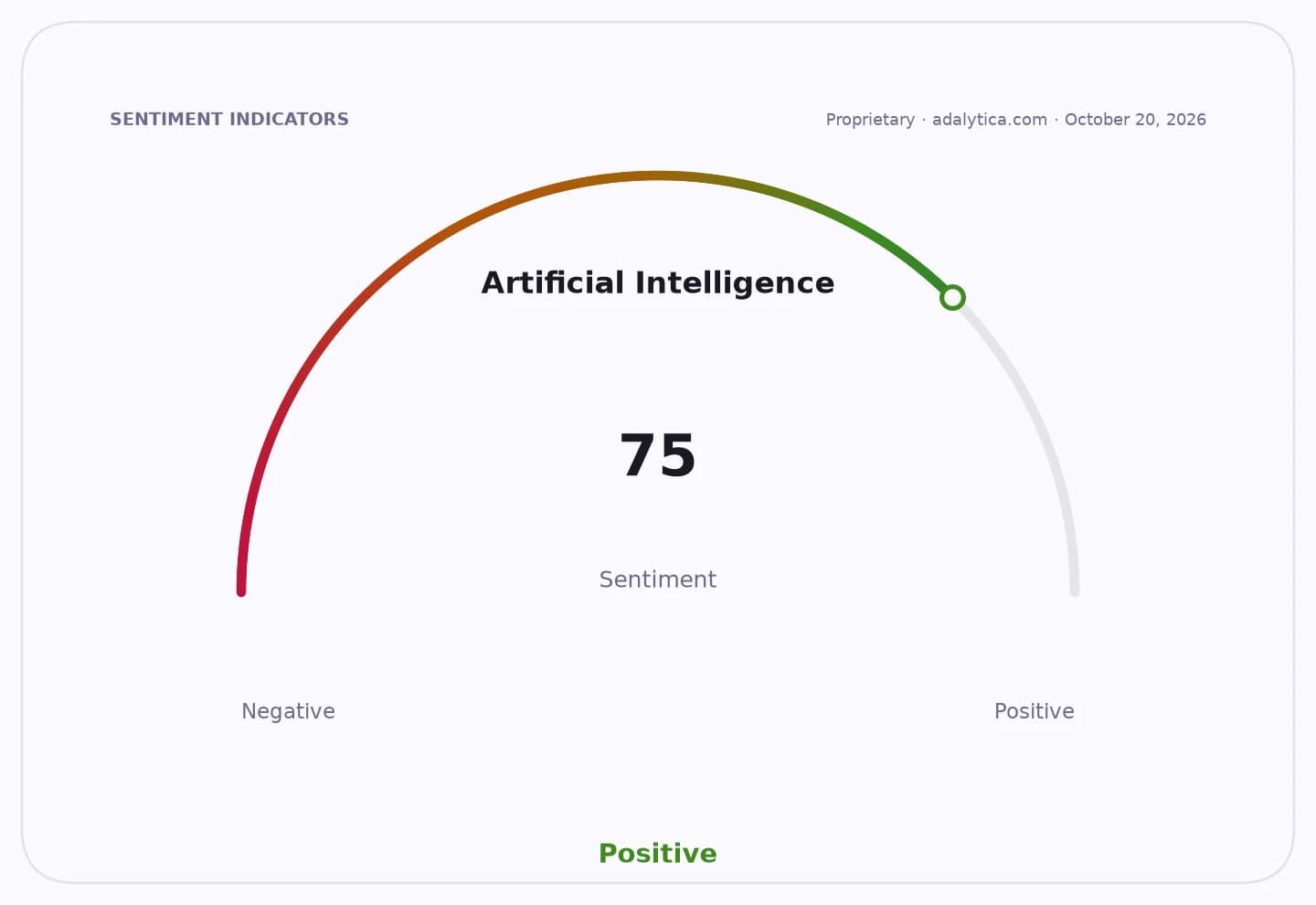
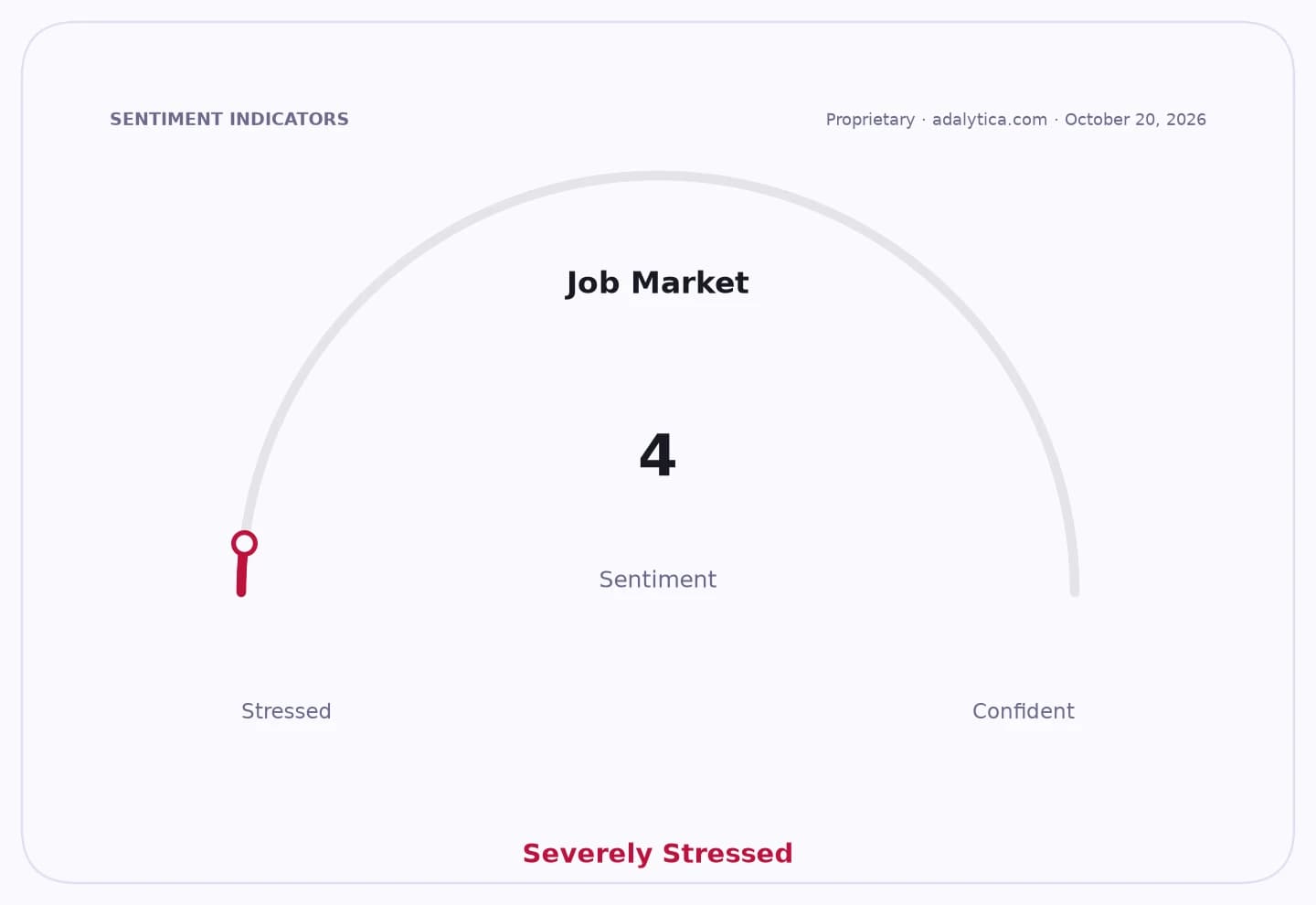
Sentiment IndicatorsⓘProprietary · adalytica.com · October 20, 2026
This is a snapshot — live sentiment, awareness and momentum for 130+ markets update continuously in the dashboard.Open AlphaPulse
Anthropic said in a technical report published Oct. 16 that junior technical employees fell to 14% of technical headcount from 21% at the start of 2025, while junior technical hires dropped to 9% from 27%. Postings for junior roles also fell sharply after December 2025, underscoring that the slowdown is not a one-off hiring pause but a structural reweighting of demand. In other words, the market may be underestimating how quickly AI can flatten the entry-level pipeline.
The company’s report, “How employment is changing at Anthropic,” is based on internal employment, AI-use, output, survey, communication, calendar and hiring records, plus 17 employee interviews. That makes it company-specific, not a universal labor-market template. But it is still highly investable information because Anthropic sits at the center of the AI buildout, and its operating model is likely to preview what happens as AI-heavy firms spread through software, services, finance and back-office operations.
The most important detail is not just that AI is being used more. It is that work is being reorganized around AI. Anthropic said coding-focused agent sessions by non-technical staff climbed from two per month in August 2025 to 90 in May 2026, while internal “meta-work” — building dashboards, monitoring pipelines and writing instructions for agents — rose to 22% of interactive Claude sessions from 10% a few months earlier. That is classic platform adoption behavior: once AI becomes embedded, headcount does not simply shrink, it shifts toward supervision, integration and control.
Productivity gains are already visible. Anthropic said code commits per engineer increased to about five times their level from six months earlier, while lawyers, accounts payable teams and sales staff all handled more output. It also said an internal comparison found no difference in removal or revert rates between code written by employees and code written by their agents, using its quality proxies. For investors, that is the key implication: AI is no longer just a cost story. It is becoming a throughput story, which means the winners are likely to be the providers of compute, networking, software orchestration and enterprise tooling that help firms absorb the flood of machine-generated work.
That is where the second-order trade comes into focus. If agent output is rising faster than employee capacity, companies need more infrastructure, not less. They need more GPUs, more data-center capacity, more cloud, more networking gear and more workflow software. That keeps the investment case intact for AI infrastructure leaders such as Nvidia, Microsoft and Arista Networks, even if the labor-market narrative becomes more unsettling. Microsoft remains a central beneficiary through Azure and Copilot adoption, while Nvidia still sits at the base of the compute stack that makes agentic work economically possible.
At the same time, the report hints at a bottleneck that could become one of the biggest constraints on the AI economy: human attention. Anthropic said 80% of interactive session time was idle while agents waited for human input, and by August interactive agent hours alone were six times employee hours. That suggests the constraint is moving from generation to review, approval and interpretation. The real bottleneck in the AI age may not be model quality alone, but the number of skilled humans available to direct machine labor.
That should change how investors think about the next phase of AI spending. The easy money has already gone into model training and chip demand. The next wave flows into deployment, governance, observability and enterprise workflow redesign. Companies that help businesses manage agent sprawl — from cloud software to cybersecurity to automation platforms — may see durable demand even if hiring freezes spread across some technical roles.
| Entity | Gains | Losses |
|---|---|---|
| AI infrastructure firms | ▲More compute demand | ▼Slower capex if adoption stalls |
| Enterprise software vendors | ▲Higher demand for workflow tools | ▼Pricing pressure from commoditized AI features |
| Junior technical workers | ▲Faster AI-assisted learning | ▼Fewer entry-level roles |
| Employers using agents | ▲Higher output per worker | ▼More review and oversight burden |