AI is not just a productivity story anymore — it is becoming a labor-market sorting machine that is likely to hit young workers and first-time job seekers hardest.
IMF warns AI hits young workers first
That warning from IMF Managing Director Kristalina Georgieva matters because it reframes the AI boom from a simple growth catalyst into a structural shift in who captures the gains. The IMF says AI could affect about 40% of jobs globally and as many as 60% in developed economies, but the biggest near-term pain may fall on entry-level workers whose starter jobs are most exposed to automation.
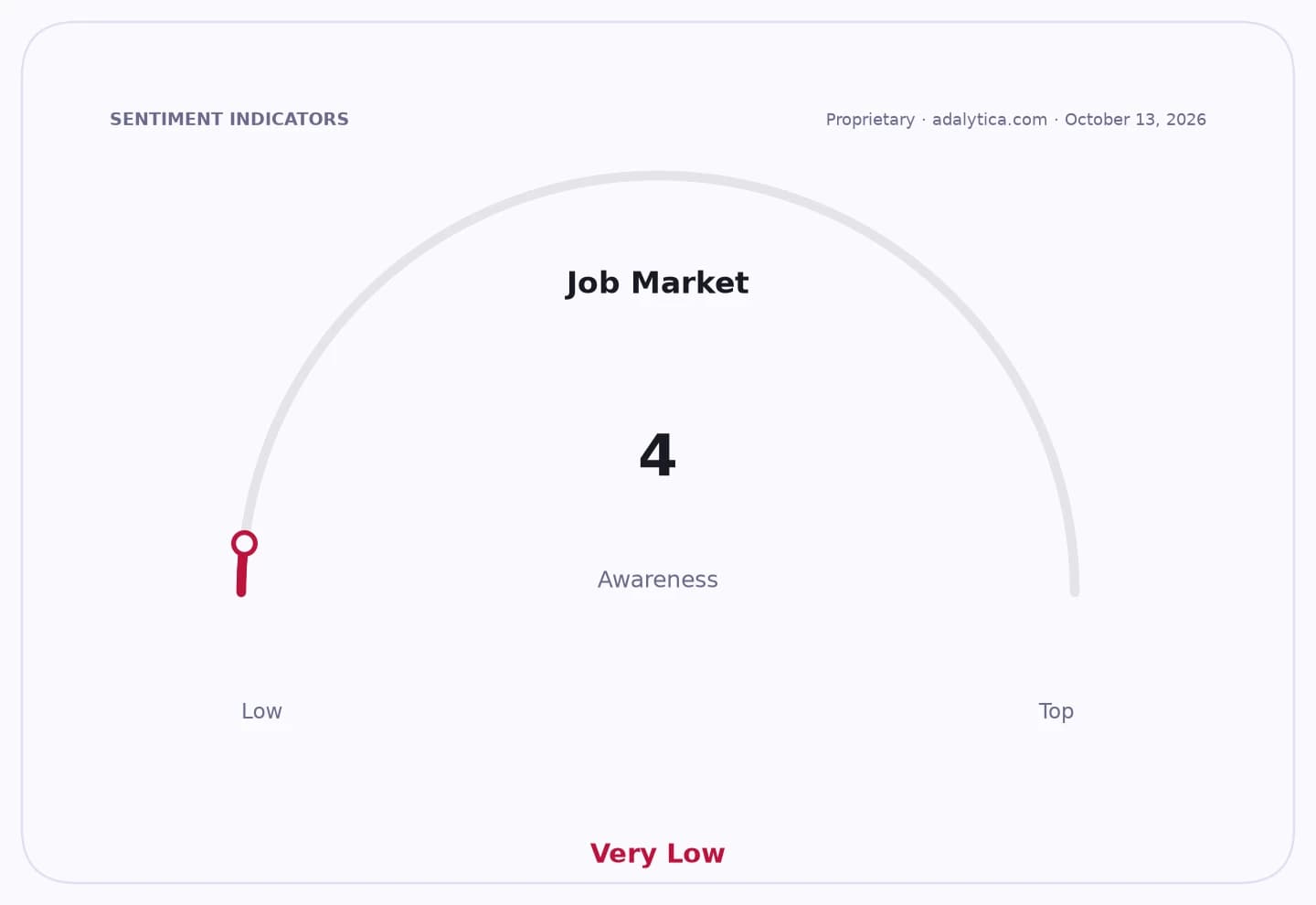
Sentiment IndicatorsⓘProprietary · adalytica.com · October 13, 2026
This is a snapshot — live sentiment, awareness and momentum for 130+ markets update continuously in the dashboard.Open AlphaPulse
For investors, that is a second-order signal with real economic consequences. If AI takes over routine, repetitive tasks, companies can grow faster with fewer junior hires, lifting margins while narrowing the pipeline of future talent. That is bullish for AI infrastructure, software and automation vendors, but it is a warning for employers that rely on cheap labor and for economies that depend on steady job creation to keep consumption rising.
Georgieva’s point is especially important because the labor market has long relied on entry-level roles as the on-ramp to higher-paying careers. Those positions teach workers how to operate inside a business, learn judgment and build experience. If AI strips out those stepping-stone jobs, the damage is not just cyclical unemployment — it is a disruption to career formation itself.
That helps explain why the market keeps rewarding the picks-and-shovels of AI. The Nasdaq 100 tracker QQQ remains far stronger than the old economy, while the Global X Robotics & Artificial Intelligence ETF, BOTZ, has held investors’ attention even after a volatile year. The trade is not simply about robots replacing people; it is about capital shifting toward compute, cloud, data centers, industrial automation and the software layer that lets companies do more with less headcount.
The macro backdrop reinforces that divide. U.S. payrolls remain near record highs, but job openings have cooled from the post-pandemic surge, suggesting employers are already more selective. In that environment, AI is likely to widen the gap between workers with digital and AI skills and those seeking the kind of repetitive tasks that once made up the first rung of the ladder.
That is why the most vulnerable group is not “labor” in general but young workers entering the market for the first time. Experienced employees with judgment and domain knowledge are harder to replace; graduates competing for routine analyst, support, clerical and administrative roles are not. If companies can automate those functions, hiring will skew toward fewer, more specialized roles — and that raises the bar for every new entrant.
The investment implication is clear: the market may be underestimating how much of AI’s economic gain comes from labor compression rather than pure revenue expansion. That favors chipmakers, cloud providers, data-center operators, industrial automation names and HR software firms that help enterprises manage leaner workforces. It also argues for caution on businesses with large pools of replaceable labor and limited pricing power.
There is also a policy overhang. Georgieva said governments may need to rethink taxation and education as AI changes the balance between capital and labor income. That is not just an academic debate. If more income accrues to capital and less to payrolls, the winners will be asset owners and the companies selling the tools of automation. The losers will be younger workers trying to get their first foothold and the institutions that depend on broad-based wage growth.
Our thesis is that AI is creating a labor-market bifurcation, not a simple job apocalypse. The hardest people to hire will be the hardest people to train: young workers without experience, especially in roles built around repetitive tasks. The best opportunity now is to position for the infrastructure and automation layers that benefit from that shift before the rest of the market fully prices in the coming squeeze on entry-level labor.
| Entity | Gains | Losses |
|---|---|---|
| AI infrastructure firms | ▲Higher capex demand | ▼Labor-intensive employers |
| Experienced workers | ▲Skill premium | ▼Entry-level applicants |
| Employers using automation | ▲Lower costs, margins up | ▼Junior hiring pipeline |
| Governments and schools | ▲Reform urgency | ▼Old tax/training model |