The fight over how students learn with AI is turning into a broader question about trust, enforcement and the infrastructure behind the software boom.
Anthropic watermarking and AI trust in education

Anthropic’s move to watermark AI-generated text lands at a moment when schools, universities and employers are struggling to distinguish legitimate use of large language models from plagiarism and automation. That matters economically because education is no longer just a policy debate: it is becoming an early stress test for whether AI can be absorbed into daily work without eroding standards, pricing power or institutional credibility.
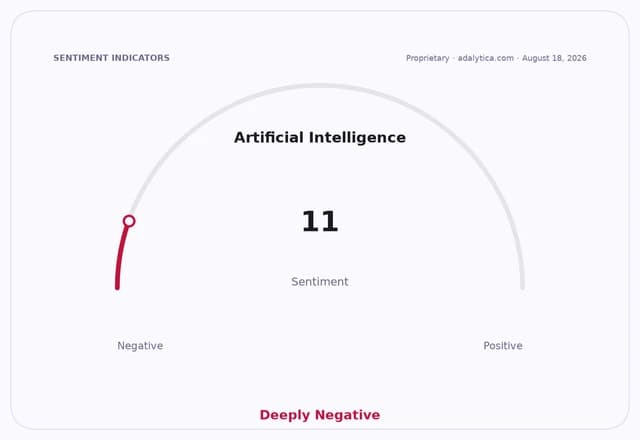
Sentiment IndicatorsⓘProprietary · adalytica.com · August 18, 2026
This is a snapshot — live sentiment, awareness and momentum for 130+ markets update continuously in the dashboard.Open AlphaPulse
The new watermarking technology is designed to expose AI-assisted school essays, addressing a problem that has intensified as students use chatbots for real-time feedback and drafting. Educators have already raised concerns that AI tools can produce uneven evaluations and encourage shortcuts rather than learning. If watermarking is effective, it could help restore confidence in assessment. If it is easy to evade, the result could be an arms race between detection and concealment that raises compliance costs for schools and publishers while doing little to slow misuse.
That has broader implications for the AI business model. The sector has been marketed as a productivity breakthrough, but the education example shows the adoption curve is complicated by verification costs and reputational risk. For AI developers such as Anthropic, stronger guardrails may be a way to preserve legitimacy with institutions that need audit trails. For schools and content platforms, they may offer a partial defense against flood-like volumes of synthetic work, translations and low-quality material that could dilute the value of human output.
The market backdrop underscores how central AI infrastructure remains even as the narrative shifts from enthusiasm to scrutiny. Nvidia shares have climbed to $219.74, up sharply from $170.07 on Sept. 17 and still well above the 50-day moving average of $206.94, even after a pullback from recent highs. But the stock’s RSI of 77.4 points to stretched near-term conditions, while Microsoft’s shares have rebounded to $481.63, far above their 200-day average of $430.74. That suggests investors continue to price in strong AI spending even as the practical limitations of deployment become more visible.
The tension is important for the semiconductor and cloud leaders that sit at the center of the AI trade. A world in which schools, publishers and corporations demand watermarking, provenance and compliance tools could support demand for enterprise AI services and security layers. But it also implies a more regulated market, where adoption may be slower, software margins may be pressured by oversight costs and some AI use cases face resistance from customers unwilling to accept higher fraud or integrity risk.
Adalytica’s AI sentiment gauge reflects that fragility: the snapshot sits at 11, labeled Extreme Fear, after a 89-point drop over the past 30 days. That is not a fundamental valuation metric, but it captures the abrupt cooling in confidence around AI-linked narratives even as capital expenditure and infrastructure buildout remain elevated. Microsoft’s own filing warned that demand for cloud-based AI products is difficult to forecast and that overbuilding capacity could lead to underutilized infrastructure, a reminder that enthusiasm can outrun monetization.
For investors, the key question is not whether AI continues to spread, but how much friction comes with it. The bullish case is that watermarking and similar tools make AI more acceptable in regulated settings, widening the addressable market. The bearish case is that every layer of detection and control adds cost, slows adoption and exposes the gap between AI promise and operational reality.
What happens next will depend on whether watermarking becomes a standard feature in education and enterprise workflows, or merely another imperfect patch in an escalating cat-and-mouse game. If it gains traction, it could bolster the case for AI platforms that can prove provenance and compliance. If it fails, the pressure shifts back to schools, regulators and employers to police misuse with limited tools, while investors remain left to price a technology whose commercial scale is still racing ahead of its social rules.
| Entity | Gains | Losses |
|---|---|---|
| Anthropic | ▲trust in AI tools | ▼misuse of generated text |
| Schools and universities | ▲integrity checks | ▼cheating and grading disputes |
| AI developers with provenance tools | ▲enterprise adoption | ▼reputational risk |
| Nvidia and AI infrastructure suppliers | ▲continued spending | ▼slower adoption if controls bite |