Argentina’s savings market is tilting toward the inflation-linked UVA deposit as depositors weigh a roughly 5% 90-day return on traditional fixed terms against protection from price increases over the same period.
Argentina UVA Deposits Gain as Inflation Eases
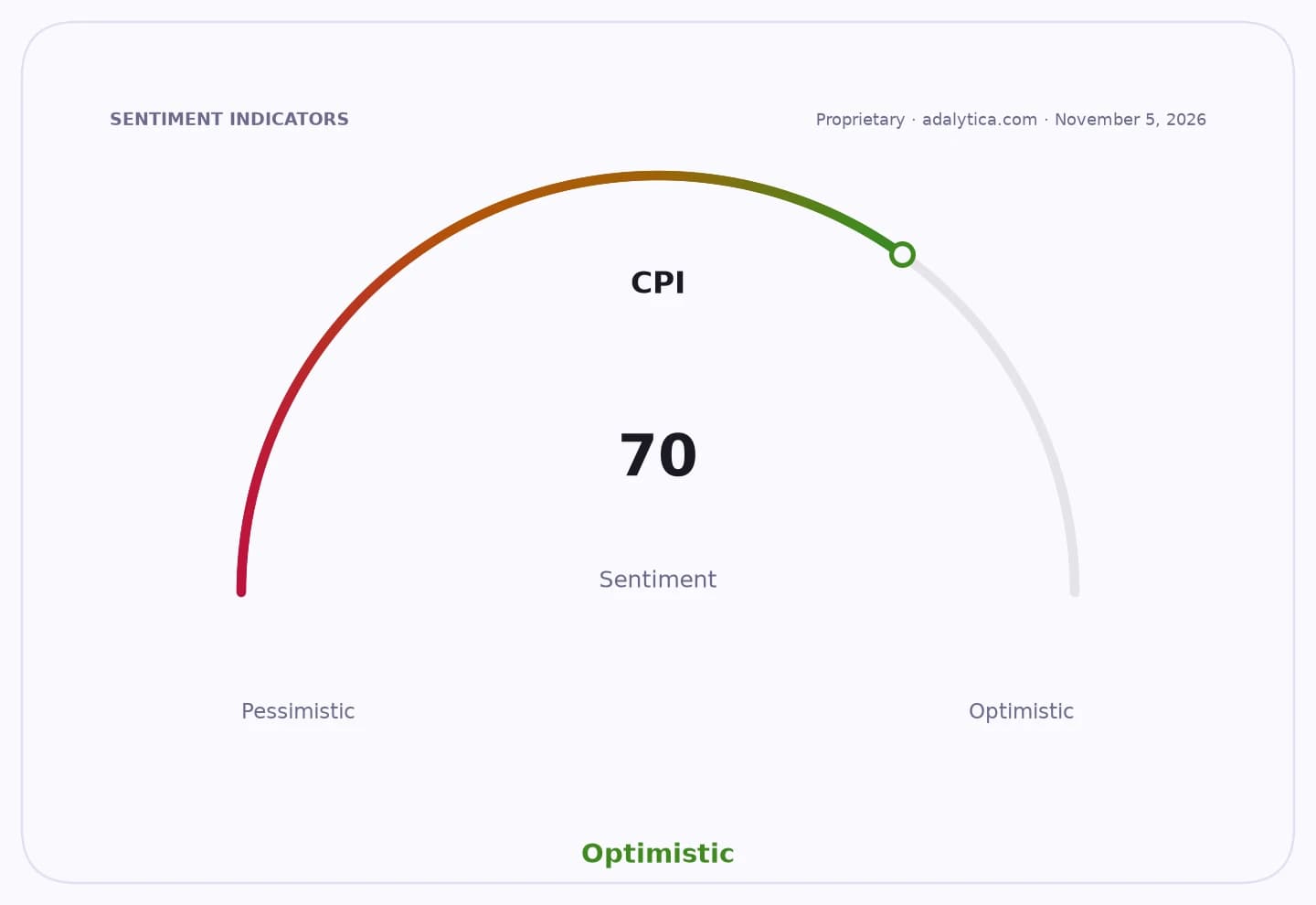
CPI
The choice matters because it is no longer just about locking in a rate — it is about whether savers think inflation will keep falling or re-accelerate. With consumer prices up 1.7% in the latest monthly reading and 21.3% year-to-date through August, the gap between a fixed nominal yield and an inflation-adjusted instrument is narrow enough that timing now drives the decision.
Sentiment Indicators
A traditional plazo fijo fixes the interest rate on day one, giving savers certainty for 30 days and, when rolled into a 90-day horizon, a projected gain of about 5% if the average annual nominal rate near 20.67% holds. That makes it attractive for depositors who want liquidity and a known payout, especially if banks cut rates further as inflation slows.
The UVA deposit works differently. Principal is adjusted by the consumer price index through the CER benchmark, and the minimum term is 90 days, meaning it pays if inflation outruns the bank’s fixed rate. A precancelable version exists, but early exit usually means accepting a lower rate.
Demand for inflation-linked deposits is already rising. According to the Banco Central, the stock of UVA deposits climbed from 568.5 billion pesos in March to 1.03 trillion in April and 1.49 trillion in May, showing savers are still looking for protection even as inflation moderates.
That makes the current backdrop crucial. If price growth keeps easing, the traditional fixed term can win by locking in a known return before banks trim rates again. If inflation surprises higher, UVA becomes the safer bet because it preserves purchasing power rather than just promising a nominal yield.
For investors and savers, the market signal is straightforward: the best option today depends less on the product itself than on the inflation path over the next quarter. In a disinflationary trend, fixed-rate deposits gain appeal; in a renewed inflation shock, UVA is the stronger hedge.
| Entity | Gains | Losses |
|---|---|---|
| Traditional fixed-term depositors | ▲Known 90-day payout | ▼Inflation protection |
| UVA depositors | ▲Purchasing-power protection | ▼Short-term certainty |
| Banks | ▲Lower funding costs if rates fall | ▼Pressure to raise deposit rates |
| Savers fearing higher inflation | ▲Real-value preservation | ▼Nominal-rate certainty |