Asia’s coal market looks set to stay tight in the near term, and that matters because higher coal prices are feeding directly into power costs, industrial margins and the investment case for producers with exposure to seaborne markets.
Asia coal prices stay elevated on supply tightness
Fitch Ratings said thermal coal prices in the region should remain elevated as gas-to-coal switching keeps demand firm in Japan and South Korea while supply from China and Indonesia falls. That combination is important: when buyers turn to coal because gas is expensive or scarce, the market can stay stronger for longer even if the broader economy is cooling.
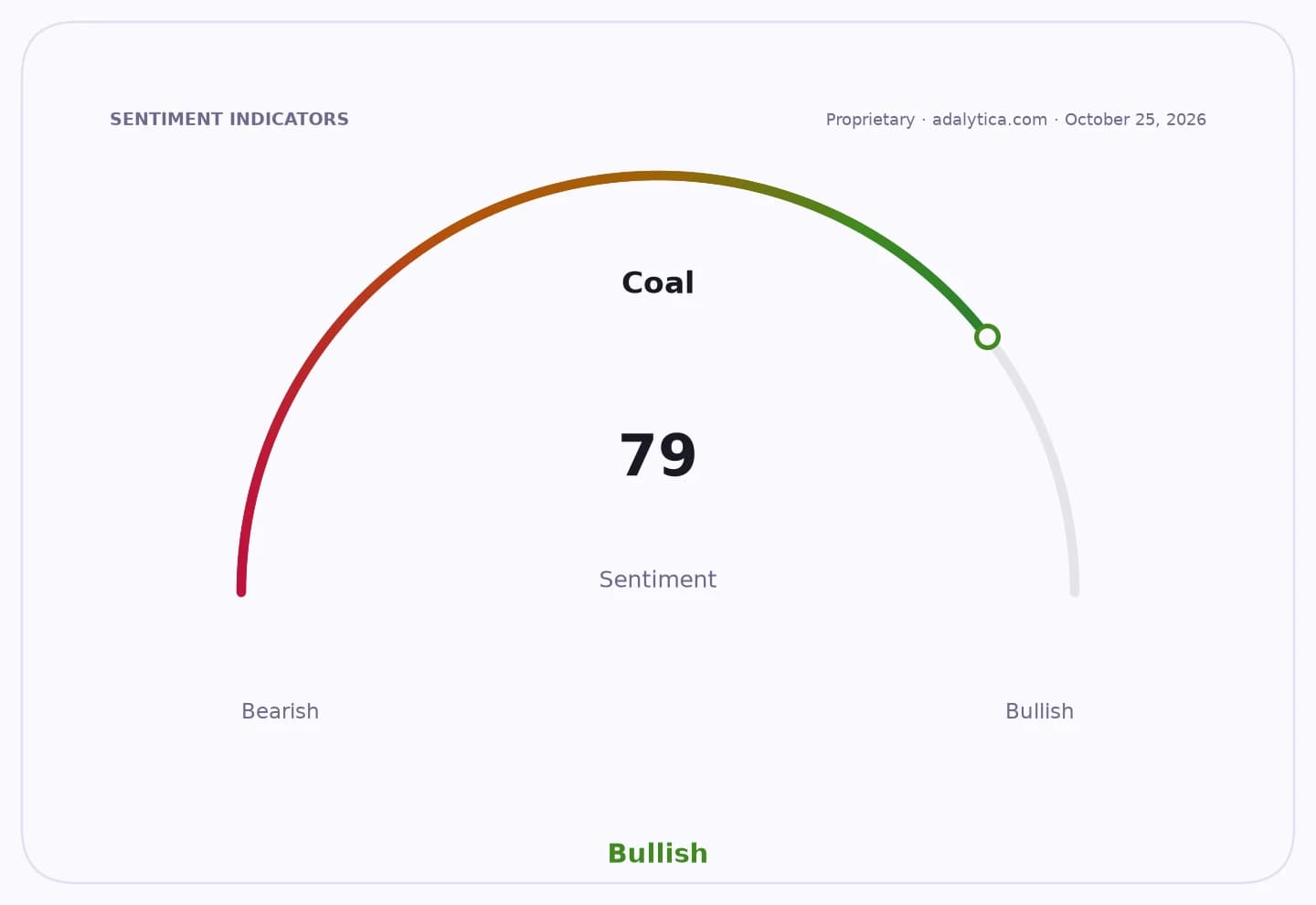
Sentiment IndicatorsⓘProprietary · adalytica.com · October 25, 2026
This is a snapshot — live sentiment, awareness and momentum for 130+ markets update continuously in the dashboard.Open AlphaPulse
The supply side is doing most of the work. Indonesia, one of the world’s key exporters, has been constrained by government production quotas and by El Niño-related disruption to river barge traffic that moves coal to export terminals. China, meanwhile, has been producing less coal year to date after a deadly mining disaster prompted tougher safety checks and temporary mine suspensions in Shanxi, a major coal region.
The result has been a sharp reset in prices. Coal in China has climbed to a three-year high, and Newcastle futures, the global benchmark, are about 30% above pre-war levels, Fitch said. For investors, that is a reminder that coal remains a cyclical commodity, but one where supply shocks and geopolitics can overwhelm normal demand patterns for long stretches.
The timing also matters for the region’s power systems. Japan and South Korea are leaning harder on thermal coal because the Middle East conflict has supported gas prices and complicated the fuel mix. In India, where power shortages and coal inventories have already been a concern, firmer seaborne prices can make imported fuel even less attractive and keep pressure on utilities and regulators to secure supply.
For coal producers, elevated prices are a tailwind, especially for exporters with access to higher-calorific-value coal that buyers prefer in a tight market. For consumers, the story is the opposite: more expensive coal means higher generation costs, tighter margins and potentially more inflation pressure if the strength persists.
There is a reason investors should care beyond the next quarter. Energy security has become a bigger part of the coal narrative again, and that tends to support the sector whenever gas markets are disrupted or supply chains are brittle. The challenge is that policy risk remains high, especially in Indonesia, where export rules and quotas can change quickly.
For long-term investors, the lesson is not to chase coal as a forever trade, but to recognize that tight supply can sustain pricing power longer than many expect. Producers with disciplined capital spending and strong free cash flow can benefit while the market stays firm, but the volatility is real. This is a sector where patience, diversification and a clear view of policy risk matter. Worth watching for now.
| Entity | Gains | Losses |
|---|---|---|
| Coal miners/exporters | ▲Higher selling prices | ▼Policy and quota uncertainty |
| Power utilities/importers | ▲Short-term fuel access | ▼Higher generation costs |
| Japan and South Korea | ▲Supply from existing contracts | ▼Pricier gas-to-coal switching |
| India | ▲Incentive to boost domestic supply | ▼More pressure on electricity costs |