Atherton has reclaimed the crown as America’s priciest ZIP code, and the more important story is that elite U.S. housing is still being pulled upward by a tiny set of ultra-wealthy enclaves even as the broader market cools.
Atherton regains U.S. priciest ZIP code

The Silicon Valley town’s 94027 ZIP code posted a median sale price of $10.73 million, up 29% from a year earlier and the first in the country to clear the $10 million mark, according to PropertyShark’s annual ranking. That puts Atherton nearly $3.4 million above second-ranked Sagaponack, New York, and cements its position at the top for nine of the past 11 years.
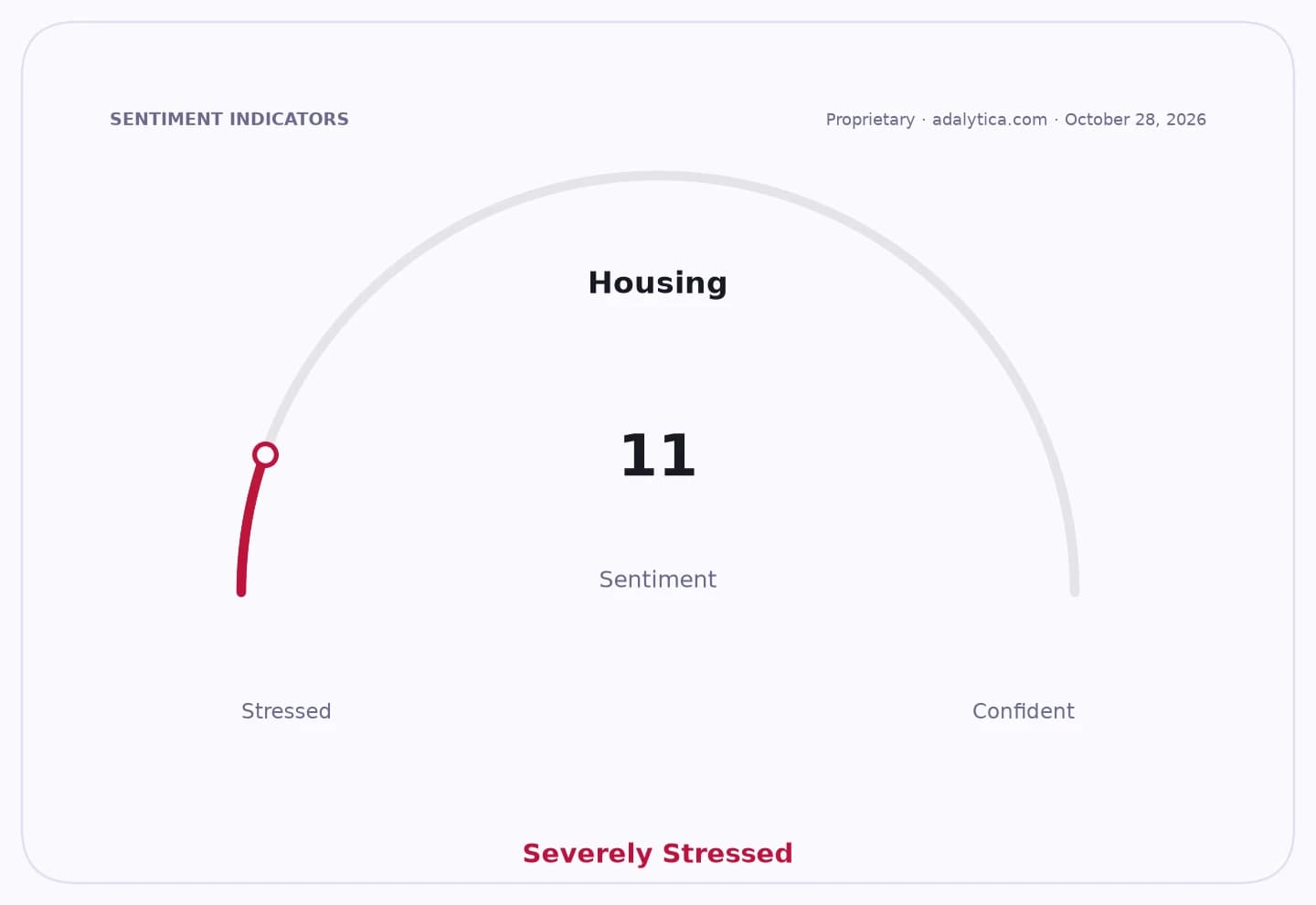
Sentiment Indicators
For investors, the message is not just about trophy homes. It is about where wealth, stock-option gains, venture capital, and high-end liquidity continue to concentrate. Atherton’s return to the top underscores how resilient the ultra-prime market remains in the Bay Area, even as the region’s footprint in the national luxury ranking has shrunk. The Bay Area still placed 31 ZIP codes in the top 100, matching New York for the first time, but that is far below its 55-ZIP-code peak in 2019.
California still dominated the national list with 57% of entries, though that was its smallest share in more than a decade. The loss of share reflects not a collapse in values, but a more selective market in which only the deepest-pocketed buyers are still bidding aggressively. In San Mateo County, seven ZIP codes made the top 100, down from 11 at the peak, while Santa Clara County had 13, down from 17 before the pandemic. Yet most of those remaining luxury pockets still set record medians this year.
That is the real investment takeaway: the luxury housing market is becoming more polarized, not weaker. Atherton, Los Altos, and Palo Alto remain the clearest beneficiaries of the post-pandemic wealth reset, powered by AI-era compensation, elevated public-market valuations, and persistent demand for scarce land near the region’s tech core. Los Altos-Los Altos Hills ranked No. 10 at $4.875 million, Los Altos came in at No. 12 with a record $4.71 million median, and Palo Alto placed No. 18 at $4.29 million.
The national backdrop also matters. Existing-home turnover remains constrained by affordability and higher borrowing costs, but the ultra-luxury tier is far less sensitive to mortgage rates than the mass market. With the 10-year Treasury still near 5%, the conventional housing trade remains under pressure, yet the top end continues to trade on liquidity, equity wealth and scarcity. That makes this segment a better barometer of concentrated capital than of household health.
The implication for investors is straightforward. The winners are the platforms, brokers, builders and service providers tied to high-end California housing and the broader wealth ecosystem, not the average U.S. homeowner. The market underestimates how durable this concentration can be when AI spending, stock-market gains and venture wealth keep feeding the same geography. If the next leg of growth remains centered on Silicon Valley, the luxury housing premium there can stay elevated far longer than bears expect. For positioning, that favors exposure to the Bay Area wealth chain rather than broad national housing bets.
| Entity | Gains | Losses |
|---|---|---|
| Atherton / 94027 | ▲Record $10.73M median | ▼Broader U.S. luxury rivals |
| Bay Area luxury sellers | ▲Strong pricing power | ▼Buyers facing scarce inventory |
| California high-end housing | ▲57% of top 100 ZIPs | ▼Markets losing share, like Florida |
| National homebuyers | ▲— | ▼Higher entry costs, fewer affordable options |