Australia’s housing shortage is still the bigger market story, and John McGrath’s attack on “one dimensional” politicians lands because the economics keep deteriorating faster than the politics can keep up.
Australia Housing Shortage Keeps Prices Elevated
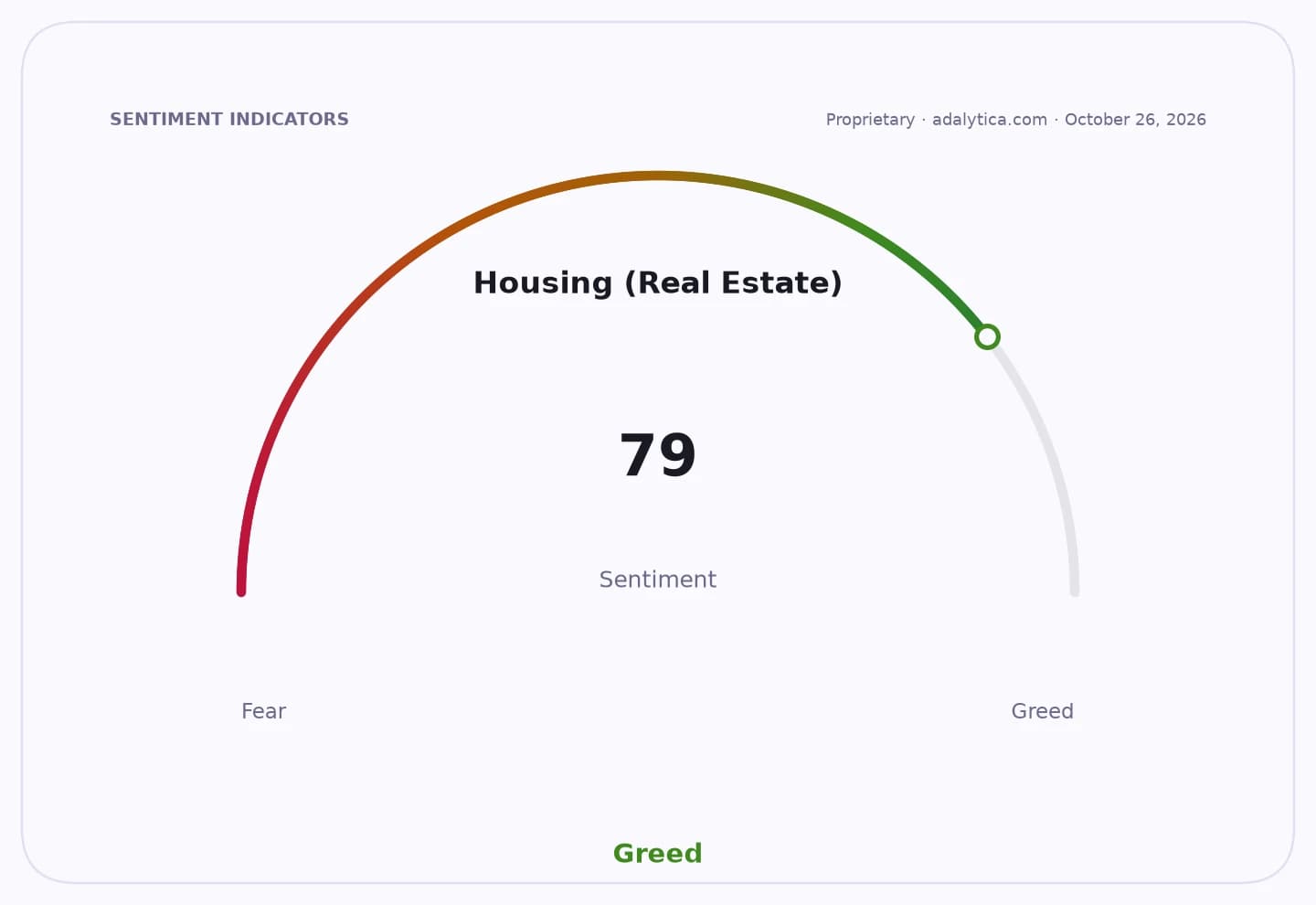
Housing (Real Estate)
The real estate veteran’s criticism of Prime Minister Anthony Albanese reflects a blunt truth investors cannot ignore: when supply fails to meet population growth, housing stops behaving like a normal consumer market and starts acting like a structural inflation engine. That is exactly the environment now confronting Australia, where shortages are squeezing renters, supporting prices and forcing policymakers to confront a problem they have repeatedly promised to fix but not solved.
Sentiment Indicators
The numbers show why the pressure is not going away. Australia’s housing starts have recently been running well below the levels needed to close the gap, with a latest reading of 1,221 and a forecast only modestly higher at 1,277.9. At the same time, the national house price index has climbed to 336.741 from 308.055 in mid-2022, underscoring how constrained supply continues to prop up valuations even as affordability worsens. Unemployment at 4.2% leaves the labor market firm enough to support demand, but not strong enough to fix the core problem: there simply are not enough homes being built.
That mismatch matters far beyond the political argument. Housing is one of the largest channels through which rates, wages and migration feed into the broader economy. When supply remains tight, rents stay sticky, household formation gets delayed and consumer spending becomes more constrained. For policymakers, that means the housing crisis can become a persistent inflation and productivity drag. For investors, it means the winners are not necessarily the headline homebuilders alone, but the entire ecosystem tied to permits, land conversion, construction materials, financing and rental exposure.
The market is already trying to price that reality. The SPDR Homebuilders ETF, XHB, has bounced back to 100.97 and sits above its 50-day moving average, with momentum improving on the latest technical reading. That recovery suggests traders still see upside in housing-related names, but the broader picture remains fragile. The iShares U.S. Home Construction ETF, ITB, has also rebounded to 92.74 and is above its 50-day average, yet still trades below its 200-day moving average, showing the sector has not fully escaped the damage from higher borrowing costs and affordability stress.
Adalytica’s Housing Fear & Greed Index for XHB sits at 29, labeled Fear, with awareness at just 4, or Extreme Fear. That is a useful contrarian signal: sentiment around housing remains deeply cautious even as the structural shortage persists. In plain English, the market is still underestimating how durable the supply squeeze can be when it collides with demographics, zoning constraints and political inertia.
That is why McGrath’s comments should be read less as a political rant and more as an investable macro signal. Australia’s housing debate is moving from cyclical to structural. If governments respond with faster approvals, land-release reform and incentives for new supply, the beneficiaries will be builders, developers and suppliers with the capacity to scale. If they do not, the shortage will continue to support asset values for existing owners while worsening affordability and keeping pressure on rents.
For investors, the opportunity lies in the second-order effects. The market is pricing the politics; it is not fully pricing the duration of the shortage. That leaves room for select exposure to housing infrastructure, residential developers and landlord-heavy vehicles that can benefit from persistent scarcity. The takeaway is simple: the housing crisis is no longer just a social issue in Australia — it is a capital allocation story, and the policy response will determine which parts of the property chain compound next.
| Entity | Gains | Losses |
|---|---|---|
| Existing homeowners | ▲Higher property values | ▼Affordability backlash |
| Homebuilders and suppliers | ▲More policy support, more demand | ▼Margin pressure from delays |
| Renters and first-home buyers | ▲Little in the near term | ▼Rising costs, limited supply |
| Government policymakers | ▲Chance to act on reform | ▼Blame for stalled housing supply |