Australia’s mortgage belt is showing fresh signs of strain as Equifax warns rising unemployment could push more borrowers into repayment trouble and force banks to revive holiday-style support plans.
Australia mortgage arrears rise in regional hotspots
That matters because the pressure is no longer confined to a few overheated inner-city pockets. Equifax says regional Australia accounts for 14 of the 25 worst mortgage-arrears hotspots, with outer suburbs in Sydney, Melbourne, Brisbane, Perth and Adelaide filling out the rest. The common thread is clear: borrowers are being squeezed by still-high mortgage rates, softer home prices and an economy that is starting to lose momentum.
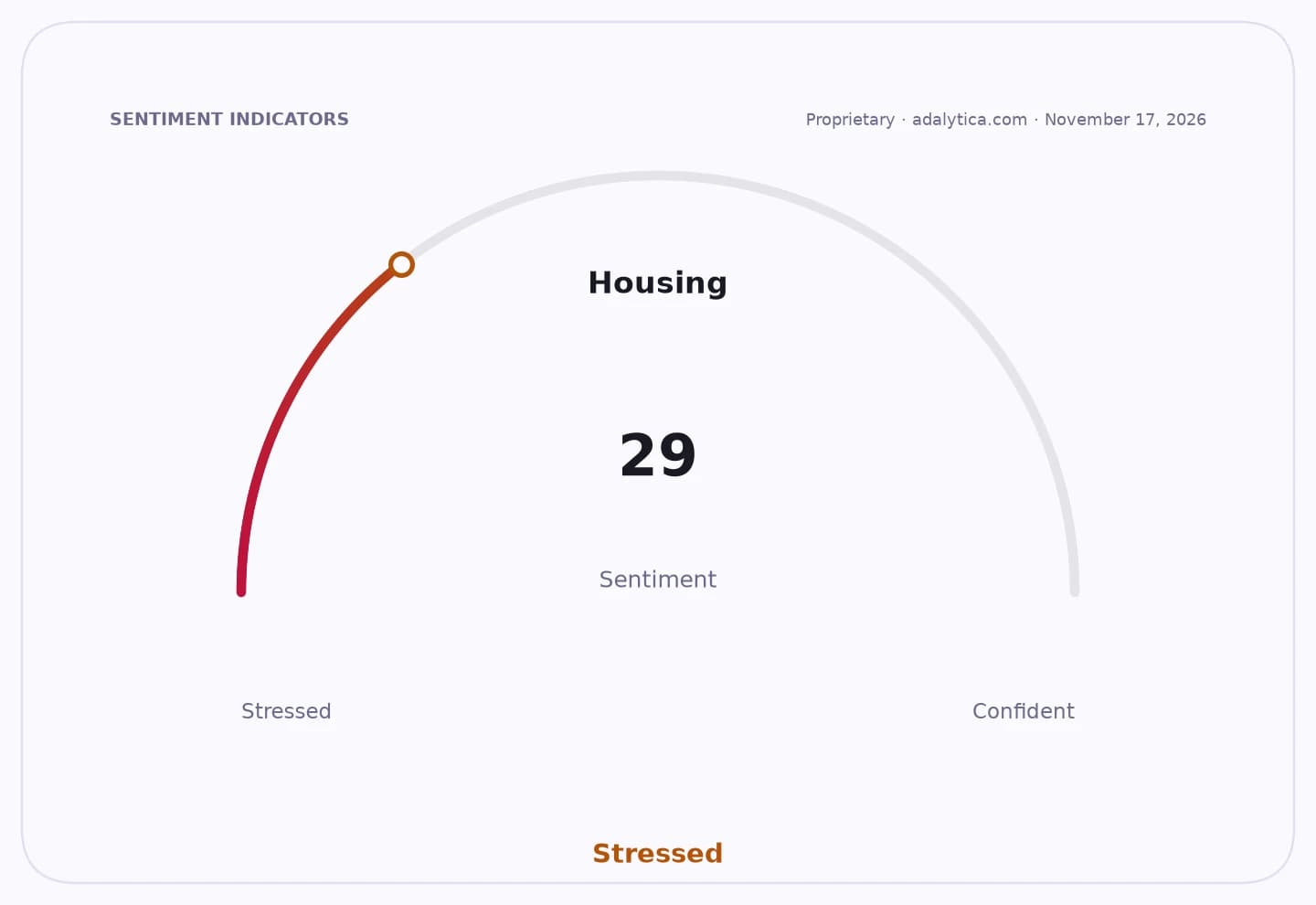
Sentiment Indicators
The credit bureau’s warning lands just as Australia’s job market deteriorates. Unemployment hit a five-year high of 4.7% in August and economists expect Thursday’s October labour data to show weaker job creation. That is the most dangerous mix for housing credit: when hours are cut or jobs disappear, arrears can rise quickly because households have less cash on hand to absorb rate shocks.
Melbourne’s west, including St Albans and Melton, had the worst capital-city arrears rate at 0.52%. In regional Australia, Broken Hill in far west New South Wales matched that level, followed by Mandurah south of Perth and outback west Queensland at 0.51%. The list then runs through northwest Victoria, WA’s Wheat Belt, the Murray region, Ballarat and New England, before landing in Sydney’s outer southwest and Parramatta. These are not speculative luxury markets; they are the places most exposed when incomes stall and borrowing costs stay elevated.
For investors, the significance is broader than housing distress in a few postcodes. Mortgage stress is an early warning signal for consumer spending, bank credit quality and the durability of Australia’s housing floor. If job losses deepen, households will likely pull back on discretionary spending, and lenders may face more forbearance requests, slower loan growth and higher impairment risk. That would hit banks, retailers and any business tied to a confident, cash-rich homeowner.
There is also a market implication for Australia’s property complex. The more exposed suburbs are often the ones that saw prices run hardest and fastest, meaning affordability has already been stretched and balance sheets are thinner than they look. If arrears keep rising into the first quarter, forced selling risk increases in the weakest corridors, especially where prices are already falling or employment is volatile.
The trading read-through is straightforward: the market may be underestimating how quickly mortgage stress can shift from a local housing story to a national macro drag. Banks will likely be pressured to offer temporary repayment relief if unemployment keeps rising, while housing-related equities and consumer lenders face a tougher earnings backdrop. For investors, the opportunity is not in chasing the most stressed suburbs — it is in positioning for the second-order winners: lenders with stronger credit underwriting, and sectors that benefit if policy support eventually has to step in.
| Entity | Gains | Losses |
|---|---|---|
| Stronger banks with cleaner loan books | ▲Lower impairment risk | ▼Slower mortgage growth |
| Strained borrowers in mortgage belt suburbs | ▲Temporary repayment relief | ▼Rising arrears |
| Housing-linked retailers and lenders | ▲Policy support if stress worsens | ▼Softer consumer spending |
| Homebuyers in weaker markets | ▲Better affordability over time | ▼Forced-sale price pressure |