Azerbaijan’s gathering with Central Asian heads of state points to a more ambitious attempt to turn shared geography, energy and transport routes into a durable geopolitical and commercial bloc, with implications for trade flows from the Caspian to Europe and Asia.
Azerbaijan-Central Asia corridor push lifts energy, transport focus
The central economic significance is not the symbolism of another summit but the effort to institutionalize coordination around corridors, ports, pipelines and power links at a time when the region is being pulled by Russia’s war, China’s westward push and Europe’s search for alternative suppliers. If the meeting produces tighter alignment on transit, customs and investment rules, it could lower friction across a corridor that increasingly matters for oil, gas, metals and container traffic moving between Central Asia, the South Caucasus and the Black Sea.
Sentiment IndicatorsⓘProprietary · adalytica.com · July 31, 2026
This is a snapshot — live sentiment, awareness and momentum for 130+ markets update continuously in the dashboard.Open AlphaPulse
That is why investors should care. A more coherent Caspian partnership can affect pricing power and financing conditions for exporters, improve visibility for infrastructure projects and reinforce demand for energy and transport assets. It also creates a counterweight to routes that remain exposed to sanctions risk, bottlenecks and geopolitical disruption. The market backdrop is favorable for any initiative that can claim to improve resilience: Brent has been volatile, with WTI around $84.25 on the latest data after trading above $109 in May, while the 10-year US Treasury yield sits near 4.62%, keeping global funding costs elevated and making projects with clear strategic backing more attractive than speculative ones.
Energy markets are already signaling that geopolitics is once again the dominant driver. The energy ETF XLE closed at $59.40, above its 50-day moving average of $56.49 and its 200-day average of $52.03, with the relative strength index at 67.3, indicating strong momentum. The exploration and production ETF XOP has outperformed more sharply, finishing at $176.69 versus a 200-day average of $150.51, a sign that investors continue to favor upstream cash flows in a tight-supply, geopolitically sensitive environment. By contrast, long-duration Treasuries, as tracked by TLT, slipped to $81.98, leaving it below both its 50-day and 200-day moving averages, a reminder that bond markets are still pricing higher-for-longer rates even as global risk sentiment improves.
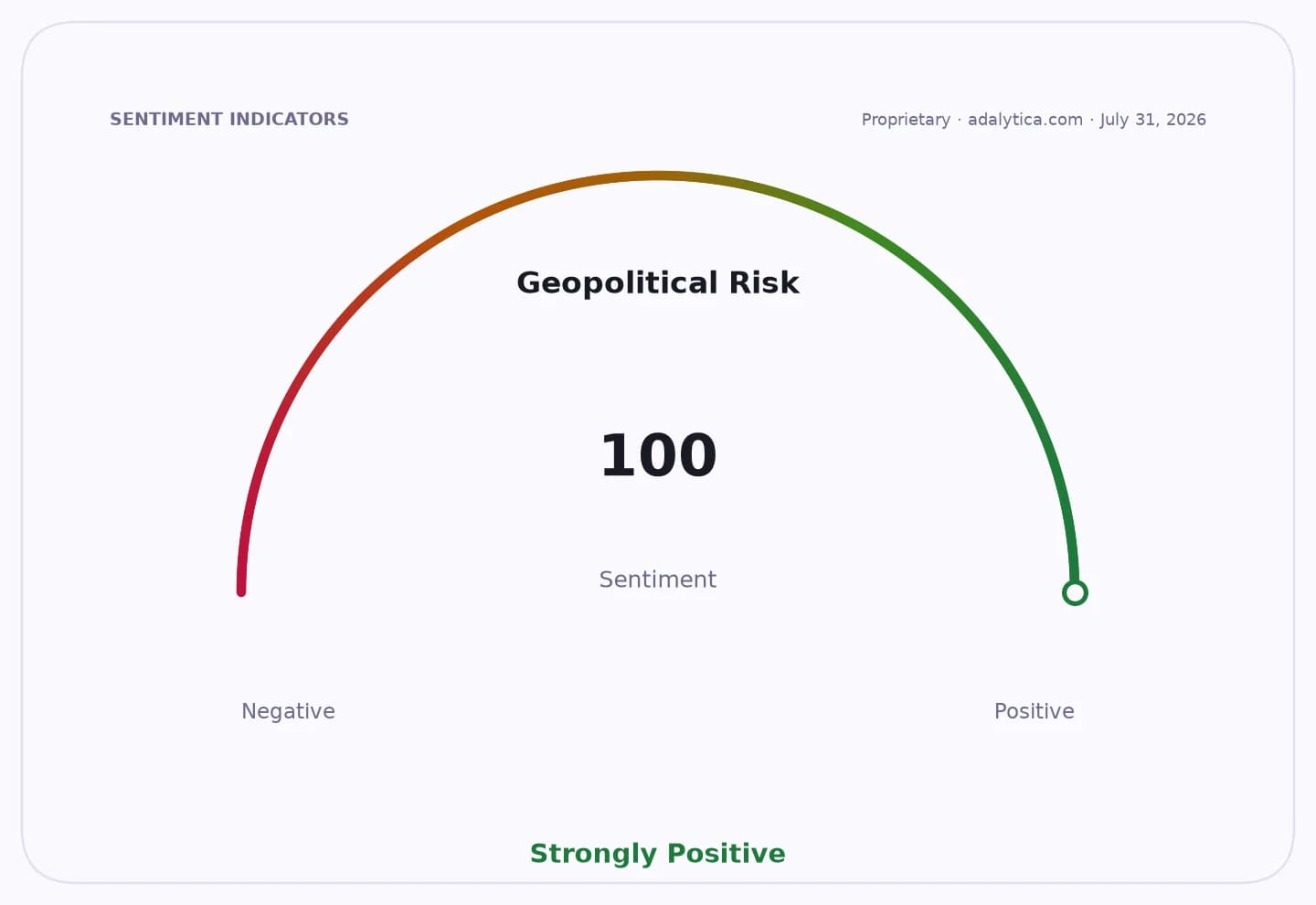
Geopolitical Risk — 30-day sentimentadalytica.com
Explore this data interactively — full history, time series and cross-market comparisons.Open AlphaPulse
Adalytica’s Global Stability Sentiment gauge is at 100, labeled Extreme Greed, while awareness is only 4, or Extreme Fear, a combination that suggests investors are willing to lean into geopolitically exposed themes even when public attention has not fully caught up. Oil trade signals from Adalytica remain cautious, but the broader message is that headline risk is being priced as an opportunity as much as a threat. For the Caspian states, that creates a window to convert strategic relevance into bargaining power.
The bull case is that the Azerbaijan-Central Asia format becomes a practical platform for corridor financing, upstream cooperation and industrial linkages, especially if it can reduce reliance on slower or riskier transit paths. The bear case is that the bloc remains declaratory, constrained by rival interests, uneven infrastructure and the difficulty of coordinating policy across multiple sovereigns with different external partners.
For investors, the next catalysts are not speeches but execution: port expansion on the Caspian, customs harmonization, pipeline and rail agreements, and evidence that the region can move more cargo and energy with less political drag. If the summit leads to that kind of follow-through, the market will treat the Caspian less as a map feature and more as a tradable strategic corridor.
| Entity | Gains | Losses |
|---|---|---|
| Azerbaijan and Central Asia | ▲Corridor leverage | ▼Fragmented transit costs |
| Energy exporters | ▲Route diversification | ▼Single-route dependence |
| Transport and infrastructure investors | ▲New project pipeline | ▼Policy uncertainty |
| Russia and rival transit hubs | ▲— | ▼Share of regional influence |




