Banxico’s decision to leave its benchmark rate unchanged at 6.50% keeps Mexico’s inflation fight in a holding pattern just as the broader debate over whether central banks should rethink their targets is gaining traction.
Banxico Holds Rate at 6.50% as Inflation Cools

The pause matters because it shows policymakers are still prioritizing credibility over stimulus even after a recent monthly easing in consumer prices, with lower gasoline and food costs helping to cool headline inflation. But inflation remains above target and still elevated year to date, leaving the central bank little room to declare victory. For investors, that means Mexican rates are likely to stay restrictive for longer, supporting the peso and local carry trades but limiting the scope for a sharp rally in duration-sensitive assets.
The call to hold rather than cut also reflects a familiar central-bank dilemma: growth needs support, but easing too early risks letting price pressures re-embed. That trade-off has become sharper as energy and production costs remain volatile and global inflation is still not fully subdued. A steady policy rate suggests Banxico is waiting for a clearer and more durable downtrend in prices before shifting its stance, especially with the inflation-target debate itself under scrutiny.
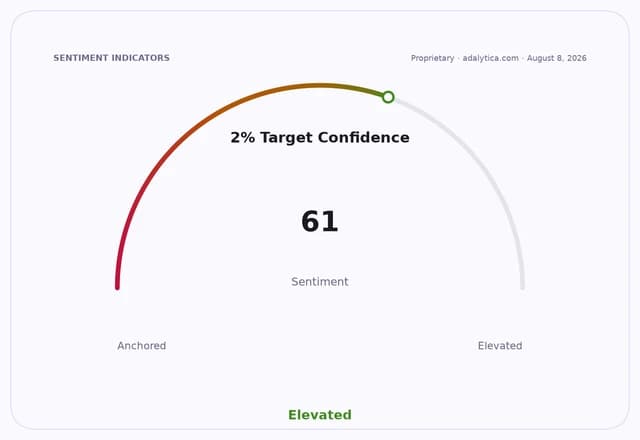
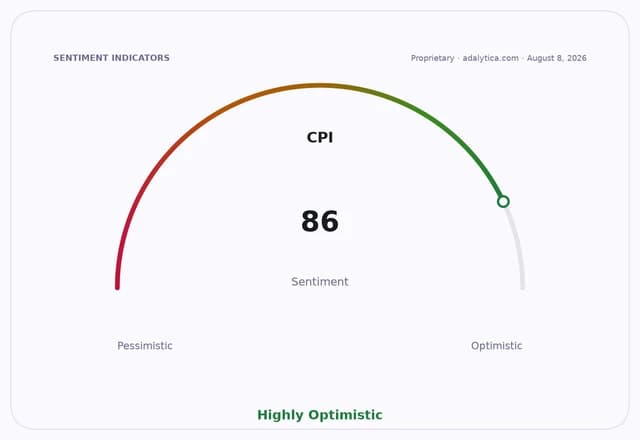
That broader debate is visible in market pricing and sentiment. Adalytica’s gauge on confidence in the Fed’s 2% inflation target remains at 61, neutral, while long-term inflation expectations sentiment has climbed to 86, indicating investors are paying closer attention to whether central banks can still anchor price expectations. The 5-year breakeven gauge, meanwhile, has eased back to 61 after a recent surge, underscoring how quickly inflation views can swing when policymakers appear behind the curve.
Bond markets are already reflecting that uncertainty. The 10-year Treasury yield has hovered around 4.63% to 4.69%, levels that keep real-financing costs elevated and make it harder for central banks to pivot without validating higher inflation expectations. Long-duration assets have remained volatile as well: TLT was last around 82.76, below its 50-day and 200-day moving averages, with RSI readings showing no decisive trend break, suggesting investors are still cautious on rate-sensitive bonds.
For Banxico, the near-term path likely depends on whether inflation continues to cool in a way that is broad-based rather than just driven by food and fuel. If price pressures keep easing, officials can preserve room for eventual cuts without reopening the credibility debate. If not, the current pause may last longer than markets want, reinforcing the view that central banks cannot afford to lower their inflation targets just because the post-pandemic inflation shock has faded.
| Entity | Gains | Losses |
|---|---|---|
| Banxico | ▲Policy credibility | ▼Growth support |
| Peso / carry traders | ▲Higher relative yield | ▼Faster easing |
| Borrowers / consumers | ▲None immediately | ▼Higher financing costs |
| Bond bulls / duration holders | ▲Potential disinflation later | ▼Near-term rate pressure |