Berkshire Hathaway’s ability to sit on a mountain of cash while the economy softens is back in focus, with the conglomerate’s latest filing and market action underscoring why investors view it as one of the market’s most powerful contrarian buyers.
Berkshire’s Cash Pile Becomes Recession Optionality
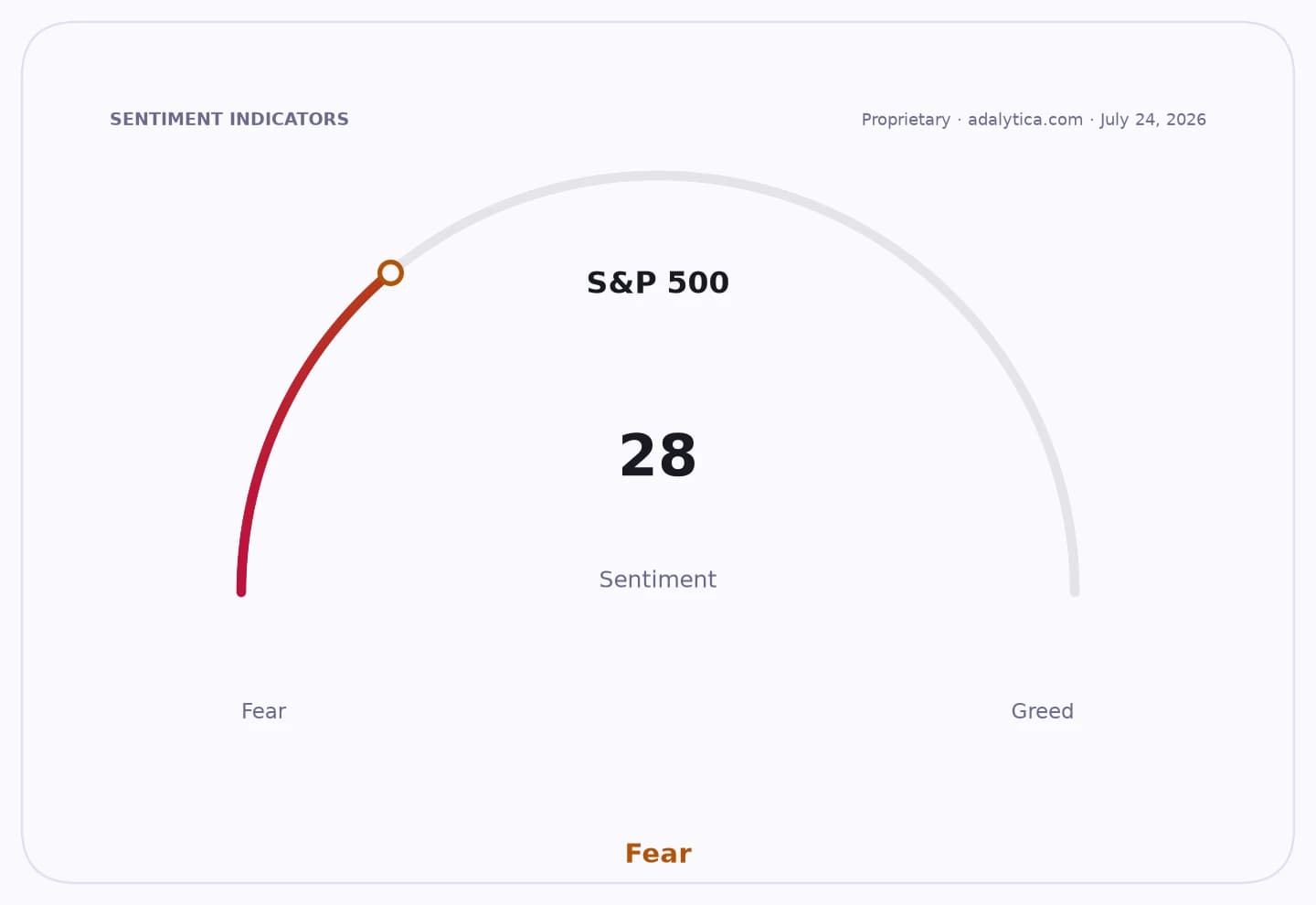
That matters because Berkshire’s balance sheet gives it a rare advantage in a high-rate, slowdown-prone environment: when credit tightens, asset prices weaken and weaker companies are forced to sell, Berkshire can deploy capital quickly and at scale. The company already has roughly $800 billion in cash and Treasury holdings by investor estimates tied to its huge liquidity position, giving it the firepower to buy distressed assets at a discount and then compound returns when conditions normalize.
Sentiment IndicatorsⓘProprietary · adalytica.com · July 24, 2026
This is a snapshot — live sentiment, awareness and momentum for 130+ markets update continuously in the dashboard.Open AlphaPulse
The macro backdrop supports that narrative. The U.S. economy is no longer showing recession risk in the data context, but unemployment still sits at 4.2% and the 10-year Treasury yield has climbed to 4.688%, keeping borrowing costs elevated and pressure on valuations intact. Adalytica’s trade signals also show fear in the S&P 500 and extreme fear in U.S. Treasury bonds, a mix that points to choppy risk appetite and lingering uncertainty around growth and rates.
Berkshire shares have reflected that tension. Class B stock closed at $490.85 on July 23, just above its 50-day moving average of $488.80 and slightly below its 200-day average of $490.12, while RSI readings fell to 27.5, a conventional technical indicator that suggests the stock has been oversold in the near term. Bank of America, one of Berkshire’s major holdings and a proxy for the banking sector it often shops in during stress, has surged to $61.28 and sits well above both its 50-day and 200-day averages.
USRECM vs UNRATE — macro contextadalytica.com
Explore this data interactively — full history, time series and cross-market comparisons.Open AlphaPulse
Investors care because Berkshire’s cash is not idle capital in the usual sense. It is optionality: protection in a downturn, dry powder for M&A, and a recurring source of outperformance if Buffett’s successor can keep buying businesses and securities when others are forced to sell. The bigger the slowdown, the more valuable that balance-sheet flexibility becomes.
The next catalyst is whether further economic cooling, a jump in credit stress or a pullback in stocks gives Berkshire another chance to convert its liquidity into bargains. If the expansion holds, the cash earns less; if it cracks, Berkshire’s war chest becomes the trade.
| Entity | Gains | Losses |
|---|---|---|
| Berkshire Hathaway | ▲Distressed buying power | ▼Lower return on idle cash |
| Sellers of assets | ▲Immediate liquidity | ▼Lower sale prices |
| Weak companies | ▲Chance of rescue capital | ▼Forced dilution or liquidation |
| Equity bulls | ▲Buffett backstop support | ▼More downside if recession deepens |




