Bitcoin’s next big move in the U.S. may not come from the chart — it may come from Washington. The federal project to define how digital currencies are regulated, taxed and settled is now the most important catalyst for the crypto market, because it could decide whether the industry keeps trading like a speculative asset class or evolves into a mainstream financial rail.
Bitcoin and Coinbase hinge on U.S. crypto rules
That matters economically because crypto is no longer a side bet. Bitcoin is still changing hands around $64,751, but its pricing has become tightly linked to policy expectations, with the 10-year Treasury yield near 4.63% and the fed funds rate at 3.63% keeping real-financing conditions restrictive even as investors search for assets that can absorb liquidity and macro volatility. When the cost of capital is elevated, regulation becomes a valuation driver: clearer rules can unlock institutional adoption, lower compliance risk and pull more balance-sheet money into the market.
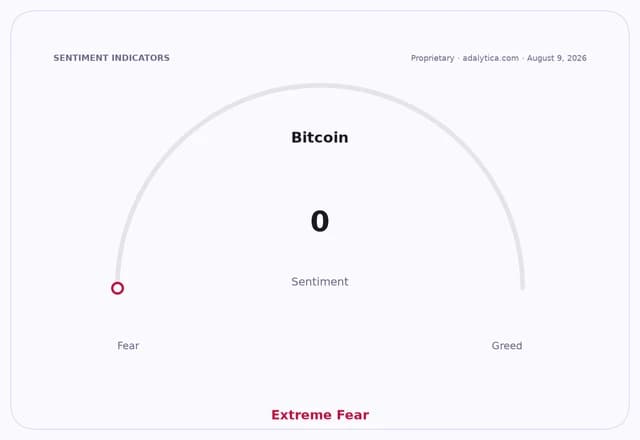
Sentiment IndicatorsⓘProprietary · adalytica.com · August 9, 2026
This is a snapshot — live sentiment, awareness and momentum for 130+ markets update continuously in the dashboard.Open AlphaPulse
The market is already telling the story. Bitcoin has fallen far from its highs, while Adalytica’s Bitcoin Fear & Greed Index shows “Extreme Fear” even as awareness remains at “Extreme Greed,” a combination that often marks capitulation rather than indifference. Coinbase Global has dropped to about $153.60 from levels above $300 earlier in the cycle, and MicroStrategy has slid to roughly $100 from well over $300, showing how directly crypto-linked equities still trade on confidence in the asset class itself. If Washington provides a credible framework for stablecoins, exchange oversight and market structure, these names can re-rate quickly because the market is underestimating how much of their value depends on regulatory visibility rather than just bitcoin direction.
That is why the federal effort matters far beyond crypto traders. A U.S. digital currency framework would reshape payment rails, custody, brokerage economics and treasury demand for tokenized dollars. Stablecoin issuers, exchanges, payment platforms and miners all stand to benefit if the rules reduce legal ambiguity and bring more institutional flows into the ecosystem. The losers are just as clear: firms built on regulatory gray zones, and shorts betting that crypto remains permanently boxed out of traditional finance.
Bitcoin — 30-day sentimentadalytica.com
Explore this data interactively — full history, time series and cross-market comparisons.Open AlphaPulse
The broader setup is constructive for investors willing to look past the recent drawdown. Bitcoin has already shown it can rebound sharply when liquidity and policy align, and the current reset in sentiment looks more like a clearing event than a collapse in the thesis. If Congress and regulators deliver a workable U.S. framework, the next phase of the crypto cycle will be driven less by retail speculation and more by capital allocation from banks, asset managers and payments companies.
For investors, the opportunity is not to chase every bounce in bitcoin. It is to own the infrastructure that gets paid if digital currencies move from experiment to system. Coinbase, select miners, payments proxies and stablecoin-adjacent names could be the biggest beneficiaries of a U.S. policy breakthrough, and the window to position before that shift becomes consensus may be closing fast.
| Entity | Gains | Losses |
|---|---|---|
| Coinbase | ▲clearer U.S. rules | ▼regulatory overhang |
| Bitcoin | ▲institutional adoption | ▼policy uncertainty |
| MicroStrategy | ▲balance-sheet thesis | ▼leverage sensitivity |
| Crypto skeptics | ▲little | ▼re-rating risk |