Bitcoin’s latest surge back toward the mid-$66,000s is reigniting one of crypto’s most important investment debates: whether the asset is maturing into a true store of value, or still trading like a leveraged risk asset.
Bitcoin Gains as Digital Gold Debate Heats Up
That matters because the “digital gold” thesis is not about one good week or even one strong quarter. It is about whether capital will increasingly treat bitcoin as a monetary hedge in a world of persistent fiscal stress, policy uncertainty and a shaky faith in traditional havens. If that shift is real, the market is still underpricing the second-order winners: bitcoin miners with scale, exchanges, custodians, treasury platforms and infrastructure names tied to institutional adoption.
The move is notable not just for the price, but for the way bitcoin has behaved against gold itself. Spot bitcoin has climbed from roughly $64,700 on July 19 to $66,197 on July 21, while GLD, the SPDR Gold Trust, has drifted around the mid-$370s after earlier strength. Gold-related equities have been far more erratic, underscoring that even the metal investors have long called the ultimate safe haven is no longer delivering a clean, one-way hedge. In that setting, bitcoin’s relative resilience looks increasingly relevant.
Technical signals reinforce the point. Bitcoin is now trading above its 50-day moving average of about $63,087 and has recovered from deeply oversold conditions earlier this year, when RSI readings collapsed into the low 20s and the price briefly sank below its 200-day average. On July 21, RSI had rebounded to 62.8 and MACD had turned positive, suggesting momentum is rebuilding rather than simply bouncing. That does not prove the digital gold thesis, but it does show the market is no longer pricing bitcoin as a broken speculative asset.
Bitcoin — 30-day sentimentadalytica.com
Explore this data interactively — full history, time series and cross-market comparisons.Open AlphaPulse

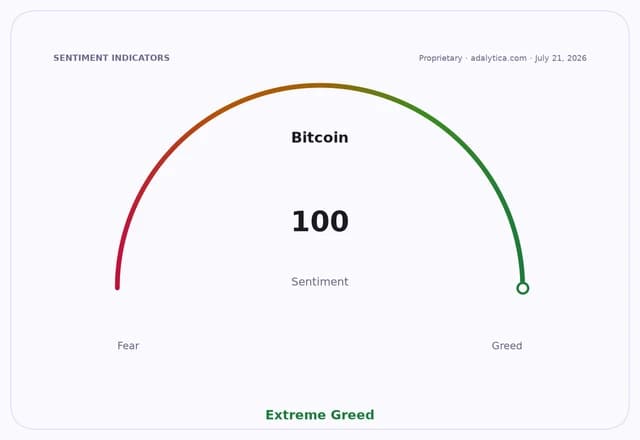
The bigger economic backdrop helps explain why the narrative is gaining traction. Investors are still searching for assets that can hold value outside the traditional financial system as global liquidity, central-bank policy and geopolitical risk remain unstable. Gold has benefited from that instinct for decades, but bitcoin is increasingly competing for the same role with a more portable, digitally native pitch. Adalytica’s Bitcoin Fear & Greed Index shows sentiment at 100, or “Extreme Greed,” even as awareness remains at 1, a combination that often appears at the point where a market starts drawing in a broader audience rather than a peak consensus trade.
For investors, the key question is not whether bitcoin can replace gold tomorrow. It is whether the marginal dollar of defensive capital starts to flow into BTC instead of, or alongside, bullion. If that happens, the market underestimates the upside optionality in the entire digital asset stack. Bitcoin ETFs, crypto exchanges, custody providers and high-quality miners all stand to benefit from a world in which bitcoin is treated less like a speculative token and more like a reserve-style asset.
That is why the real opportunity is not simply owning bitcoin, but positioning ahead of the infrastructure trade around it. The thesis becomes more powerful if institutions keep allocating, volatility gradually compresses and bitcoin continues to hold above key trend levels while gold itself remains choppy. If BTC keeps behaving like a macro hedge rather than a momentum casino, the “digital gold” label stops being marketing and starts becoming a capital flows story.
| Entity | Gains | Losses |
|---|---|---|
| Bitcoin | ▲Store-of-value narrative | ▼Pure speculative framing |
| Gold / GLD | ▲Safe-haven demand | ▼Monopoly on hedge flows |
| Bitcoin miners / crypto infrastructure | ▲Higher adoption, more flows | ▼Low-volume, hype-only cycles |
| Traditional cash / fiat holders | ▲Less direct benefit | ▼Purchasing-power erosion narrative |




