Bitcoin is entering a crucial inflection point: Wall Street is opening the door wider just as one of the market’s most iconic corporate hoarders has begun selling coins for the first time. That combination matters because it shifts Bitcoin from a pure scarcity trade into a deeper liquidity and distribution story, and the market is still underestimating how much institutional access can offset the headline risk from Strategy’s initial sales.
Bitcoin Institutional Access Offsets Strategy Sales
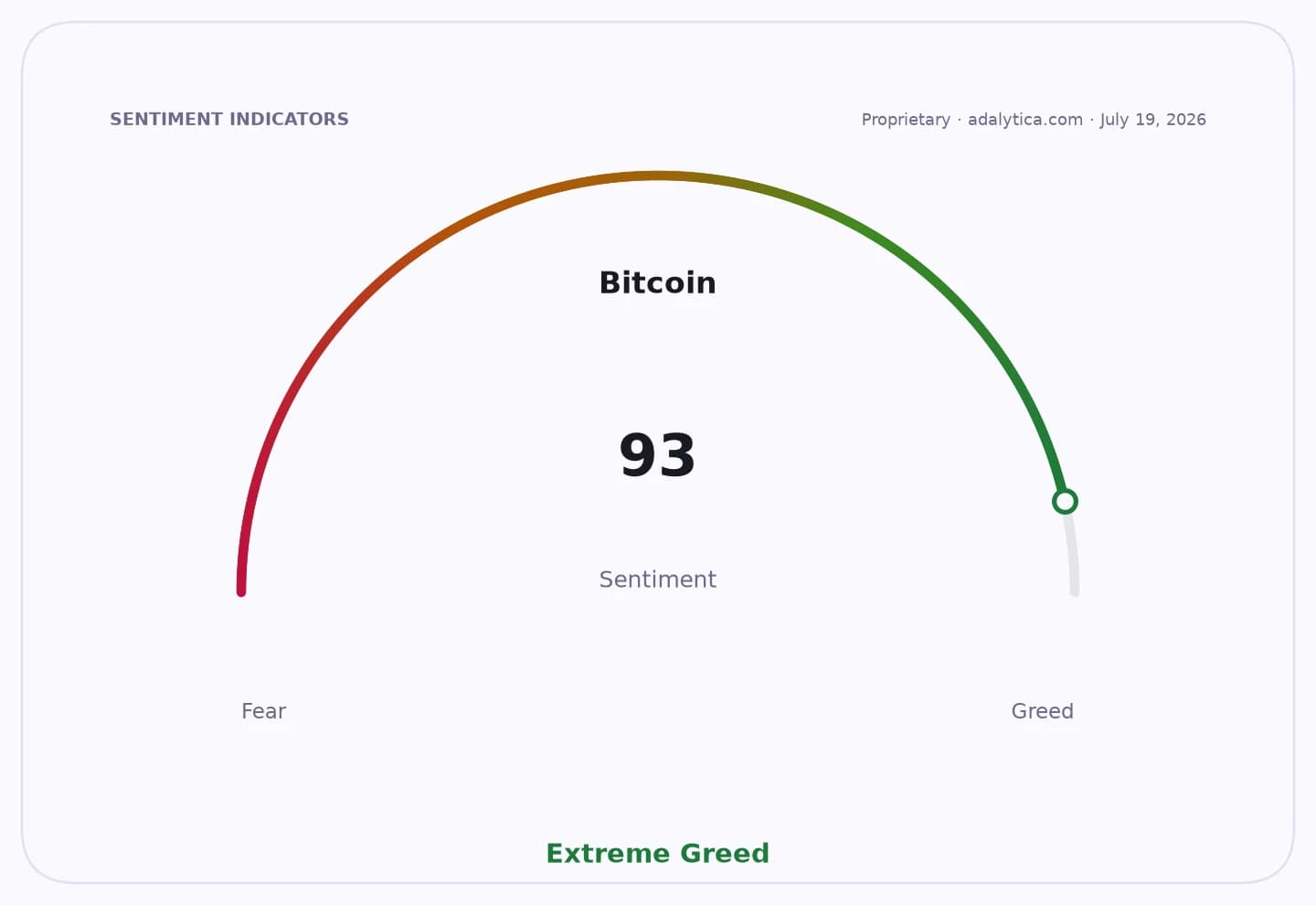
The immediate signal is not the price itself — Bitcoin was holding around $64,600 on July 19 — but the structure around it. The token is trading near its 50-day moving average and well below its 200-day average, after a violent drawdown from above $81,000 in May. Yet standard technical indicators are no longer flashing panic: RSI has rebounded into the mid-50s, and MACD has turned positive. In other words, the asset has already absorbed a major deleveraging, while sentiment is back at “Extreme Greed” even as proprietary Adalytica awareness remains in “Extreme Fear,” a classic setup for a market that is stronger underneath than the crowd believes.
Sentiment IndicatorsⓘProprietary · adalytica.com · July 19, 2026
This is a snapshot — live sentiment, awareness and momentum for 130+ markets update continuously in the dashboard.Open AlphaPulse
That is why Morgan Stanley’s crypto launch matters so much. A major investment bank putting a formal crypto product on the shelf is not just another brand-name endorsement; it is a distribution event. It expands access for wealth clients, retirement allocators and advisers who have been waiting for institutional wrappers, compliance comfort and a familiar counterparty. For Bitcoin, that means a broader buyer base at the exact moment supply discipline is being tested by Strategy’s first round of sales.
Strategy’s filing is the other half of the story. The company disclosed Bitcoin sales for June 29-30, totaling 1,363 coins at an average price of $59,256, a notable break from the “never sell” narrative that made the stock a proxy for perpetual accumulation. The market should not dismiss that shift. Strategy has been the single most important corporate symbol of Bitcoin treasuries, and even a modest sale introduces a new reality: corporate holders can become sources of supply when balance-sheet financing, preferred stock obligations or market conditions change.
Economically, this is a story about who sets the marginal price of Bitcoin. If corporate selling becomes episodic rather than existential, and if institutions continue to absorb new exposure through products launched by firms like Morgan Stanley, the market can digest supply shocks far more easily than in prior cycles. That is especially important with Treasury yields still around 4.56% and high-yield spreads near 2.72%, conditions that keep risk capital selective and make large, liquid, branded access points more valuable than ever.
For investors, the setup argues for a different conclusion than the one most traders are drawing. The bear case focuses on Strategy’s sale and Bitcoin’s still-weak placement beneath its 200-day average. My thesis is the opposite: this is the kind of transition phase that often precedes a durable re-rating. When an asset moves from being owned mainly by conviction holders and leverage to being distributed through regulated channels, volatility can stay high — but the long-term capital base gets larger. That is exactly how exponential adoption curves begin to compound.
The investable implication is straightforward. Bitcoin itself remains the cleanest beta to the institutionalization of crypto, but the higher-conviction trade is in the picks-and-shovels beneficiaries: exchanges, brokers, custodians and asset managers that win when mainstream money enters the asset class. Coinbase remains the clearest operating leverage play on trading and custody demand, while platforms tied to wealth distribution and options access can also benefit from the widening product stack. For those seeking direct exposure, Bitcoin still looks like the core asset, but the market underestimates how much this next leg can be driven by channels rather than pure narrative.
Strategy, meanwhile, is becoming a different kind of trade. The stock has already been punished hard, with shares near $95 and far below the levels that once priced in relentless balance-sheet aggression. That creates asymmetry in both directions: if Bitcoin stabilizes and the company keeps the market’s confidence, the stock can rebound sharply; if sales accelerate and the halo fades, the multiple compresses further. Either way, investors should stop treating Strategy as a one-way Bitcoin maximization vehicle. It is now a capital structure story.
The next catalyst is whether Morgan Stanley’s launch draws meaningful inflows and whether other large firms follow with more crypto distribution. If they do, Bitcoin’s July 2026 forecast is not about a quick breakout to new highs. It is about a higher floor. In a market where institutional access is expanding and corporate supply is no longer sacred, the most important move may be the one the crowd misses: Bitcoin consolidating before its next secular advance.
| Entity | Gains | Losses |
|---|---|---|
| Bitcoin | ▲Broader institutional demand | ▼Short-term supply shocks |
| Morgan Stanley | ▲New crypto revenue stream | ▼Legacy skeptics |
| Coinbase and crypto brokers | ▲More trading and custody volume | ▼Smaller retail-only venues |
| Strategy (MSTR) bulls | ▲Potential rebound if BTC holds | ▼End of “never sell” purity trade |




