Bitcoin’s latest retreat to about $63,987 has sharpened the question investors keep asking at each cycle peak: is the world’s largest cryptocurrency still capable of turning small stakes into fortunes, or is the upside now capped by size, volatility and competition for capital?
Bitcoin Matures as Upside Narrative Softens

That matters because Bitcoin is no longer a niche trade. At more than $1.2 trillion in market value, its gains now have to come from a much larger base than in the early years. The arithmetic of compounding has changed: a move from $10,000 to $100,000 was a 10-fold return, but a similar leap from the current range would require far more capital, broader adoption and a stronger macro tailwind than Bitcoin has had to rely on before.
Sentiment IndicatorsⓘProprietary · adalytica.com · July 25, 2026
This is a snapshot — live sentiment, awareness and momentum for 130+ markets update continuously in the dashboard.Open AlphaPulse

The recent price action shows both sides of the debate. Bitcoin has slid about 4.5% over the past three sessions and is down sharply from the year’s highs above $120,000, while still sitting well above its 50-day moving average near $63,105. Technical readings suggest the market has cooled but not cracked: the RSI around 49 points to a neutral setup, and the MACD remains positive, hinting that the broader trend has not fully turned lower. But the distance from the 200-day moving average, still around $72,406, underscores how far the asset has fallen from the more exuberant phase of the rally.
That pullback matters for investors because Bitcoin’s biggest draw has never been steady compounding; it has been convexity. It can outperform dramatically when liquidity is abundant, real yields are falling and speculative appetite is high. It can also punish holders when leverage unwinds. Adalytica’s Bitcoin Fear & Greed Index still shows “Extreme Greed” at 87, even after dropping 12 points in a day and 11 points over the week, a sign that sentiment remains elevated even as price momentum has weakened. That combination often precedes choppy trading rather than a straight-line advance.
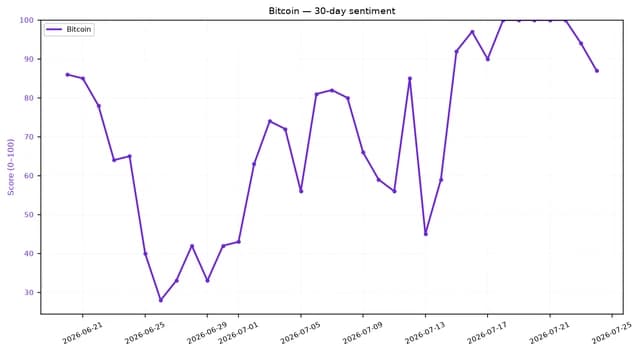
The broader market message is that Bitcoin is behaving less like an emerging technology bet and more like a large-cap macro asset. The dollar’s trade signals, which Adalytica flags at “Extreme Fear,” point to a softer greenback backdrop that in theory supports Bitcoin, but the cryptocurrency has not fully capitalized on it. Instead, the market is wrestling with whether institutional adoption, exchange-traded fund flows and treasury-balance-sheet demand can keep pushing the ceiling higher or whether the asset has already absorbed much of that narrative.
That question also matters for related names. MicroStrategy, long the most leveraged corporate proxy for Bitcoin, has fallen to about $91.67 from more than $186 in mid-May, while Coinbase is down to roughly $158 from above $216 in early May. Both stocks have traded far more like high-beta reflections of Bitcoin’s risk cycle than clean beneficiaries of adoption. If Bitcoin’s upside slows, the market usually compresses the valuation of the whole crypto complex, especially names whose earnings or balance sheets are tied to trading volume and token prices.
The bull case remains straightforward. Bitcoin still has a brand advantage, a finite supply narrative and deepening institutional infrastructure, including security efforts and custody improvements that may make the asset more acceptable to large allocators over time. If global liquidity improves and investors continue to seek scarce assets outside the sovereign currency system, Bitcoin could still compound meaningfully from here.
The bear case is that the “millionaire-maker” phase is behind it. At current scale, each incremental dollar of upside requires broader mainstream participation, steadier regulation and continued tolerance for drawdowns that can exceed those of traditional risk assets. For new investors, that lowers the odds of another life-changing return from a modest entry point. For existing holders, it raises the bar for what counts as success: not a meteoric rise, but sustained outperformance against equities, gold and other alternative stores of value.
For now, Bitcoin still looks like an asset with upside, but its ceiling is increasingly defined by macro liquidity, investor risk appetite and the willingness of institutions to keep bidding on scarcity. The next move will tell investors whether this remains a generational wealth trade or has become something more modest: a volatile but mature alternative asset with less room to surprise.
| Entity | Gains | Losses |
|---|---|---|
| Bitcoin longs | ▲Scarcity thesis | ▼Diminishing asymmetry |
| MicroStrategy shareholders | ▲Bitcoin leverage if it rebounds | ▼Balance-sheet risk |
| Coinbase investors | ▲Higher trading activity | ▼Lower crypto beta |
| Dollar bears | ▲Easier liquidity backdrop | ▼Need for macro confirmation |




