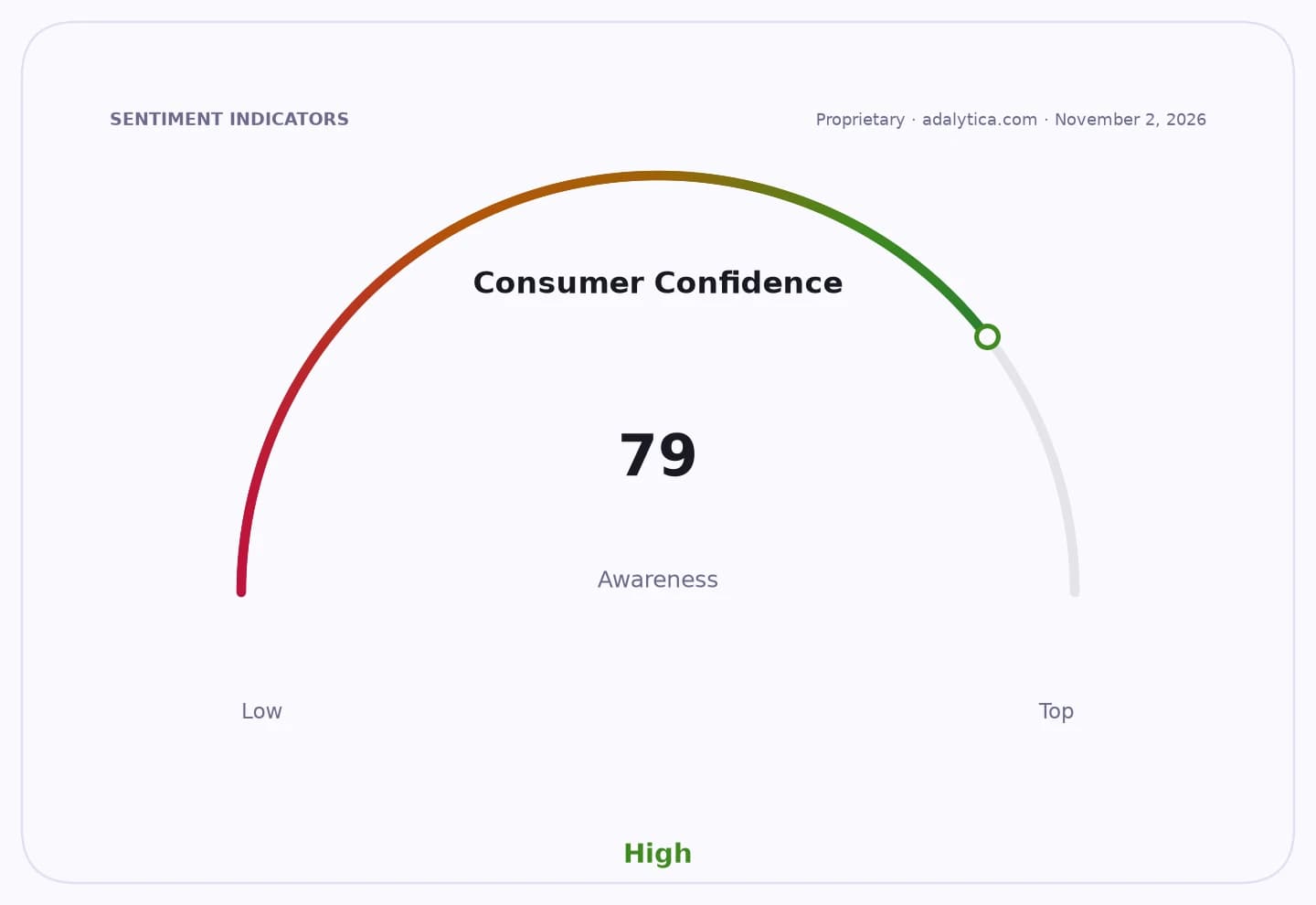
Brazilian workers have until Nov. 30 to receive the first installment of the 13th salary, and this year the bigger economic story is not the timing but the tax break attached to it. For millions of households, the year-end bonus arrives just as inflation, holiday spending and household debt decisions collide — and in 2026, more of that money should stay in workers’ pockets.
Brazil 13th Salary Tax Break Boosts Take-Home Pay
Consumer Spending
The first half of the annual bonus is generally equal to half of the worker’s monthly pay and comes free of deductions, while the second installment carries the INSS social security charge and, in many cases, income tax. That matters because the 13th salary is one of Brazil’s most important consumer-income transfers, a year-end cash injection that can support retail sales, services spending and bill payments at a time when family budgets are under pressure.
Sentiment Indicators
Consumer Spending
What changes this year is the income tax treatment. Brazil’s Finance Ministry says the exemption for people earning up to 5,000 reais a month also applies to the 13th salary, with partial relief for incomes from 5,000.01 reais to 7,350 reais. That means more workers should see a cleaner December deposit, especially in the second installment, where the tax normally bites hardest.
For investors, that is a small but meaningful tailwind for consumer spending in Brazil. The 13th salary helps explain why holiday-season sales can hold up even when credit is tight. It also gives a clearer picture of disposable income across lower- and middle-income households, a key driver for supermarkets, apparel chains, pharmacies, travel, and other domestic-facing businesses.
The law still leaves room for variation. Workers who were hired midyear receive a proportional amount, calculated at one-twelfth of monthly pay for each month worked, and anyone who worked at least 15 days in a month counts that month in full. Extra pay such as overtime, commissions, night shift premiums and hazardous-duty allowances can also lift the total.
The second installment is due by Dec. 20, though because that date falls on a Sunday this year, employers are likely to advance payment to the preceding Friday. Workers who resigned or were dismissed without cause receive the proportional amount at termination, while those dismissed for cause may lose the right to the bonus.
For long-term investors, the broader takeaway is simple: Brazil’s household spending engine is still powered by policy, payroll and taxation. A larger tax-free slice of the 13th salary may not change the investment case on its own, but it does reinforce the resilience of domestic demand heading into year-end — a trend worth watching for consumer stocks, payment companies and local retailers.
| Entity | Gains | Losses |
|---|---|---|
| Lower- and middle-income workers | ▲Higher take-home 13th salary | ▼Less tax withheld |
| Brazilian retailers and service firms | ▲Stronger holiday spending | ▼Weaker cash flow if households save more |
| Federal tax authorities | ▲None | ▼Lower income tax collection |
| Employers | ▲Clearer payroll rules | ▼Earlier year-end cash outflow |