Brazil’s presidential runoff is more than a domestic political contest: it will help decide whether South America’s biggest economy tilts closer to Washington or keeps balancing between the United States and China.
Brazil election weighs U.S.-China trade ties
With Luiz Inácio Lula da Silva facing Flávio Bolsonaro in an extraordinarily tight race, investors are weighing not just policy continuity but the direction of trade, commodity flows and regional power alignments in a country of more than 210 million people that is also Latin America’s largest economy and the world’s top soybean exporter.
Sentiment Indicators
That matters because Brazil sits at the center of the hemisphere’s economic architecture. It is a major supplier of soy, iron ore and meat to China, and any shift in Brasília’s foreign policy would ripple through agricultural exporters, mining groups, ports and the broader Latin American logistics chain. China is Brazil’s largest trading partner, and the country’s export model depends on keeping those flows moving even if politics turn more confrontational.
The geopolitical stakes are rising as Donald Trump seeks to deepen U.S. influence across the Americas. Lula has argued for strategic autonomy, keeping channels open to Washington, Beijing, Moscow and the wider “global south,” while Bolsonaro has signaled a much closer alignment with Trump and a harder line on the BRICS grouping. Yet even a Bolsonaro victory would not sever Brazil’s economic dependence on China, limiting how far any administration can tilt.
Markets are already reflecting that tension. The iShares MSCI Brazil ETF, EWZ, fell to $33.62 on Oct. 28 from $42.59 a day earlier, while the Direxion Daily Brazil Bull 2X ETF, BRZU, dropped to $75.31 from $129.12. The moves point to sharp repricing around election risk, with traders unwinding bullish exposure as the vote nears and uncertainty over policy, diplomacy and capital flows rises.
The technical backdrop underscores how abrupt the shift has been. EWZ has slid well below its 50-day moving average of $38.47 and its 200-day average of $37.02, while its RSI has fallen to 20.8, a level that suggests deeply oversold conditions in conventional technical analysis. BRZU shows a similar pattern, trading far under both its 50-day and 200-day averages after its latest selloff.
For investors, the key question is not simply who wins, but how much room the next president has to alter Brazil’s external posture without jeopardizing export earnings or inflation control. A Lula victory would likely preserve the current model of hedging between major powers, reassuring China-linked commodity flows but frustrating more pro-U.S. investors. A Bolsonaro win could improve sentiment in Washington and among Brazil’s right-leaning market constituency, but any aggressive pivot away from Beijing would risk hitting the country’s largest trade relationship.
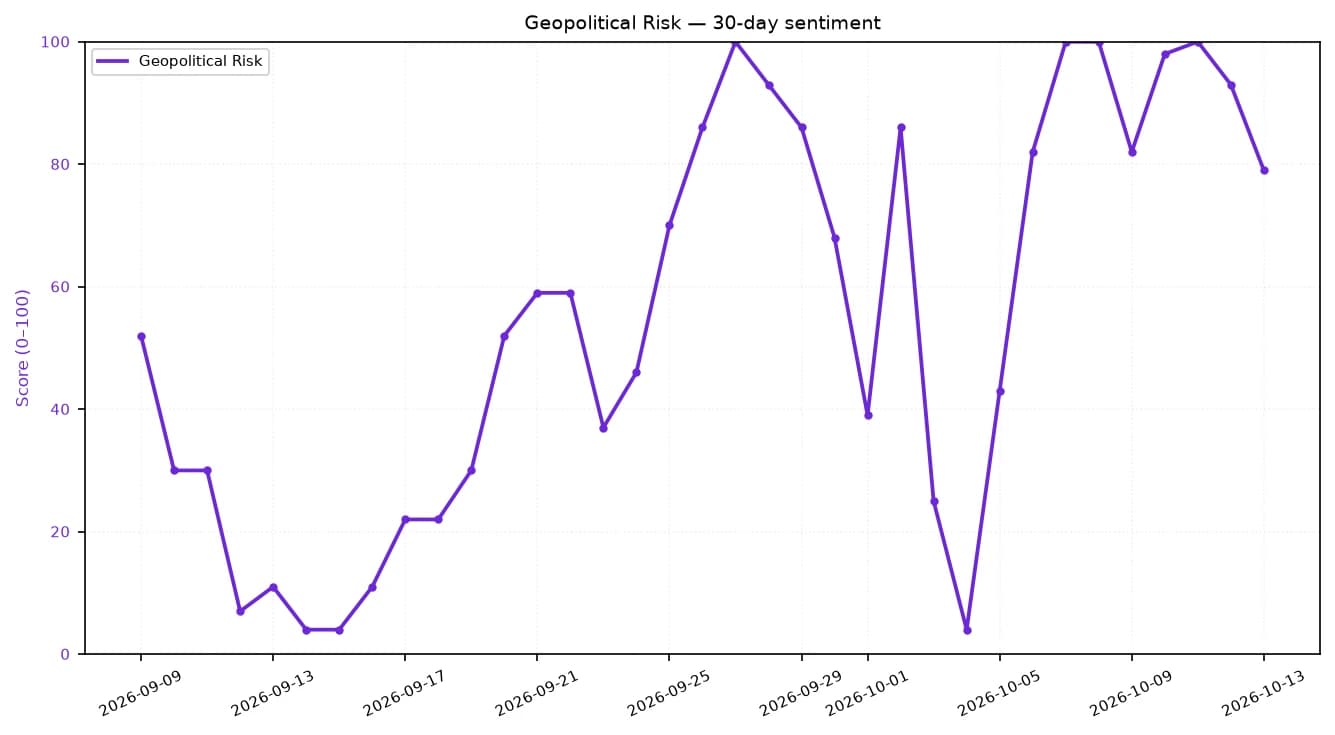
The election also comes as broader global sentiment remains fragile. Adalytica’s Global Stability Sentiment gauge shows “Extreme Greed” at 89, but “awareness” is in “Extreme Fear” at 7, a combination that suggests investors are alert to geopolitical shocks even when risk appetite appears elevated. In that environment, Brazil’s vote has become a proxy for the wider contest between U.S. and Chinese influence in Latin America.
The result will therefore matter well beyond Brasília. It will shape Brazil’s BRICS posture, its leverage in talks with Washington, and the terms on which it sells the commodities that underpin its balance of payments. For markets, the immediate catalyst is election day; the bigger story is whether Brazil keeps acting as a swing state between superpowers or begins to lean decisively toward one.
| Entity | Gains | Losses |
|---|---|---|
| Lula/continuity camp | ▲Strategic autonomy | ▼Faster U.S. alignment |
| Bolsonaro/U.S.-tilt camp | ▲Closer Washington ties | ▼BRICS influence |
| China | ▲Commodity access, trade continuity | ▼Political leverage in Brasília |
| Brazilian exporters | ▲Stable demand from China | ▼Policy-driven trade disruption |