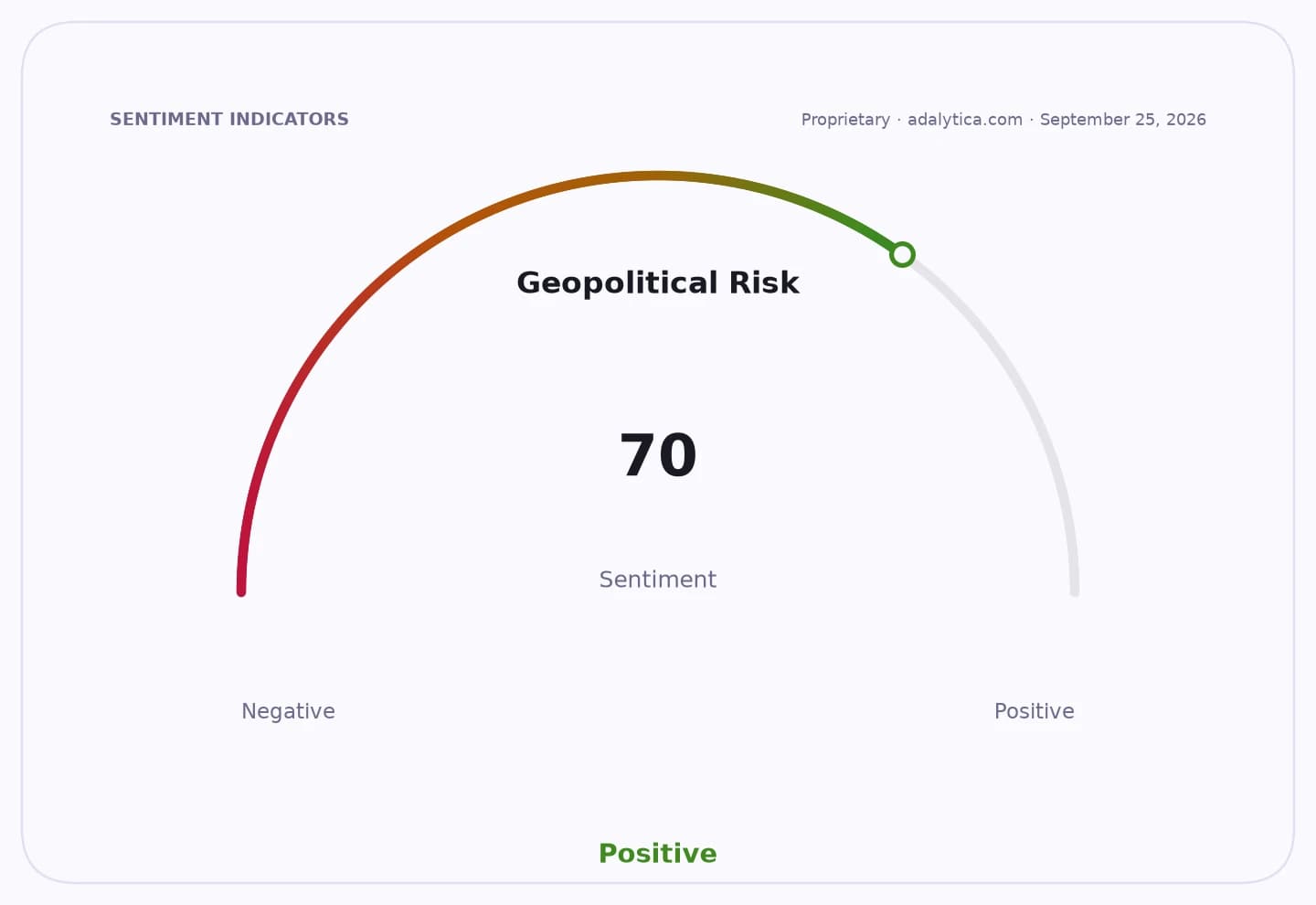
Brazil said Europe is seeking help in dialogue with Russia, underscoring how the Ukraine war remains a live geopolitical risk even as markets try to look through the conflict and focus on rates, growth and commodities.
Brazil Says Europe Seeks Help on Russia Talks
The significance is broader than the diplomacy itself: any fresh effort to open a channel with Moscow could affect energy prices, risk appetite and trade flows at a time when investors are already wrestling with volatile oil and a softer global stability backdrop. Brent’s U.S. peer, West Texas Intermediate, has climbed back toward $87 a barrel in the latest data, while the 10-year Treasury yield sits near 4.7%, a combination that keeps global financing conditions tight and leaves emerging markets sensitive to headlines that can move capital quickly.
Sentiment IndicatorsⓘProprietary · adalytica.com · August 13, 2026
This is a snapshot — live sentiment, awareness and momentum for 130+ markets update continuously in the dashboard.Open AlphaPulse
Brazil’s role matters because it has positioned itself as a potential bridge between the West and Russia, especially as U.S.-led peace efforts have stalled. That gives Brasília diplomatic relevance beyond Latin America, but it also places President Luiz Inácio Lula da Silva in a delicate position: he wants to project influence as a mediator without alienating either Washington or Brussels, both important for Brazil’s trade and investment ties.
For investors, the immediate market read is about whether mediation rhetoric can reduce geopolitical risk premia. A credible path to dialogue would likely support risk assets, pressure safe-haven flows into the dollar and ease some of the upward pressure on oil. In the latest price data, the Brazilian real has firmed to around 5.18 per dollar from 5.11 earlier in the week, while the iShares MSCI Brazil ETF has slipped to $33.77 after peaking above $35 in July, suggesting local assets are still trading more on broader EM sentiment than on any immediate peace dividend.
The technical picture reflects that caution. EWZ is now below both its 50-day and 200-day moving averages, and its relative strength index has fallen into oversold territory, a sign that recent selling has been persistent rather than orderly. The dollar, by contrast, remains supported enough to keep pressure on currencies exposed to external financing and commodity swings, even if proprietary Adalytica signals on U.S. trade conditions have cooled from earlier highs.
Oil is the clearest transmission channel. Any hint that diplomacy could constrain escalation around Russian energy or lower the odds of broader disruption tends to cap crude, while failure reinforces the premium embedded in supply risk. That matters for inflation expectations, rate cuts and the valuation of cyclical and commodity-linked equities across emerging markets, including Brazil.
The bull case for Brazil is that mediator status enhances its geopolitical standing and could eventually support lower risk premiums on local assets if dialogue gains traction. The bear case is that the effort produces little beyond headlines, leaving investors with the same macro mix of high rates, firm oil and a fragile global risk backdrop.
For now, Brazil’s message that Europe is asking for help is less about an imminent breakthrough than about the continued search for a negotiating channel in a war that still has the power to move markets well beyond Ukraine.
| Entity | Gains | Losses |
|---|---|---|
| Brazil | ▲Diplomatic relevance | ▼Risk of overpromising |
| Europe | ▲Potential backchannel | ▼Reliance on intermediaries |
| Russia | ▲More переговоры/leverage | ▼Pressure to compromise |
| EM assets | ▲Lower risk premia | ▼Geopolitical volatility |