Brazil’s political battle is moving beyond speeches and into a more dangerous phase for investors: a second round of lawfare against a center-left government, now overlapping with an increasingly bitter presidential race and a revived right-wing coalition around the Bolsonaro family.
Brazil Politics Adds Risk to Equities

That matters because Brazil’s market story is always bigger than one election cycle. When legal warfare becomes a campaign weapon, it raises the odds of policy paralysis, institutional friction and policy reversals that can affect everything from Petrobras’ strategy to the country’s risk premium. For long-term investors, the issue is not just who wins the presidency. It is whether Brazil can keep institutions stable enough for capital to compound.
Sentiment IndicatorsⓘProprietary · adalytica.com · July 29, 2026
This is a snapshot — live sentiment, awareness and momentum for 130+ markets update continuously in the dashboard.Open AlphaPulse
The latest political escalation came as Argentine President Javier Milei attacked President Luiz Inácio Lula da Silva during a visit to São Paulo and threw his support behind Senator Flávio Bolsonaro, who has been formally nominated as the conservative standard-bearer. The symbolism is powerful. Milei has made himself a regional champion of the anti-left, and his embrace of the Bolsonaro camp helps frame Brazil’s race as part of a broader ideological contest across Latin America.
For Brazil, that is not just theater. It feeds a narrative in which the country’s governing coalition is under siege from both the ballot box and the courtroom. That kind of “full spectrum war” creates uncertainty for investors because it can distort how policy is made, how laws are enforced and how quickly reforms can move through Congress. If every major economic decision becomes a proxy battle in a wider political conflict, the discount rate on Brazilian assets tends to rise.
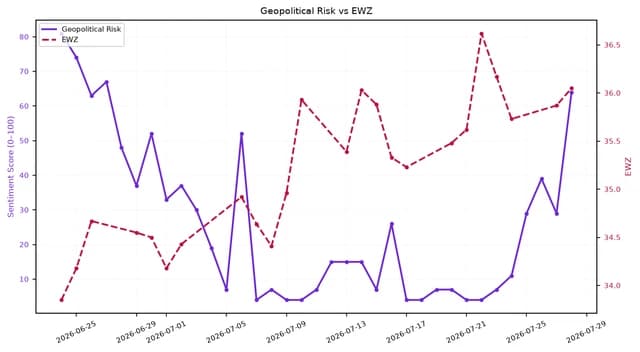
Markets are already telling a story of volatility and resilience. The iShares MSCI Brazil ETF, EWZ, closed at 36.05 on July 28, up from 33.23 in early December and still above its 200-day moving average, which suggests the longer-term trend remains constructive. But the move has not been smooth. EWZ has swung sharply enough to push its relative strength index, a standard technical indicator, into overbought territory at points before cooling again. That is the market’s way of saying investors are interested, but not comfortable.
Petrobras, the giant at the center of Brazil’s equity market, shows the same tension. Shares recently traded at 18.07, well above the 200-day moving average of 15.99, reflecting the market’s faith in the company’s cash-generating power and energy exposure. Yet the stock has also been choppy, and that is no surprise when a state-linked company sits at the intersection of politics, fuel pricing and national strategy. In Brazil, politics does not just influence Petrobras. It can change the investment case.
That is why the legal and electoral conflict matters so much economically. Brazil needs foreign capital, domestic confidence and policy continuity to support growth, the real and its equity market. A more aggressive lawfare environment makes those ingredients harder to sustain. It can keep investors on the sidelines, push up borrowing costs and make companies hesitate on capital spending.
There is also a regional angle. Milei’s backing of the Bolsonaro family signals that Brazil’s election may be watched far beyond its borders as a test of whether the Latin American right can regroup against the left. That could shape trade, diplomacy and investor sentiment across the region. Global stability sentiment, tracked by Adalytica, has improved recently but remains only neutral overall, a reminder that geopolitical risk has not disappeared even if markets have become more selective about where they take it.
For investors, the lesson is not to chase headlines. It is to separate noise from durable opportunity. Brazil remains a large, liquid market with world-class resources, energy assets and consumer demand. But when politics turns into lawfare, the path to returns gets bumpier. That usually argues for patience, diversification and a long horizon rather than trying to predict the next twist in the campaign.
If Lula’s camp can preserve institutional credibility, Brazil could keep attracting capital despite the noise. If the election hardens into a prolonged legitimacy battle, the winners may be the most insulated businesses and the losers may be the broader market multiple. Either way, Brazil is worth watching closely — not as a trading story, but as a test of whether politics can outrun fundamentals for another cycle.
| Entity | Gains | Losses |
|---|---|---|
| Bolsonaro bloc | ▲Political momentum | ▼Legal and reputational risk |
| Lula government | ▲Institutional legitimacy if it holds | ▼Policy room if conflict escalates |
| EWZ investors | ▲Upside from reform hopes | ▼Volatility from political risk |
| Petrobras | ▲Strong cash flow narrative | ▼Political interference risk |