The U.S. tariff move against Brazil is starting to look less like a bilateral dispute and more like a regional macro shock, with the real holding near 5.21 per dollar and the iShares MSCI Brazil ETF, EWZ, slipping to 33.93 as investors price in broader trade and growth damage.
Brazil tariff dispute hits real and EWZ
That matters because Brazil is not just another exporter caught in Washington’s crosshairs. It is the largest economy in Latin America, a key supplier of commodities, industrial goods and food, and a gateway for capital flows across emerging markets. When the U.S. targets Brazil and Brasília responds by opening a reciprocity process, the risk is that supply chains, export pricing and currency stability begin to wobble well beyond both countries.
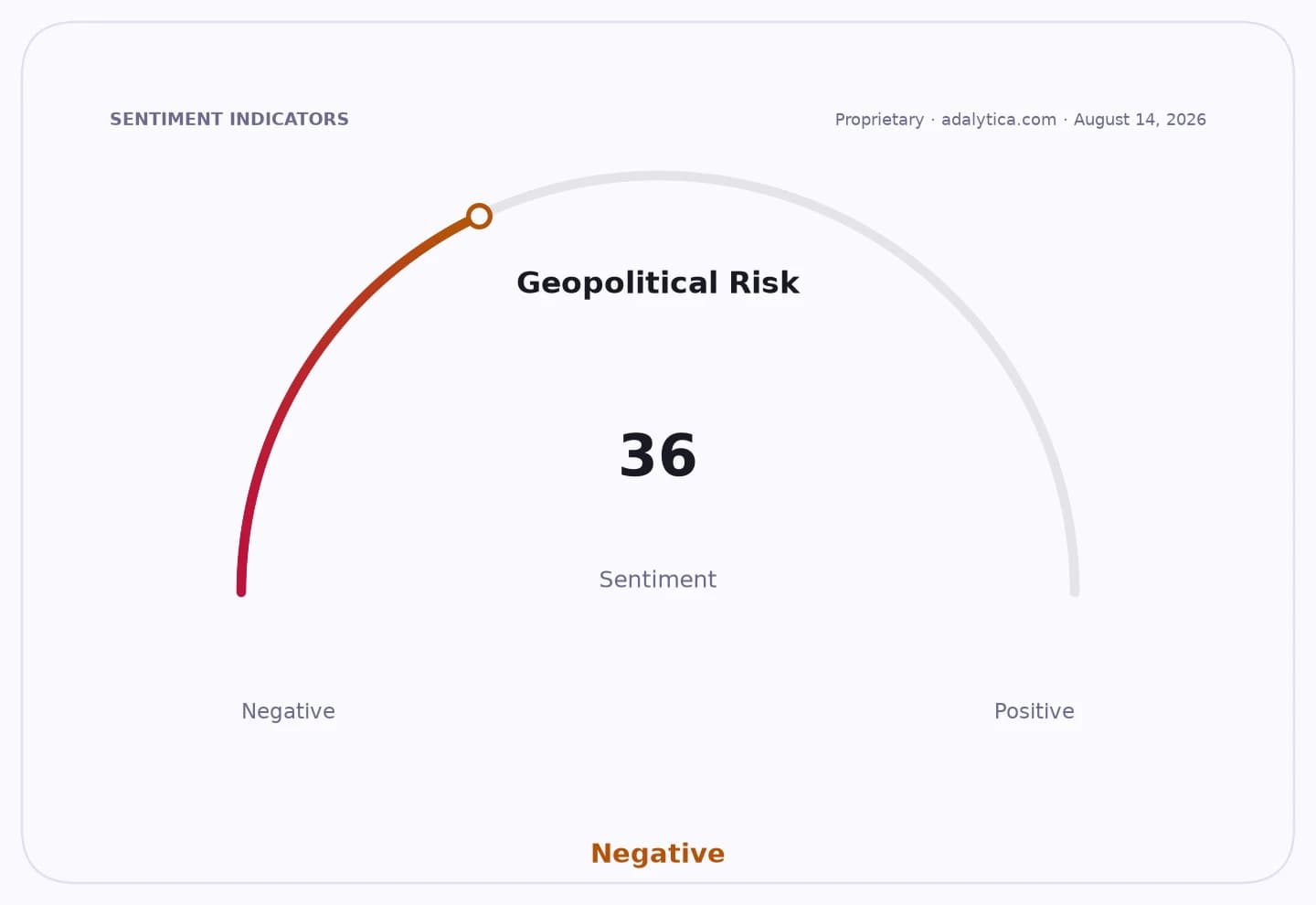
Sentiment IndicatorsⓘProprietary · adalytica.com · August 14, 2026
This is a snapshot — live sentiment, awareness and momentum for 130+ markets update continuously in the dashboard.Open AlphaPulse

The market’s message is already clear. EWZ has broken below its 200-day moving average and is trading under its 50-day moving average, while its RSI reading near 30 points to an oversold tape rather than a clean bargain. That weakness comes even as U.S. Treasury yields hover around 4.65%, a reminder that global capital is still being pulled toward higher-return dollar assets. In this environment, tariff escalation does not stay contained: it feeds a stronger-for-longer dollar, tighter financial conditions for emerging markets and lower appetite for risk assets tied to trade.
Brazil is trying to avoid the worst-case outcome. President Luiz Inácio Lula da Silva’s government has signaled it prefers negotiation over retaliation, a pragmatic stance that reflects the damage a full trade war could inflict on Brazilian exporters, manufacturers and consumers. But the formal reciprocity process keeps countermeasures on the table, and that alone raises the odds of disrupted shipments, higher import costs and softer corporate margins across sectors that depend on cross-border trade.

For investors, the most important implication is not simply that Brazil equities can stay volatile. It is that tariff policy is becoming a valuation variable for the entire emerging-market complex. The real’s firmness around 5.21 has so far prevented outright panic, but the combination of weaker risk sentiment, rising geopolitical awareness and an already fragile EWZ chart argues for caution on broad Brazil exposure until the policy path becomes clearer.
The asymmetric opportunity is in second-order winners. Companies and funds tied to domestic demand, pricing power and non-Brazil supply chains should fare better than exporters exposed to retaliation. Conversely, commodity-linked names, Brazilian industrials and EM trade beta remain vulnerable if Washington and Brasília keep hardening their positions. If negotiations fail, the market may quickly discover that the real cost of tariffs is not the headline duty rate, but the capital that leaves when investors stop believing the dispute will stay bilateral.
| Entity | Gains | Losses |
|---|---|---|
| U.S. dollar | ▲Safe-haven demand | ▼— |
| Brazilian exporters | ▲— | ▼Higher tariff risk |
| EWZ / Brazil equities | ▲— | ▼Valuation compression |
| Domestic Brazil firms | ▲Relative insulation | ▼Less external demand |




