A free pass to escape justice is not just a political charge against the Bolsonaros; it is a warning that Brazil’s policy risk premium is alive and well even as the market rushes back into local assets.
Brazil Tariff Risk Boosts Defensives

The immediate economic issue is not the rhetoric, but the trade shock now hanging over Latin America’s biggest economy. Washington’s 25% tariff on Brazilian imports threatens exporters, investment plans and already-fragile confidence, while Brasília’s talk of reciprocity raises the odds of a wider tit-for-tat that could hit growth and keep the real under pressure. For investors, the key question is whether this is a temporary political flare-up or the start of a longer period in which Brazil’s economy is priced less like a reform story and more like a sovereignty contest.
Sentiment IndicatorsⓘProprietary · adalytica.com · July 21, 2026
This is a snapshot — live sentiment, awareness and momentum for 130+ markets update continuously in the dashboard.Open AlphaPulse
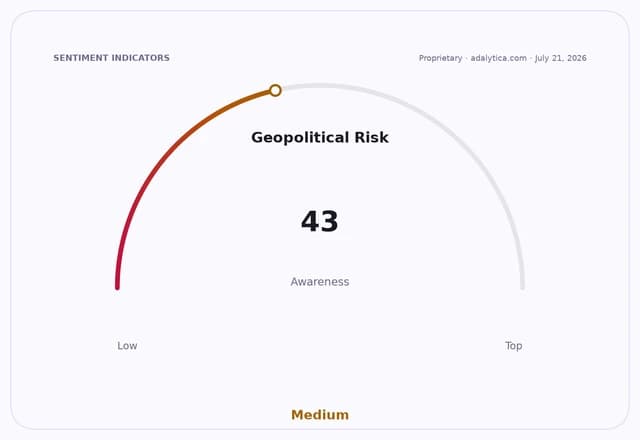
That is why the political fight around Jair Bolsonaro and his allies matters beyond the courthouse and the campaign trail. When Congressman Lindbergh Uczai calls a supposed escape from justice a “betrayal of Brazil,” he is tapping into a broader narrative now shaping investor sentiment: the country is entering a phase in which trade, legal exposure and electoral positioning are becoming intertwined. The Bolsonaro camp’s response to the tariff dispute has only sharpened that divide, turning an external shock into a domestic stress test for institutions, rhetoric and capital flows.
Markets are already sending a mixed message. The iShares MSCI Brazil ETF, EWZ, has climbed to 35.62 from 33.23 in early December, and remains above both its 50-day and 200-day moving averages, with the 50-day now around 35.21 and the 200-day near 34.59. That says investors are still willing to own Brazil. But the recent volatility shows how quickly sentiment can flip: EWZ sank to 34.73 in March before rebounding, and the latest RSI reading near 60 points to a market that is no longer oversold, but not yet decisively euphoric either. In other words, Brazil is being bought, but not unconditionally.
The bigger opportunity, in our view, is that the market may still be underestimating the second-order winners from this kind of geopolitical and political friction. A weaker confidence backdrop can support exporters with hard-currency revenue, defensive domestic franchises and companies tied to food security, logistics and energy resilience. Petrobras, with its shares at 18.54, remains a classic geopolitical hedge: its stock has recovered sharply from the spring pullback and is now trading well above its 200-day average, with momentum improving as oil-linked cash flows and Brazil’s strategic role in global energy stay intact. BRF, at 16.05, is more nuanced, but it sits at the intersection of food inflation, export demand and currency translation — the kind of business that can benefit when global buyers look for supply outside politically exposed trade corridors.
By contrast, the losers are easier to spot. Tariff-sensitive exporters, policy-dependent cyclical names and investors who assumed Brazil’s political noise was fading now face a harsher reality. The Brazilian market has been rewarded for discounting chaos before, but this time the threat comes from both Washington and Brasília. If reciprocity measures escalate, companies with thin margins and little pricing power will feel it first, and the broader equity premium could widen even if headline indexes hold up.
That is the narrative the market is missing: this is not simply a tariff dispute or a family scandal. It is a reminder that Brazil’s investable story remains hostage to politics, legal risk and external pressure, and that those risks can create mispricings in both direction. The right posture is not to abandon Brazil, but to own the names that can thrive when policy uncertainty rises and global supply chains reprice sovereignty. The next move belongs to investors who can separate political theater from structural winners before the consensus catches up.
| Entity | Gains | Losses |
|---|---|---|
| Petrobras (PBR) | ▲energy hedge appeal | ▼policy uncertainty |
| BRF (BRF) | ▲export diversification | ▼tariff-linked volatility |
| EWZ holders in defensives | ▲relative resilience | ▼broad Brazil premium |
| Tariff-hit exporters | ▲ | ▼margin pressure |




