The United States’ 25% tariff on select Brazilian imports is more than a bilateral trade spat: it is a reminder that tariffs are once again being used as a policy weapon, and investors should expect the fallout to show up in currencies, exporters, and emerging-market risk appetites well beyond Brazil.
Brazil Tariffs Stir Volatility in Emerging Markets
For the economy, the immediate issue is not just the levy itself but the message it sends. Washington says the move responds to unfair trade practices, while Brasília is preparing aid for affected companies and weighing reciprocity measures. That raises the odds of a tit-for-tat cycle that can disrupt supply chains, squeeze margins, and slow trade flows at the margin. Even when tariffs are narrow, they tend to ripple through pricing, purchasing decisions, and business confidence.
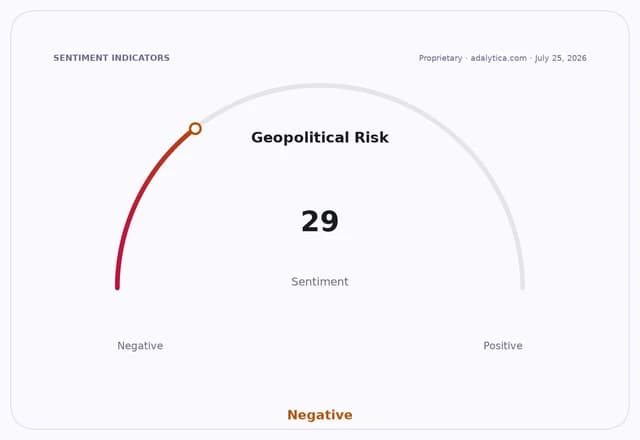
Sentiment IndicatorsⓘProprietary · adalytica.com · July 25, 2026
This is a snapshot — live sentiment, awareness and momentum for 130+ markets update continuously in the dashboard.Open AlphaPulse
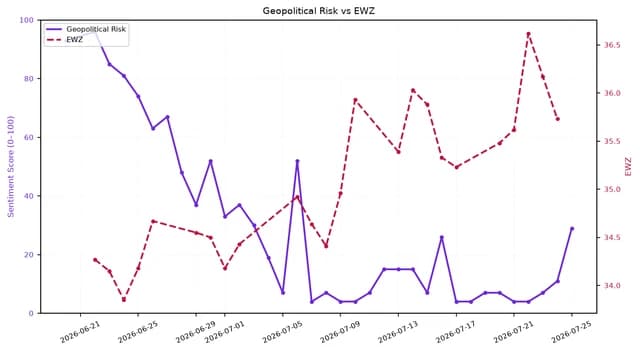
Markets have already been treating Brazil as a more volatile trade than a few weeks ago. EWZ, the main U.S.-listed Brazil ETF, had climbed sharply into early February before giving up ground in March and May, and its recent rebound has left it close to its 50-day moving average again. That kind of whipsaw is exactly what investors see when trade policy becomes a moving target: sentiment can turn quickly, even when the long-term investment case for a country remains intact.
The bigger investor takeaway is that tariffs rarely stay isolated. Brazil matters as a supplier, a customer, and a bellwether for commodity-linked emerging markets. If retaliation broadens, exporters on both sides can take a hit, while importers and consumers may face higher costs. If negotiations follow, the shock may fade, but not before it reminds investors why diversification matters. A portfolio built to hold through policy swings is better positioned than one trying to trade every headline.
There is also a macro backdrop to watch. Adalytica’s Global Stability Sentiment gauge has fallen into “Fear,” while the dollar trade signal also sits in “Fear,” suggesting investors are already more cautious about cross-border policy risk. In that kind of environment, tariff news can reinforce a shift toward defensive positioning, even if the economic damage from the duty itself remains manageable.
For long-term investors, the right response is usually not to react to one tariff announcement, but to ask which businesses can absorb higher costs, pass them on, or keep growing despite them. Companies with pricing power, low leverage, and durable demand tend to handle trade shocks better than cyclical names tied directly to exports. Brazil’s response will matter, but so will the broader lesson: policy risk is now part of the investing landscape, and patience still beats prediction.
| Entity | Gains | Losses |
|---|---|---|
| U.S. protected producers | ▲Less import competition | ▼Higher input costs |
| Brazilian exporters | ▲Temporary leverage in talks | ▼Tariff-hit sales |
| Brazilian government | ▲Bargaining chip in negotiations | ▼Pressure to spend on aid |
| Long-term diversified investors | ▲Better entry points after volatility | ▼Short-term headline risk |




