Brazil’s refusal to grant visas to two US officials trying to meet with electoral authorities is the latest sign the relationship between Brasília and Washington is fraying, raising the risk of wider policy friction that could spill into trade, investment and currency markets.
Brazil-US Visa Row Raises Policy Friction Risk
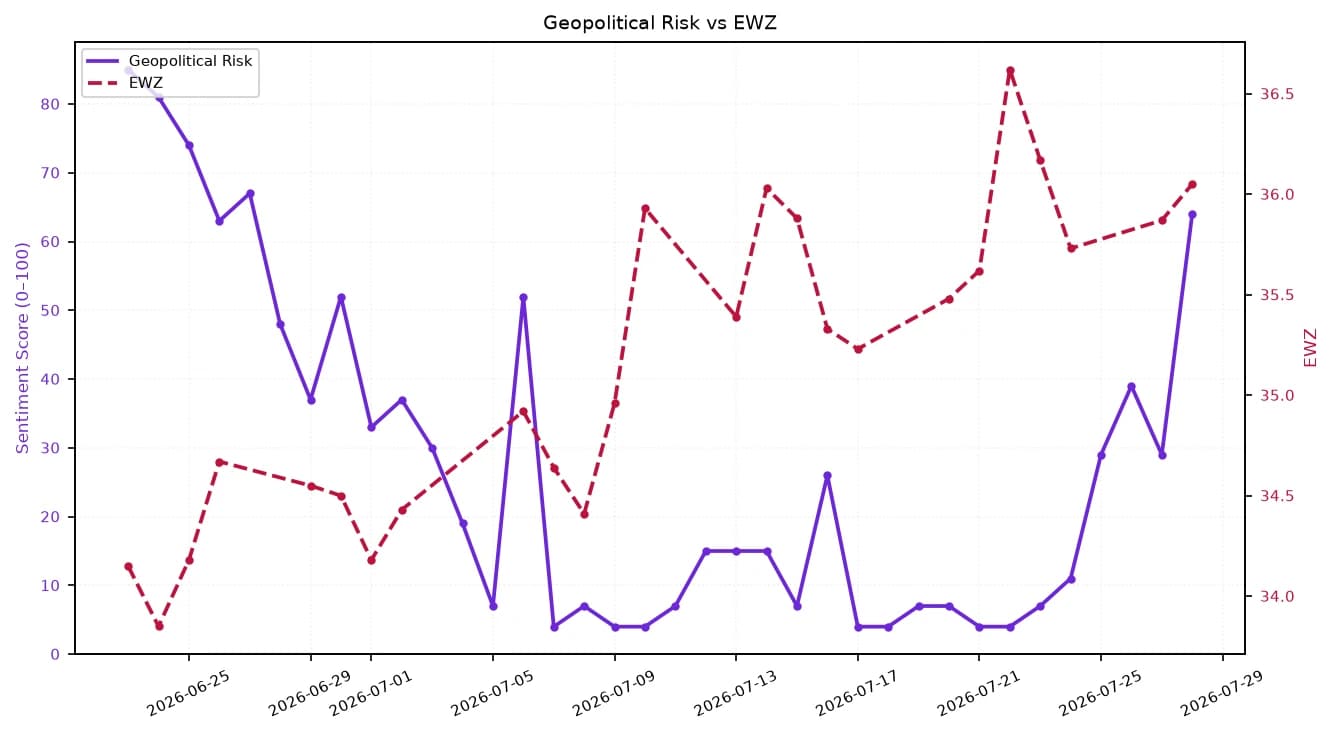
The dispute matters economically because Brazil is Latin America’s largest economy and a key destination for US capital, commodities trade and financial flows. Any sustained deterioration in bilateral ties can complicate cooperation on elections, regulation and regional security, while also feeding uncertainty around tariffs, sanctions risk and cross-border business confidence.
Sentiment IndicatorsⓘProprietary · adalytica.com · July 28, 2026
This is a snapshot — live sentiment, awareness and momentum for 130+ markets update continuously in the dashboard.Open AlphaPulse
The US called the allegations around the visit baseless, while Brazil’s Foreign Ministry signaled clear irritation, underscoring how quickly a diplomatic issue can become a market issue. Investors tend to punish uncertainty first: when relations sour between major economies, the result is often a weaker risk appetite for local assets, higher volatility in the currency and a heavier discount on banks, exporters and domestically exposed stocks.
That tension is showing up in market behavior. The iShares MSCI Brazil ETF, EWZ, has rebounded to $36.05 after a sharp swing in recent weeks, but technical indicators suggest the move is still fragile: the fund is only modestly above its 50-day moving average at $35.06, and its RSI at 63.4 points to improving momentum without yet indicating panic. Banco Bradesco preferred shares, BBD, are trading at $3.62, also above both their 50-day and 200-day moving averages, showing the market is not pricing in immediate financial stress, even as geopolitical noise rises.
The broader backdrop is one of heightened sensitivity. Adalytica’s Global Stability Sentiment snapshot is neutral at 64, but awareness sits in fear territory at 18, a sign investors are watching geopolitical shocks more closely. Adalytica’s US dollar trade signals also show extreme fear at 1, reflecting how currency markets are braced for instability even as broader risk sentiment remains mixed.
For now, the immediate economic damage is limited, but the political signal is not. If the visa dispute widens into a broader diplomatic confrontation, investors will be looking for signs of retaliation, shifts in US policy toward Brazil, or spillover into trade and regulatory cooperation.
| Entity | Gains | Losses |
|---|---|---|
| Brazil hawks | ▲Political leverage | ▼Diplomatic trust |
| US officials | ▲None | ▼Access to electoral talks |
| EWZ bulls | ▲Short-term rebound | ▼Higher volatility |
| Brazil-focused multinationals | ▲Stable relations | ▼Policy uncertainty |




