Brent crude slipped back below $90 a barrel even as the Middle East conflict widened, after Saudi Arabia proposed a naval security alliance that helped calm fears of a wider disruption to oil shipments.
Brent crude falls below $90 after Saudi naval proposal

The move matters because the oil market is showing that geopolitics alone is not enough to sustain a lasting war premium unless traders believe supply routes are actually at risk. That is a meaningful shift for an economy still sensitive to energy costs: every sustained $10 move in crude ripples through inflation, freight, airline fuel bills and central-bank policy expectations.
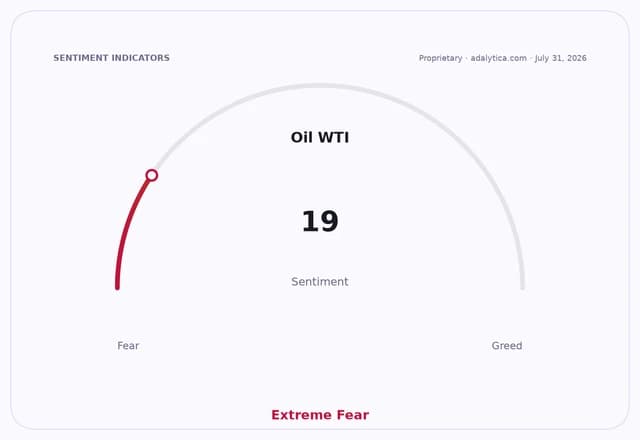
Sentiment IndicatorsⓘProprietary · adalytica.com · July 31, 2026
This is a snapshot — live sentiment, awareness and momentum for 130+ markets update continuously in the dashboard.Open AlphaPulse
The proposed Saudi-led maritime coalition appears to have reassured traders that the region’s key export lanes may remain protected, even as military escalation continues on land and at sea. Brent’s retreat below the psychologically important $90 level came despite fresh headlines that would normally keep risk bids in the market, underscoring how quickly the market is recalibrating between headline risk and actual supply disruption.
The price action was echoed in oil-linked exchange-traded products. BNO, the Brent ETF, closed at $49.94 on July 31 after touching $50.75 intraday, while USO, which tracks U.S. crude exposure, finished at $128.40. Both remain well above their 200-day moving averages, reflecting the broader oil rally that has already been priced in this year, but the latest fade suggests traders are becoming more selective about paying up for conflict risk.
Technical readings point to a market that is still firm but less euphoric than in the earlier spike. USO’s relative strength index has eased to 59.4 from overbought levels in March and May, while BNO’s RSI was 59.6 on July 31 after peaking above 90 earlier in the year. That leaves room for another leg higher if shipping is actually disrupted, but also signals that the market is no longer in panic mode.
The macro backdrop makes the stakes higher. U.S. 10-year Treasury yields have climbed back to about 4.67%, leaving policymakers less room to look through an energy shock if crude were to spike again. A sustained rise in oil would tighten financial conditions, pressure consumer spending and revive concerns about headline inflation just as investors have been trying to assess how much of the current disinflation trend is durable.
For producers, the retreat below $90 is a reminder that supply fears can be fleeting unless matched by physical bottlenecks. For airlines, refiners and other fuel-intensive users, the Saudi naval proposal is a short-term relief valve. For investors, the key question is whether the market is discounting a real de-escalation in shipping risk or simply pausing before the next escalation. If tanker routes stay open, crude may struggle to hold the premium. If they do not, the move back below $90 could prove brief.
| Entity | Gains | Losses |
|---|---|---|
| Oil importers | ▲Lower fuel costs | ▼Less hedge value from crude spikes |
| Airlines and transport firms | ▲Relief on input costs | ▼Vulnerable if shipping risk returns |
| Oil producers | ▲Higher prices when risk rises | ▼Softer prices if premium fades |
| Consumers and central banks | ▲Less inflation pressure | ▼Renewed inflation risk if escalation worsens |