Oil prices slumped more than 13% for the week, pushing Brent crude back below $100 a barrel and underscoring how quickly the market has shifted from geopolitical risk premium to concern about looser supply and softer demand.
Brent crude falls below $100 after weekly drop

Brent settled at $98.32 a barrel at the close of trade on Nov. 6, while U.S. crude finished at $90.83, leaving both benchmarks on track for one of their sharpest weekly declines in months. Brent’s January 2027 contract fell 13.32% over the week and WTI’s December 2026 contract dropped 12.76%, a move that erased part of October’s strong run and took Brent back under a psychologically important level watched closely by traders, producers and fuel buyers alike.
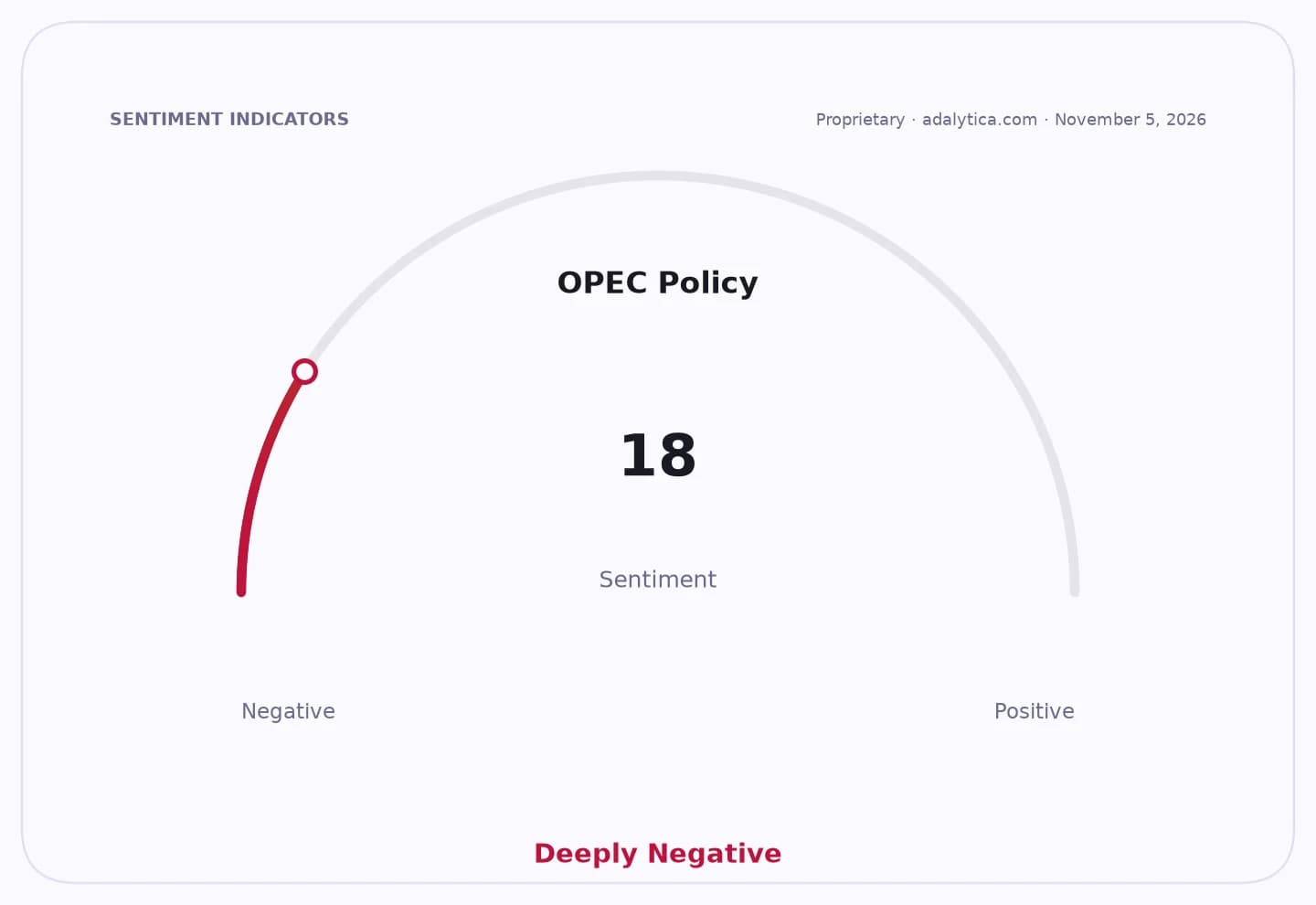
Sentiment Indicators

The scale of the decline matters because crude prices remain one of the cleanest real-time gauges of global growth, inflation and capital spending across the energy complex. A break below $100 for Brent does not just reduce headline fuel costs; it also squeezes upstream producers, trims cash flow expectations and lowers the odds that energy will continue to act as an inflation buffer for central banks.
The selloff reflected a market increasingly focused on the balance between supply and demand. Traders are seeing signs that supply is improving even as consumption has not recovered enough to absorb it, a combination that raises the risk of surplus inventories into year-end. Narrower prompt differentials for some Middle Eastern grades also point to easing tightness in physical markets, even as high shipping costs and intermittent delivery risks keep regional price spreads elevated.
Oil WTI
The technical picture also weakened. Brent’s drop left it well below its recent highs and, on standard market indicators, closer to oversold territory after a rapid reversal from October’s elevated levels. U.S. crude has followed the same pattern, with the front-month contract retreating from above $100 to the high $80s, showing how quickly bullish momentum can evaporate when macro sentiment turns.
For investors, the move cuts both ways. Refiners and fuel consumers benefit from cheaper feedstock, while oil producers, offshore service firms and shale operators face lower realized prices and potentially tighter capital budgets if the weakness persists. That is particularly relevant for companies whose earnings are tightly linked to Brent and WTI, including large international majors and U.S. shale names that have recently been selling at a much more favorable price backdrop.
The week’s losses also feed into broader market narratives. Lower oil prices can ease inflation pressure and support rate-sensitive assets, but they can also signal weaker demand expectations or a supply response that outpaces consumption. With benchmark crude now testing support rather than extending a geopolitical rally, the next move will depend on whether incoming data confirm a looser market or whether production discipline and logistics constraints put a floor under prices.
For now, the market is telling a simple story: the premium for disruption has faded, and crude is trading more on the prospect of abundant barrels than on the fear of shortages. If that balance holds, Brent may struggle to reclaim $100 quickly; if it does not, volatility is likely to remain elevated into the next round of inventory and supply data.
| Entity | Gains | Losses |
|---|---|---|
| Refiners / fuel consumers | ▲Lower input costs | ▼Less price protection |
| Oil producers | ▲Higher if prices rebound | ▼Lower realized crude prices |
| Importing economies | ▲Easier inflation pressure | ▼Less export revenue support |
| Short-term oil bulls | ▲Volatility opportunities | ▼Breakdown below key support |