High freight rates are adding upside pressure to Brent crude forecasts, with Goldman Sachs saying the cost of moving oil has stayed unusually high enough to force a rethink of price assumptions.
Brent Forecasts Rise on High Oil Freight Costs
That matters because freight is no longer just a logistics line item. When tanker costs remain elevated, they tighten effective supply, raise landed crude prices and can amplify regional dislocations in a market already sensitive to geopolitical shocks in the Middle East.
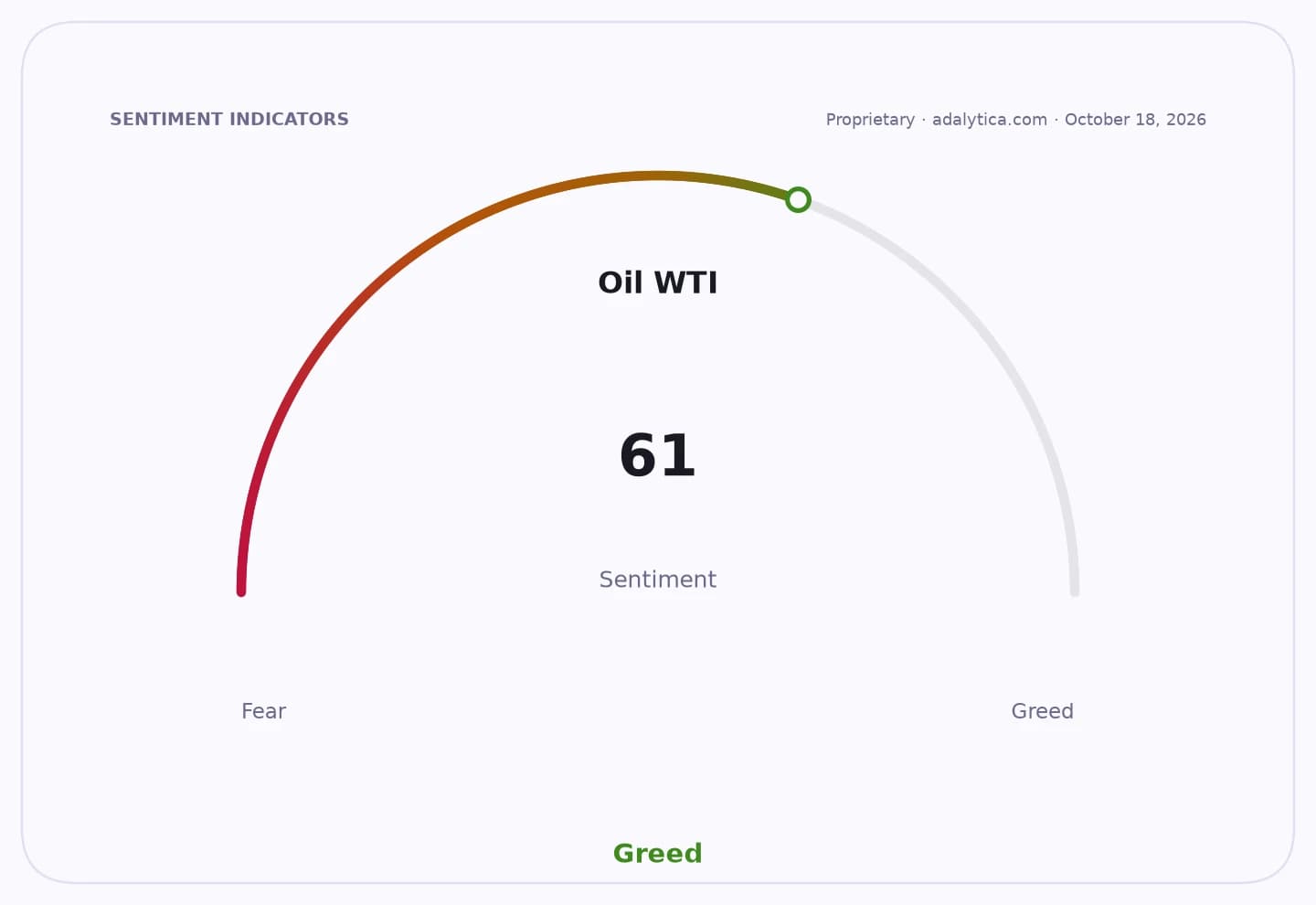
Sentiment IndicatorsⓘProprietary · adalytica.com · October 26, 2026
This is a snapshot — live sentiment, awareness and momentum for 130+ markets update continuously in the dashboard.Open AlphaPulse
Brent has been volatile in recent weeks, recently surging toward $115 a barrel before easing from six-month highs as traders priced in supply risks tied to attacks on Saudi Arabian oil infrastructure and broader conflict in the region. Goldman’s call suggests those risks are being reinforced by shipping economics, not just by the threat of barrels being taken offline.
The move also lands in a market that remains stretched. U.S. crude benchmarks have climbed sharply from midyear levels, while energy equities have outperformed, with the Energy Select Sector SPDR Fund and oil-linked ETFs trading near recent highs on sustained concern over supply security.
Technical readings point to a market that is still extended rather than exhausted. BNO, the Brent ETF, closed at $70.11 on Oct. 26, well above its 50-day moving average of $60.04 and 200-day average of $48.98, while U.S.-focused USO finished at $166.19, also far above both moving averages and with an RSI reading of 81.4, a sign of overbought conditions by standard technical measures.
Adalytica’s Oil WTI trade signals also showed extreme fear in the oil market, even as awareness remained high, underscoring how investors are still reacting to supply disruption risk more than to demand weakness.
For investors, the immediate implication is that commodity forecasters may need to keep nudging price targets higher if freight stays tight, a development that would support exploration and production stocks, tanker-linked names and inflation-sensitive assets while squeezing refiners, airlines and other fuel users.
The next catalyst is whether freight costs and Middle East tensions ease enough to unwind the risk premium, or whether shipping bottlenecks keep Brent pinned near the top of recent trading ranges.
| Entity | Gains | Losses |
|---|---|---|
| Oil producers | ▲Higher realized prices | ▼Less upside if freight normalizes |
| Tanker owners | ▲Stronger shipping rates | ▼Pressure if crude flows slow |
| Brent bulls | ▲Higher forecast revisions | ▼Volatility if geopolitics cools |
| Refiners and fuel users | ▲None | ▼Higher input costs |