Brent’s retreat from above $100 a barrel is hitting oil shares, and the move matters because it tests how much of the sector’s recent rally was built on a geopolitical shock rather than durable earnings momentum.
Brent Pullback Tests Oil-Stock Rally

After weeks of gains tied to Iran-related supply fears, crude is showing signs of fatigue: WTI was forecast around $84.98 a barrel for July 21 and Brent around $86.56, levels that are far below the triple-digit spike that had driven the latest leg higher. The pullback has cooled the immediate inflationary pressure from fuel costs, but it also removes a key support for integrated oil names that had been bid up on the assumption that tighter supply would translate into fatter margins.

That shift is already visible in the market. TotalEnergies has fallen back into focus on Paris, while Exxon Mobil and Chevron remain close to the top of their recent ranges but are showing the kind of overbought technical profiles that often accompany a crowded trade. Exxon’s RSI is above 84 and Chevron’s above 92, readings that suggest momentum has become stretched even as both stocks trade well above their 50-day and 200-day moving averages. TotalEnergies has also rebounded sharply, but its latest RSI near 80 and a MACD that has only recently turned positive point to a market still sensitive to any further weakness in crude.
The broader setup is important for European energy investors because oil majors have been acting as the market’s cleanest hedge against geopolitical risk. A rapid surge in Brent can lift upstream cash flow expectations, support buybacks and dividend cover, and draw capital into the sector at the expense of rate-sensitive or cyclical industries. A slowdown does the opposite: it raises questions about how much of the sector’s earnings power is sustainable if prices normalize while global growth remains uneven and the 10-year U.S. Treasury yield holds around 4.7%.
DCOILWTICO vs DCOILBRENTEU — macro contextadalytica.com
Explore this data interactively — full history, time series and cross-market comparisons.Open AlphaPulse
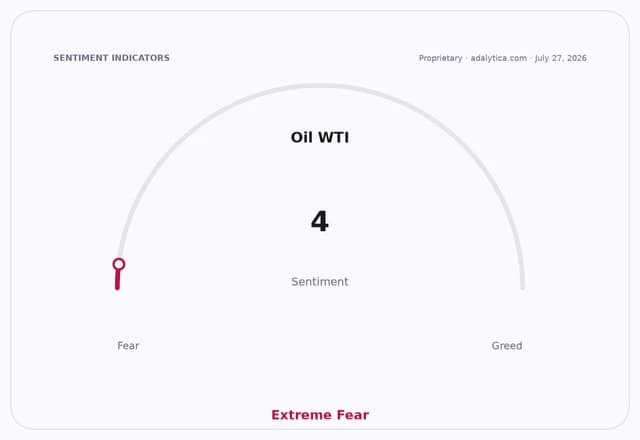
That is why the move has implications beyond the crude tape. Lower oil prices ease pressure on consumers and could reduce the inflation impulse that has kept central banks cautious, but they also threaten the earnings revisions that have helped energy shares outperform in recent months. Adalytica’s oil trade signals show “Extreme Fear” even as market awareness remains “Extreme Greed,” a combination that often marks a market where positioning is still elevated but conviction is deteriorating.
For Eni, the Italian market’s next large-cap energy name, the message is straightforward: the stock’s direction will likely follow Brent more closely than the broader equity market in the near term. If the crude pullback deepens, investors are likely to rotate away from the strongest oil beta names and toward companies with stronger downstream or gas exposure, or simply de-risk after the sector’s run-up. If geopolitical tensions intensify again and Brent snaps back through $100, the trade could reverse just as quickly.
For now, the key investor takeaway is that oil equities are no longer being priced only on supply risk, but on how long that risk can sustain margins. The next catalyst is whether crude stabilizes in the mid-$80s or resumes its climb; that will determine whether the recent rally in oil stocks is a pause for breath or the start of a broader unwinding.
| Entity | Gains | Losses |
|---|---|---|
| Oil consumers | ▲Lower fuel costs | ▼Less hedge value |
| Brent/WTI bulls | ▲Rebound risk persists | ▼Momentum fades |
| Exxon Mobil/Chevron | ▲Still high cash flow | ▼Overbought valuations |
| Eni/European oil shares | ▲Support if crude firms | ▼Pressure if Brent eases |