Canada’s push to welcome more Chinese electric vehicles is colliding with a hard national-security warning that could shape the next phase of EV trade, regulation and investor sentiment.
Canada EV policy and Chinese data security concerns

Former CSIS chief David Vigneault’s message was blunt: in Chinese-made EVs, “all of your data” — where you go, who you meet, what you say near the car — can be acquired by China. That matters because EVs are no longer just vehicles; they are rolling software platforms packed with cameras, microphones, sensors and connectivity, turning privacy and espionage risk into a commercial issue for automakers and governments alike.
Sentiment IndicatorsⓘProprietary · adalytica.com · October 18, 2026
This is a snapshot — live sentiment, awareness and momentum for 130+ markets update continuously in the dashboard.Open AlphaPulse
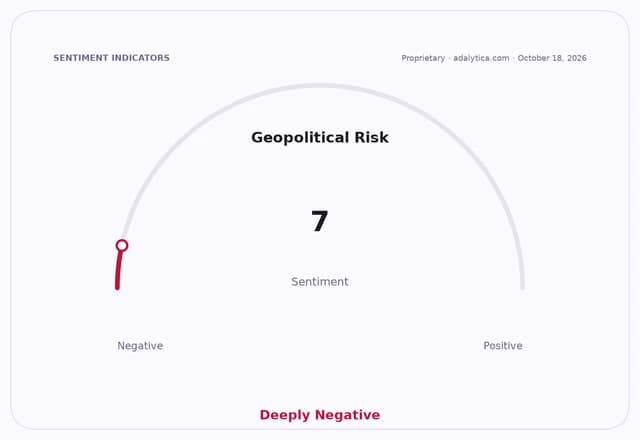
The warning lands at an awkward moment for Ottawa. Prime Minister Mark Carney has been trying to draw Chinese joint-venture EV investment into Canada as U.S. automakers pull back, while also easing tariffs on nearly 50,000 Chinese EVs a year. At the same time, Geely Auto has said it will enter the Canadian market next year. That creates a clear policy trade-off: lower costs and faster EV adoption versus higher scrutiny over data sovereignty, cybersecurity and supply-chain dependence.
For investors, the message is bigger than one interview. It reinforces the geopolitical discount hanging over Chinese EV makers just as their stocks have already been under pressure. NIO trades around $3.43, well below its 200-day moving average of $4.97, with an RSI reading of 43.7 and a bearish MACD setup that points to a market still skeptical of a sustained rebound. Xpeng is at $9.23, also below its 200-day average of $15.03, while Li Auto sits near $11.34 versus a 200-day average of $15.10. Those gaps suggest investors are not pricing in much margin for political or regulatory setbacks.
The deeper economic issue is that EVs are becoming part of the data infrastructure of the modern state. If Western governments conclude Chinese cars can serve as intelligence-collection devices, they may move from tariffs to restrictions on fleet use, data localization, procurement bans or tougher certification rules. That would not only hurt Chinese brands trying to expand abroad, it could also slow the internationalization of China’s auto sector and raise compliance costs across the industry.
The market underestimates how quickly security concerns can become demand concerns. Consumers may not follow every diplomatic flare-up, but fleets, regulators and insurers do — and they are often the first to respond when software-defined vehicles become a national-security question. That is why the real winners here are not necessarily the headline EV brands, but the companies that sell cybersecurity, secure communications, sensor validation and data-sovereignty tools.
My view: this is one of those moments when geopolitics creates a second-order investment opportunity. If Canada and other Western countries harden their stance on Chinese EV data practices, the beneficiaries are the domestic compliance stack, cybersecurity vendors and non-Chinese automakers positioned as the “safer” alternative. The losers are Chinese EV exporters that need trust, not just low prices, to win market share.
| Entity | Gains | Losses |
|---|---|---|
| Canadian cybersecurity vendors | ▲Higher demand | ▼— |
| Non-Chinese automakers | ▲“Safer” brand appeal | ▼— |
| NIO / Xpeng / Li Auto | ▲— | ▼Regulatory and trust discount |
| Canadian consumers / fleets | ▲More scrutiny, better safeguards | ▼Lower choice, higher compliance costs |