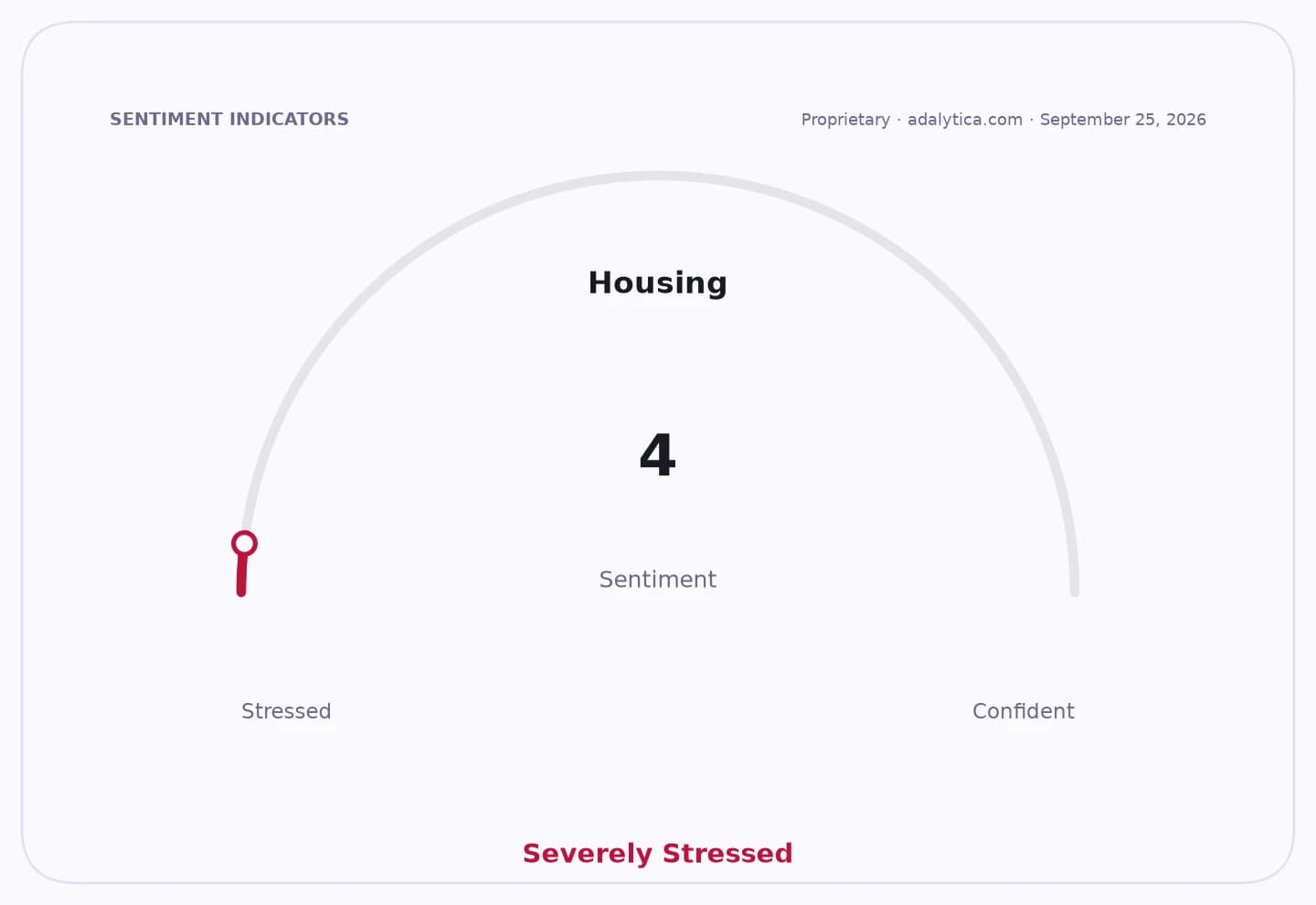
Canada’s housing market is sending mixed signals, with higher borrowing costs still pressuring affordability even as investor appetite for homebuilding and residential real estate stocks has surged to extreme levels.
Canada Housing Shows Mixed Signals
That split matters because housing is one of the economy’s most interest-rate-sensitive sectors, and in Canada it feeds directly into consumer spending, construction activity and the outlook for inflation. With the 10-year U.S. Treasury yield at 4.608% in the latest forecast and Canada’s labour market still relatively firm, the market is pricing a backdrop that is not yet friendly to a broad housing rebound.
Sentiment IndicatorsⓘProprietary · adalytica.com · July 16, 2026
This is a snapshot — live sentiment, awareness and momentum for 130+ markets update continuously in the dashboard.Open AlphaPulse
The clearest sign of strain is in the macro data. U.S. housing starts fell to 1.177 million in May from 1.392 million in April, underscoring how quickly elevated financing costs can cool new construction. At the same time, the U.S. unemployment rate is forecast at 4.18% for July, suggesting the labour market is softening but not enough to force an abrupt easing in rates. For Canadian borrowers, that means mortgage costs can stay restrictive even if growth slows.
Investors, however, are already leaning hard into a rebound. Adalytica’s Housing Fear & Greed Index for XHB, the U.S. homebuilders ETF used as a proxy for housing sentiment, sits at 100, labeled “Extreme Greed,” after jumping 85 points in seven days and 77 points over 30 days. A separate Adalytica housing and rent inflation sentiment gauge is at 15, or “Extreme Fear,” showing how volatile expectations remain around rents, affordability and policy.
That divergence is showing up in shares of residential real estate names. Apartment REIT Mid-America Apartment Communities, or MAA, closed at $134.93 on July 16, above its 50-day moving average of $132.44 and its 200-day moving average of $129.07, after trading as low as $121.94 in late October. Leggett & Platt, or LEG, has also rebounded to $11.25 from a March low of $9.50, while Equity LifeStyle Properties, or ELS, is back near $65.90 after recovering from a May trough near $60.58.
For investors, the message is that housing is no longer a uniform trade. Apartment owners, land-heavy builders and preconstruction condo developers face very different risks depending on rates, supply and regional demand. In Canada, that is especially relevant for pockets where preconstruction activity is sensitive to buyer financing, investor demand and resale-market confidence.
The next catalyst is the policy path for rates and any further evidence on housing starts, employment and inflation. Until borrowing costs ease more decisively, the Canadian housing market is likely to remain a story of selective strength rather than a broad-based recovery.
| Entity | Gains | Losses |
|---|---|---|
| Homebuilders ETF buyers | ▲Momentum from extreme-greed positioning | ▼Risk of crowded trade reversal |
| Existing homeowners | ▲Support from resilient asset values | ▼Affordability remains stretched for buyers |
| Apartment REITs | ▲Stable demand for rentals | ▼Rate-sensitive valuations |
| Preconstruction condo buyers | ▲Potential bargain hunting if prices soften | ▼Financing and completion risk |