Prime Minister Mark Carney’s plan to sign a trade arrangement with Taiwan soon matters less as a diplomatic gesture than as a signal that Canada wants a bigger role in the global semiconductor supply chain at a time of escalating US-China technology friction.
Canada-Taiwan Trade Plan and Chip Supply Chain
A deal with Taiwan would give Ottawa a way to deepen commercial ties with one of the world’s most critical chip economies without waiting for broader trade normalization in Asia. For Canada, that has economic value well beyond symbolism: Taiwan sits at the center of advanced chip production, and any framework that improves access, investment flows or regulatory certainty could help Canadian firms position themselves in a supply chain that still underpins autos, telecoms, AI hardware and industrial equipment.
Sentiment Indicators
The timing also matters. The broader backdrop is a fragile global trade environment in which governments are trying to balance open commerce against national-security concerns around advanced semiconductors. China continues to press for regional free trade, while US-China relations remain strained by chip restrictions and technology disputes. In that environment, a Canada-Taiwan arrangement would be read in markets as another sign that middle powers are hedging against supply-chain concentration and geopolitical risk rather than relying on a single trade bloc.
For investors, the most direct market implication is in semiconductor exposure. Taiwan Semiconductor Manufacturing Co., the dominant foundry in advanced chips, has seen its shares fall to about 359.76 from a recent peak near 476.29, even though its 200-day moving average remains below the current price, suggesting the longer-term uptrend has not fully broken. The pullback reflects volatility around chip demand and geopolitical positioning more than any collapse in fundamentals. Any Canadian trade opening that reinforces Taiwan’s commercial links could be supportive at the margin for firms tied to chip equipment, packaging, advanced manufacturing and AI infrastructure.
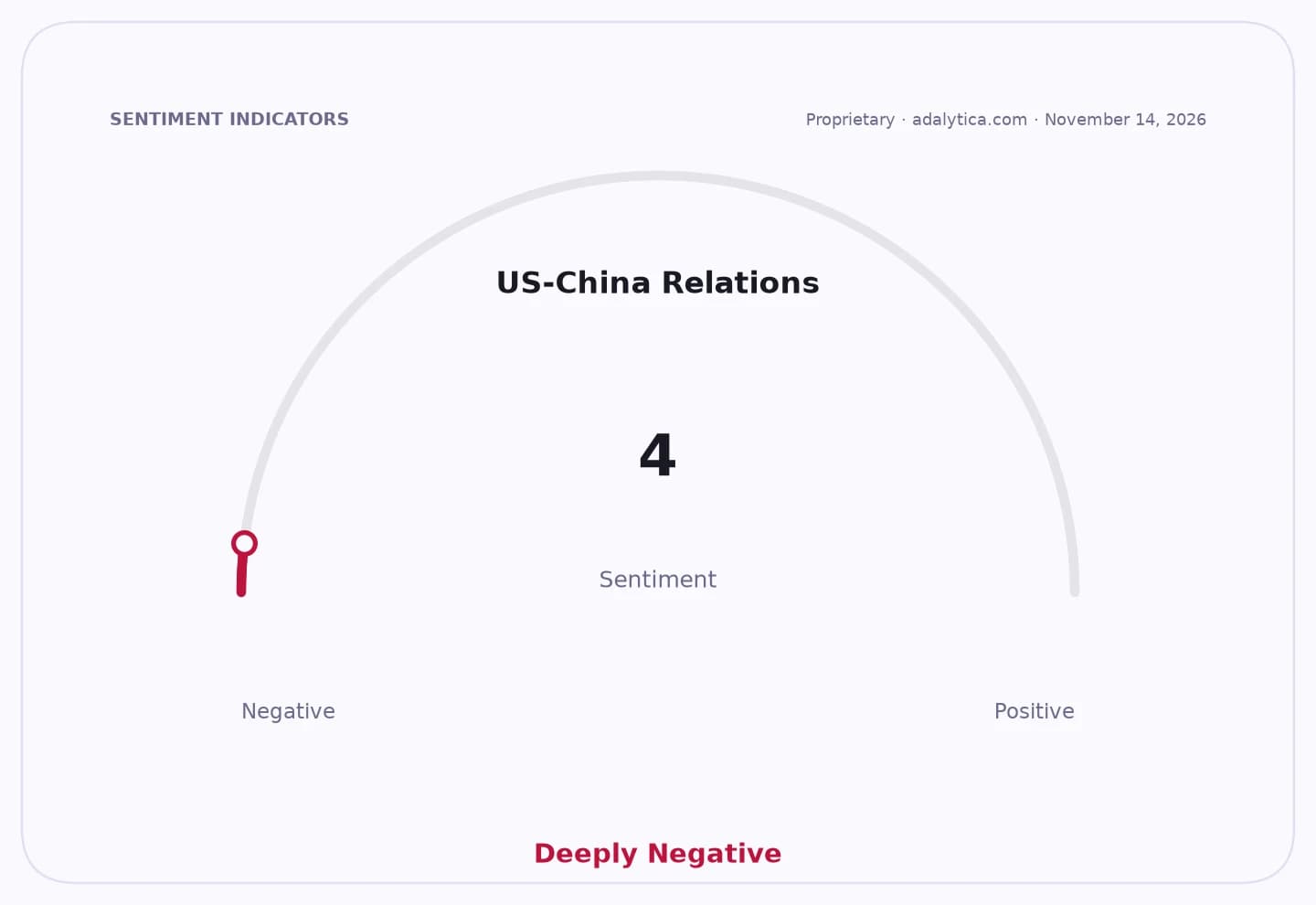
The signal extends beyond Taiwan itself. China-related risk gauges remain subdued, with Adalytica’s US-China Relations Sentiment at 14, or “Extreme Fear,” while its awareness reading is at 100, indicating the issue is front and center for markets. That combination suggests investors are highly alert to policy shifts, but still pricing a lot of uncertainty into cross-strait and broader China trade exposure.
The China proxy is also telling. FXI, the iShares China Large-Cap ETF, has slipped to 32.54 from recent levels above 38 and remains below both its 50-day and 200-day moving averages. That underperformance underscores how sensitive Chinese assets remain to trade and technology headlines. By contrast, EWT, the iShares Taiwan ETF, though weaker than its early-year highs, is still trading above its 200-day average, reflecting the market’s willingness to keep a structural premium on Taiwan-linked supply-chain assets despite periodic swings.
For Canada, the upside case is straightforward: a trade arrangement with Taiwan would diversify export ties, support high-value manufacturing and strengthen access to a strategically important technology hub. The bear case is that any move seen as too close to Taiwan could complicate Ottawa’s relationship with Beijing and add noise for sectors exposed to China demand.
What investors should watch next is whether Carney’s government frames the arrangement as a narrow economic pact or as part of a broader industrial strategy tied to critical minerals, semiconductors and supply-chain security. The more the deal is tied to those themes, the more it matters for capital allocation across North American technology, industrial and materials stocks.
| Entity | Gains | Losses |
|---|---|---|
| Canada | ▲Diversified trade ties | ▼China policy friction |
| Taiwan | ▲Wider market access | ▼More geopolitical scrutiny |
| Semiconductor supply chain | ▲Greater certainty | ▼Higher policy risk |
| China-exposed assets | ▲— | ▼Trade tension premium |