Taiwan’s foreign minister is returning to the US for a second time in two months, underscoring how Taipei is trying to harden ties with Washington even as Beijing intensifies pressure over the island’s diplomatic space and security.
Taiwan foreign minister visits US as TSMC falls

The trip matters because it comes at a moment when cross-strait risk is already elevated, with Xi Jinping reiterating that Taiwan’s reunification with China is inevitable and Beijing keeping military and political pressure on Taipei. For markets, that raises the odds of a longer period of strategic friction around the world’s most important chipmaking hub and a fresh test of whether US support for Taiwan remains stable across an increasingly volatile geopolitical backdrop.
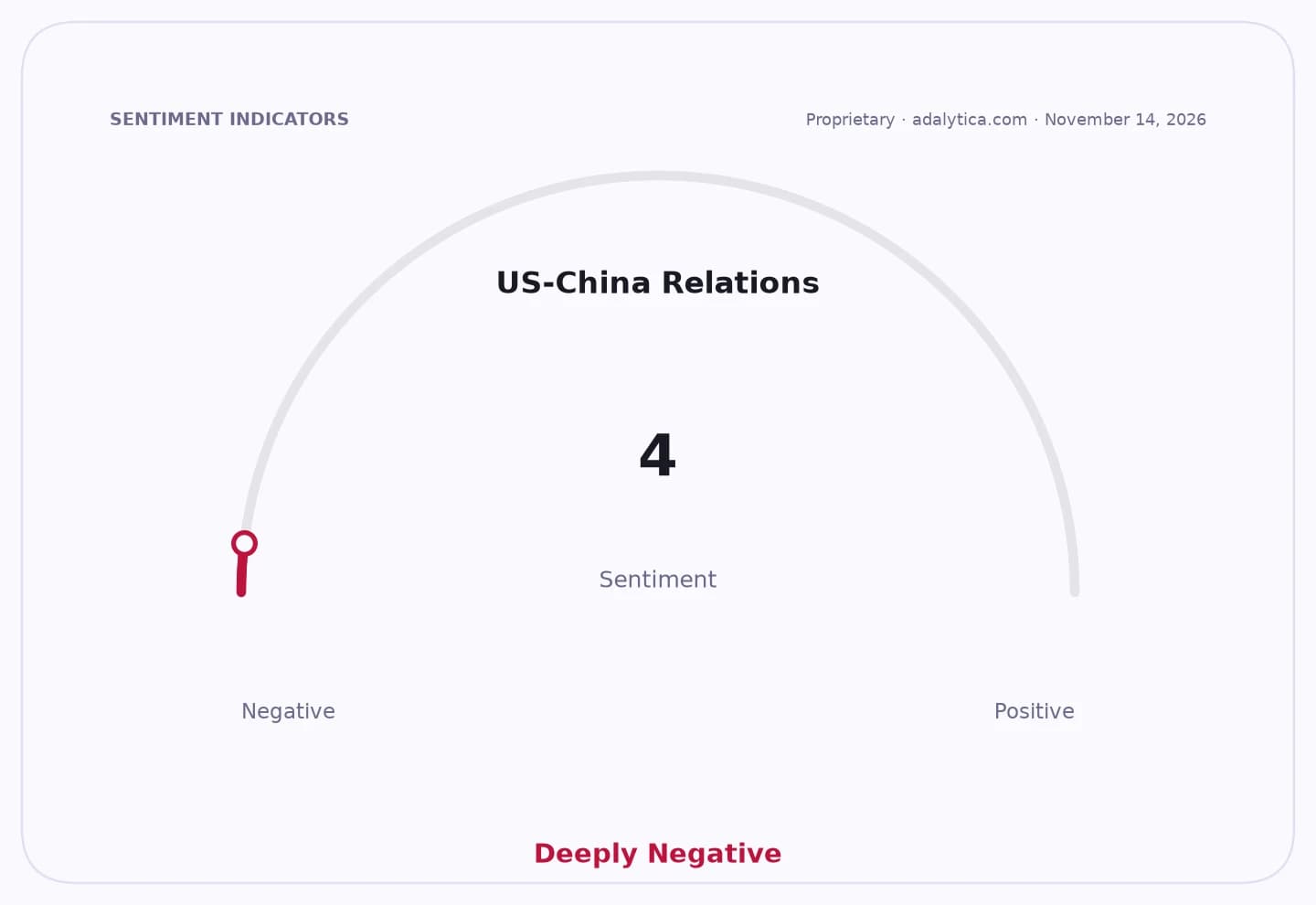
Sentiment Indicators
The visit also lands as Taiwan Semiconductor Manufacturing Co. faces its own market unease. TSMC’s shares have slid to 373.45 on Nov. 16 from 426.16 on Aug. 27 and 476.29 at the end of June, while the stock has fallen below its 50-day moving average and its relative strength index has dropped to 34.3, a sign that momentum has weakened. The shares remain above the 200-day moving average, but the pullback shows investors are not treating geopolitical risk as background noise. They are discounting it into valuations.
For Taiwan, diplomacy and economics are inseparable. The island depends on the US for security and political backing, while its technology sector — led by TSMC — sits at the center of global supply chains for AI chips, smartphones and advanced computing. Any deterioration in US-Taiwan ties would have implications well beyond formal diplomacy, potentially affecting export controls, military signaling, and corporate investment decisions across semiconductors and defense.
US-China Relations vs TSMadalytica.com
Explore this data interactively — full history, time series and cross-market comparisons.
The market reaction has not been limited to Taiwan equities. Bloomberg-style risk gauges in the supplied data show US–China relations sentiment at “Extreme Fear,” while global stability sentiment has also deteriorated sharply. That combination suggests investors are increasingly pricing a world in which geopolitical shocks are more frequent, not less. In that setting, even routine-looking diplomatic travel by a senior Taiwanese official can be read as an attempt to reassure allies and deter adversaries.
For Washington, the message is equally sensitive. Accepting a higher-level Taiwanese presence can signal commitment to Taipei without changing formal policy, but it also risks provoking Beijing at a time when Xi is leaning harder on sovereignty rhetoric. For Beijing, the timing reinforces a familiar narrative: that Taiwan is deepening external support and testing China’s red lines.
The bull case for Taiwan’s outreach is that it strengthens deterrence and keeps the US engaged at a moment of strategic uncertainty. The bear case is that every such move invites a sharper response from Beijing, keeping the probability of military, trade or diplomatic escalation elevated and making premium valuations harder to sustain in the semiconductor supply chain.
For investors, the key question is not whether Taiwan’s foreign minister can secure meetings in Washington. It is whether the trip is another incremental sign that the strategic competition over Taiwan is becoming more entrenched — and therefore more relevant to chipmakers, defense contractors and global risk assets.
| Entity | Gains | Losses |
|---|---|---|
| Taiwan government | ▲US political support | ▼Greater Beijing pressure |
| US policymakers | ▲Tighter Taiwan ties | ▼Higher China retaliation risk |
| TSMC and peers | ▲Strategic importance reinforced | ▼Geopolitical discount on valuation |
| China | ▲Leverage through pressure | ▼Diplomatic room if US engagement deepens |