Taiwan’s detention of a local communist party leader over alleged links to Beijing has sharpened concerns that China is trying to influence the island’s domestic politics at a sensitive moment, raising the stakes for a local election season already defined by cross-strait tension.
Taiwan Detains Communist Party Leader Over China Links

The move matters economically because political stability in Taiwan underpins one of Asia’s most important semiconductor and export hubs, and any perception of deeper Chinese interference can add a risk premium to an economy that is already exposed to trade, technology and security shocks. It also matters to investors because Taiwan’s markets are heavily weighted toward globally traded technology names, making them especially sensitive to any escalation that could disrupt confidence, supply chains or policy continuity.
Sentiment Indicators
Geopolitical Risk
According to local media reports, authorities detained the leader of Taiwan People’s Communist Party on allegations that he ran for borough chief under the direction and sponsorship of China’s Communist Party. The timing, ahead of local polls, makes the case politically charged: even small-scale allegations of covert influence can reverberate well beyond the municipal level in Taiwan, where elections are routinely read as a proxy for public sentiment on relations with Beijing.
For markets, the immediate issue is not the legal case itself but the wider message it sends about cross-strait friction. Taiwan has been under mounting pressure from Beijing in diplomacy and trade, including the reported closure of its office in Papua New Guinea amid Chinese pressure. That broader backdrop reinforces the view that China is using multiple levers — political, economic and diplomatic — to narrow Taiwan’s room to maneuver.
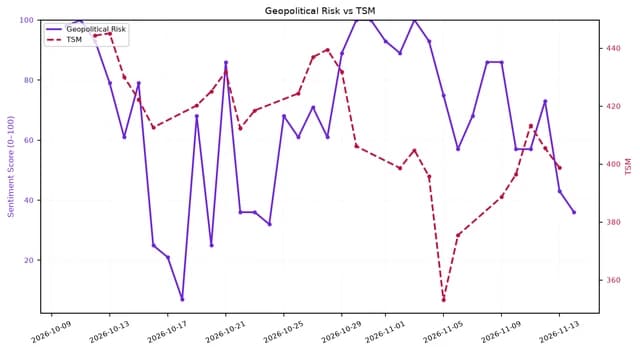
That dynamic is relevant for companies such as Taiwan Semiconductor Manufacturing Co and other Taiwan-linked exporters because investors tend to price any rise in geopolitical risk through the lens of supply-chain resilience and policy unpredictability. The latest developments do not suggest an immediate disruption to operations, but they can add volatility to Taiwan equities and to regional assets that are seen as exposed to a harder line from Beijing.
Technical readings in Taiwan-related assets reflect that uneasy balance. TSM shares remain above the 200-day moving average but have slipped back below the 50-day average, while the relative strength index has softened from overbought levels earlier in the year. The iShares China Large-Cap ETF, meanwhile, has been trading below both its 50-day and 200-day averages, underscoring how China-linked sentiment remains fragile even as policymakers in Beijing keep up pressure on Taiwan.
The broader narrative is that Taiwan’s domestic politics and external security risks are becoming more tightly linked. If authorities conclude that outside interference is entering local elections, they are likely to respond more aggressively, which could further sour ties with Beijing. For investors, that means the baseline risk around Taiwan assets remains elevated even if the immediate market reaction is muted.
What matters next is whether Taiwan expands scrutiny of political groups and candidates ahead of the polls, and whether Beijing responds with more diplomatic or economic pressure. Any escalation would likely be watched less for its immediate economic impact than for what it says about the durability of Taiwan’s political environment and the risk of a sharper cross-strait confrontation.
| Entity | Gains | Losses |
|---|---|---|
| Taiwan authorities | ▲Political control | ▼Perceived neutrality |
| Beijing/China | ▲Influence if allegations are disputed | ▼Cover for interference claims |
| Taiwan equities | ▲May benefit if stability is restored | ▼Geopolitical risk premium |
| Local opposition figures | ▲Rally support if seen as targeted | ▼Scrutiny and legal risk |