Canadian government bonds are diverging from U.S. Treasuries, underscoring how closely linked debt markets can still trade apart when domestic policy and growth expectations pull in different directions.
Canadian bonds diverge from U.S. Treasuries

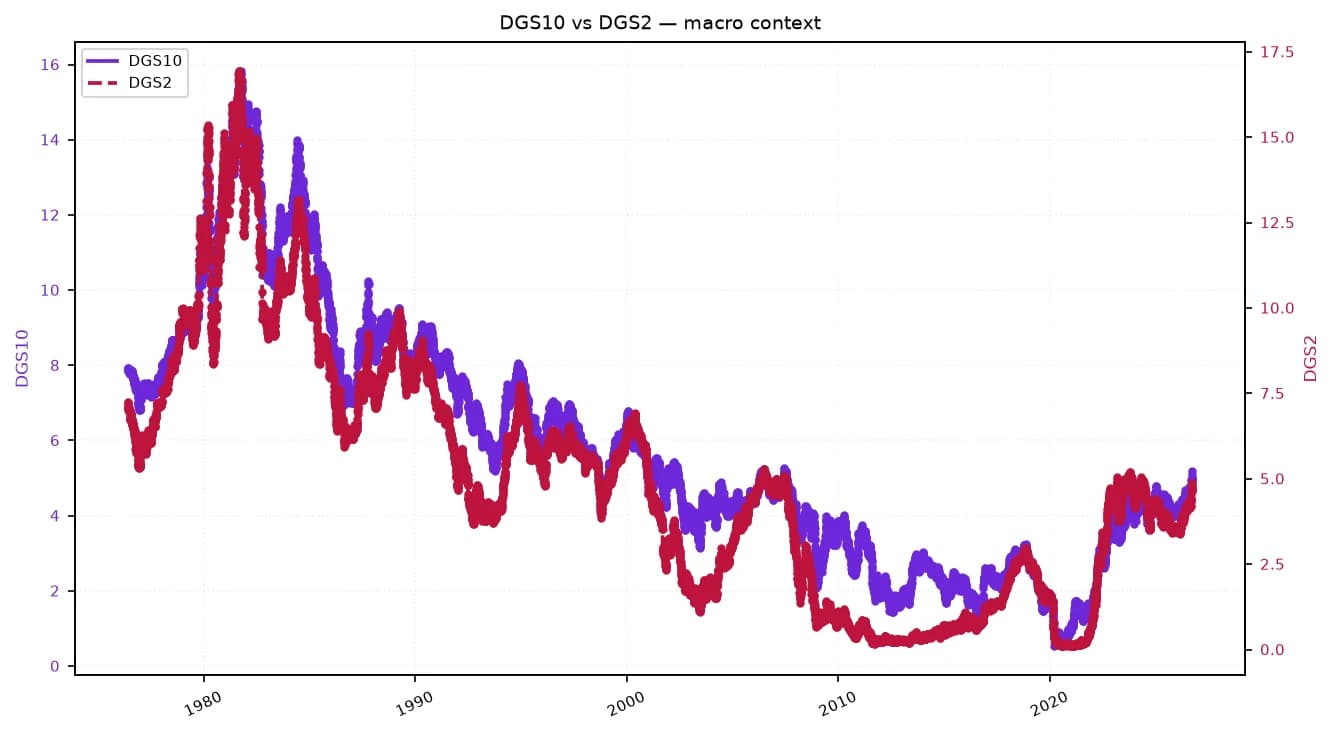
The clearest sign is the gap between benchmark yields: the U.S. 10-year Treasury is at 5.11%, while Canada’s 10-year government bond yields 4.85%, leaving a spread of 26 basis points. The 2-year gap is wider, with the U.S. at 5.18% versus Canada at 4.87%, or 31 basis points. The U.S. 10-year/2-year curve is modestly positive at 32 basis points, while Canada’s equivalent spread is just 31 basis points, reinforcing that the two markets are not moving as a single block even if they share many of the same global drivers.
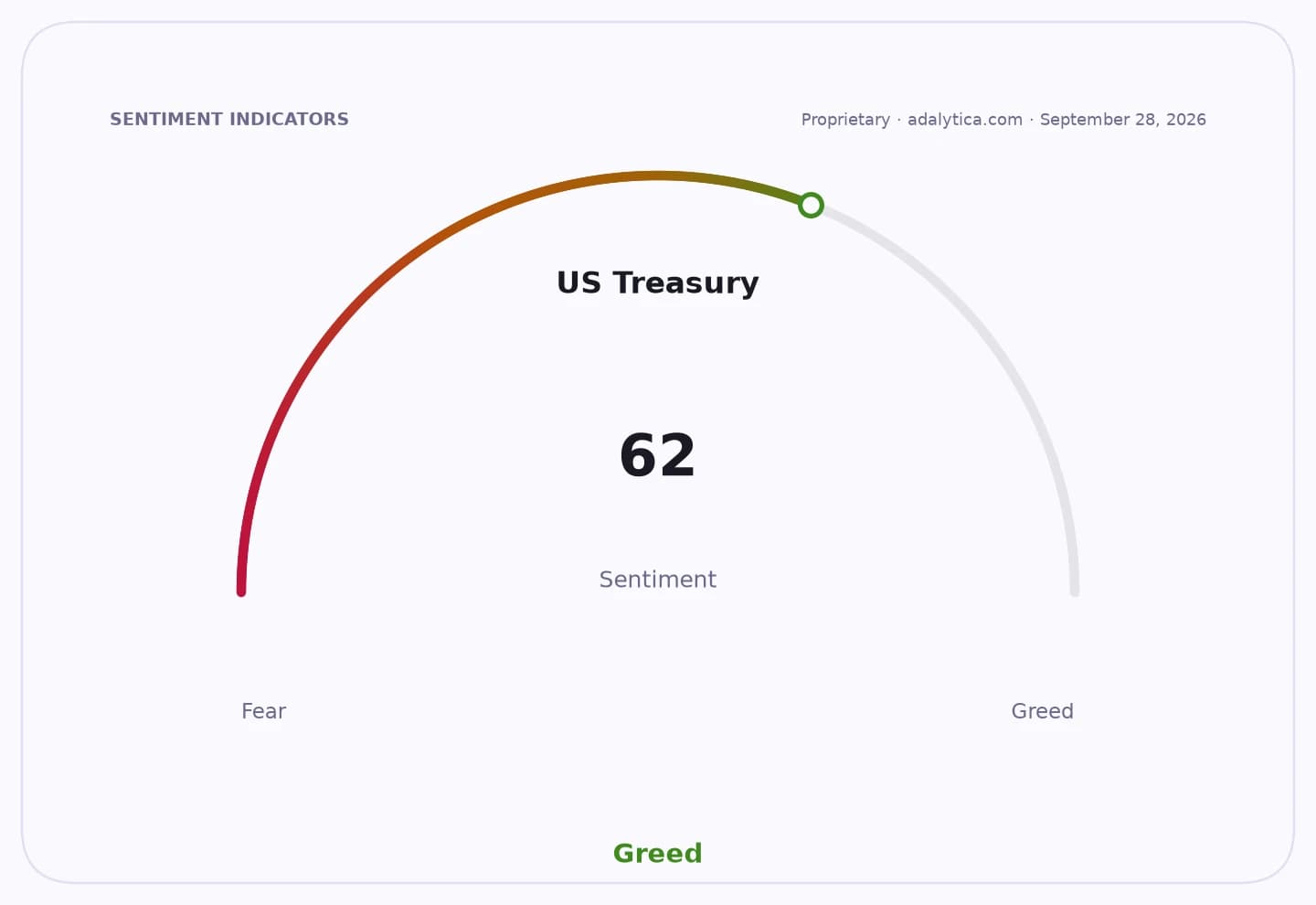
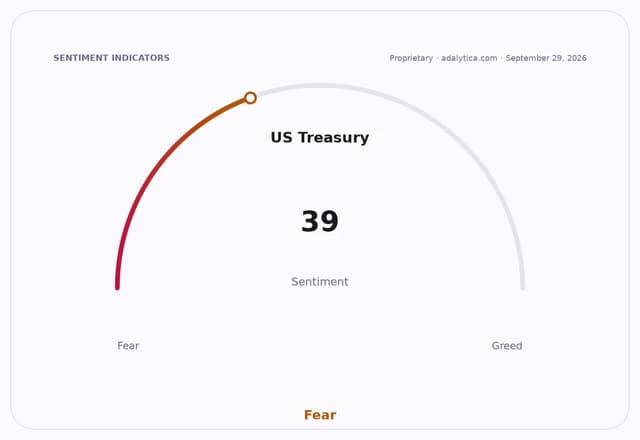
Sentiment IndicatorsⓘProprietary · adalytica.com · September 29, 2026
This is a snapshot — live sentiment, awareness and momentum for 130+ markets update continuously in the dashboard.Open AlphaPulse
That matters because sovereign bonds sit at the core of domestic borrowing costs, mortgage pricing and equity valuation models. A move of just a few basis points in Canadian yields can reshape financing conditions for households and companies, especially in a market where fixed-rate mortgage resets and bank funding costs transmit quickly into the real economy. For investors, the split also challenges the common assumption that Canadian duration is simply a beta trade on U.S. rates.
The divergence is also visible in bond fund pricing. iShares 7-10 Year Treasury Bond ETF, or IEF, has fallen to 89.43, below both its 50-day moving average of 92.01 and 200-day average of 93.22, while its RSI is 24.6, a conventional indicator that points to deeply oversold conditions. iShares 20+ Year Treasury Bond ETF, or TLT, is weaker still at 78.19, with an RSI of 25.0 and a price below its lower Bollinger Band, suggesting investors have continued to lean bearish on longer-duration U.S. debt. By contrast, Canada-specific bond pricing is not shown here, but the narrower yield gap versus the U.S. implies the Canadian market is being driven by a different mix of inflation, growth and policy expectations.
The narrative is one of relative policy independence rather than outright decoupling. Canada’s bond market remains tied to the same global forces that are pushing U.S. yields higher — resilient growth, sticky inflation and heavy sovereign issuance — but it is not obliged to mirror the U.S. move point for point. That matters for cross-border investors who hedge currency risk, own Canadian financials, or run relative-value trades between U.S. and Canadian duration.
It also has implications for the currency. Adalytica’s U.S. dollar signal shows “Extreme Fear,” with awareness near zero, hinting at a sharp shift in near-term positioning. If U.S. yields stabilize while Canadian yields stay comparatively anchored, the rate spread could become a more important driver of the loonie than broad risk sentiment. For now, the message from bond markets is clear: Canada can rhyme with the U.S. without moving in lockstep.
The key issue to watch is whether the spread widens further as investors price a slower Canadian economy or narrower if U.S. yields retreat. Either outcome would affect relative valuation across North American fixed income, bank stocks and rate-sensitive sectors.
| Entity | Gains | Losses |
|---|---|---|
| Canadian bondholders | ▲Relative yield stability | ▼U.S.-style rate volatility |
| U.S. Treasury bears | ▲Higher domestic yields | ▼Duration performance |
| Canadian borrowers | ▲Less U.S. yield pass-through | ▼None if spreads widen |
| Cross-border relative-value traders | ▲Spread opportunities | ▼Simple beta trades |