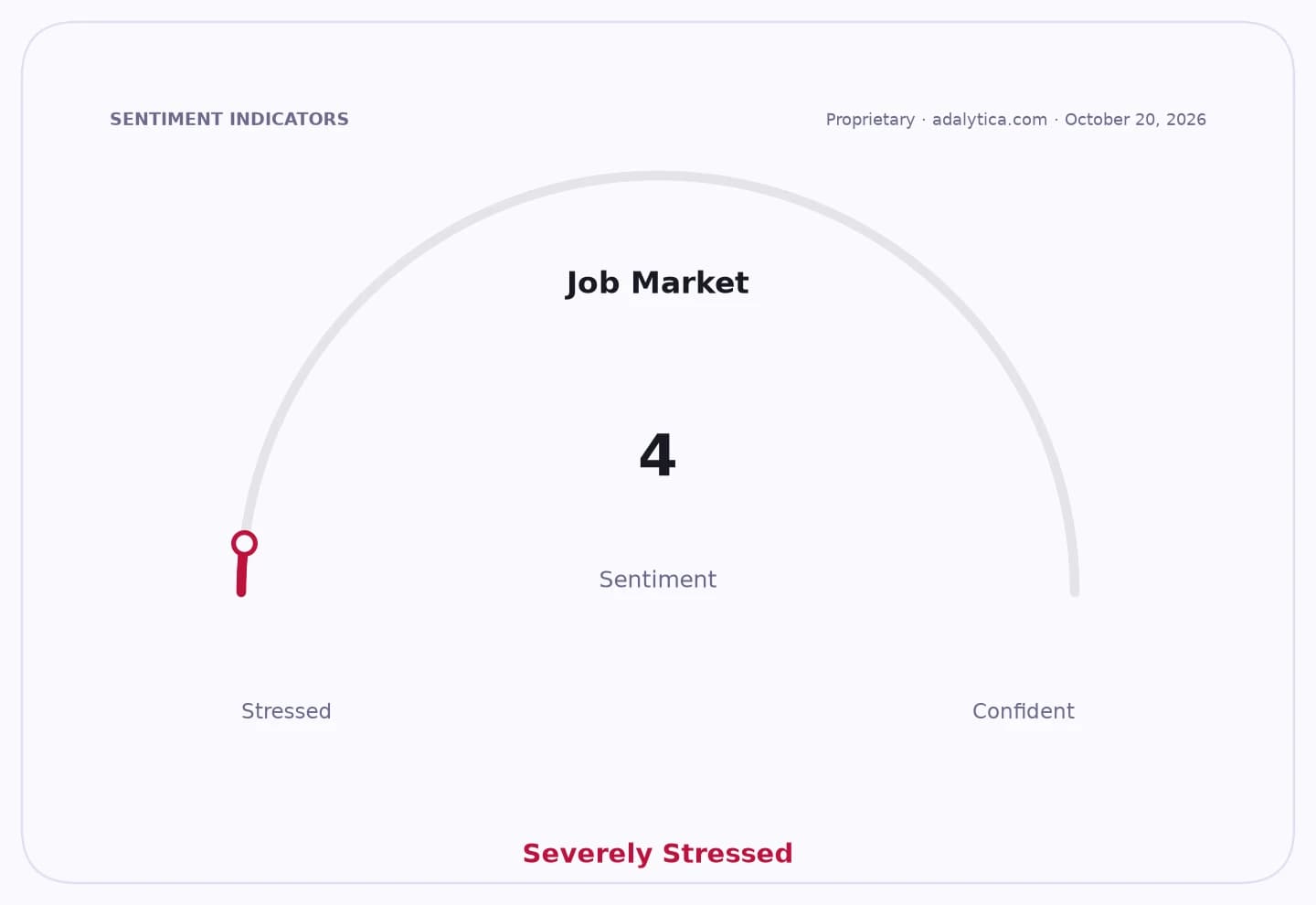
Canva is shedding 1,271 roles, or 22% of its workforce, after the design software company said it was confronting slower growth for the first time in its 13-year history and a rapidly changing market shaped by artificial intelligence.
Canva cuts 1,271 jobs amid slower growth and AI
Artificial Intelligence
The move matters because Canva’s business sits directly in the path of generative AI: tools that can create layouts, images and marketing content at lower cost and with less skill than traditional design software. That threatens the economics of one of Australia’s best-known start-ups, whose expansion has long depended on turning mass-market users into paying customers. If AI can do more of the work Canva’s software helped simplify, pricing power and product differentiation become harder to defend.
Sentiment Indicators
Chief executive Melanie Perkins told staff the restructure was “the hardest moment” in the company’s history. The company said the changes will involve cuts, role redesigns and relocations, with Sydney to become the primary home for product teams. Canva said impacted staff will receive at least six months’ salary, a year of healthcare cover and US$10,000 grants for those leaving to start businesses or support communities.
The layoffs are also a signal that AI is no longer just a product feature for software groups; it is becoming a cost and strategy shock. Canva has been adding AI tools to its platform, effectively building in-house functions that rival external AI assistants, but that response has not removed the risk that users, small businesses and enterprise customers may increasingly turn to AI-native rivals instead. As boutique advisory Revium’s Adam Barty put it, AI may prove an “existential threat” to Canva’s core model.
For investors, the key question is whether this is a one-off restructuring or the start of a wider margin reset across software. Canva’s backer Blackbird remains publicly optimistic, saying its global reach and AI capabilities leave it well placed to benefit from the technology. That is the bull case: a large user base, strong brand and product integration could still let Canva monetise AI rather than be disrupted by it. The bear case is that the company’s most valuable asset may now be its audience, not its software moat, and that AI labs and startups can capture more of the value chain.
The broader backdrop is the same across tech: software groups are cutting staff as they retool for AI, with Atlassian and WiseTech Global also announcing sizeable reductions. For markets, that reinforces a familiar pattern in the sector: AI can boost productivity and long-run profitability, but the transition can be brutal for headcount and near-term sentiment. For Canva, the next test is whether the overhaul stabilises growth before AI-native competition erodes it further.
| Entity | Gains | Losses |
|---|---|---|
| Canva management | ▲lower costs; faster reorg | ▼short-term disruption |
| Remaining shareholders | ▲potential margin support | ▼execution risk |
| Laid-off workers | ▲severance package | ▼jobs and continuity |
| AI-native rivals | ▲easier market entry | ▼— |