Artificial intelligence is delivering major gains in customer service at a small group of top organisations, but most companies are still failing to turn adoption into measurable business value.
EY India Finds AI Gains in Customer Service
EY India said the highest-performing firms are reporting more than 50% improvement in core customer service metrics, including customer experience, revenue uplift, average handle time and agent productivity, even as just 23% of surveyed organisations said they had achieved high or very high value from AI in service operations.
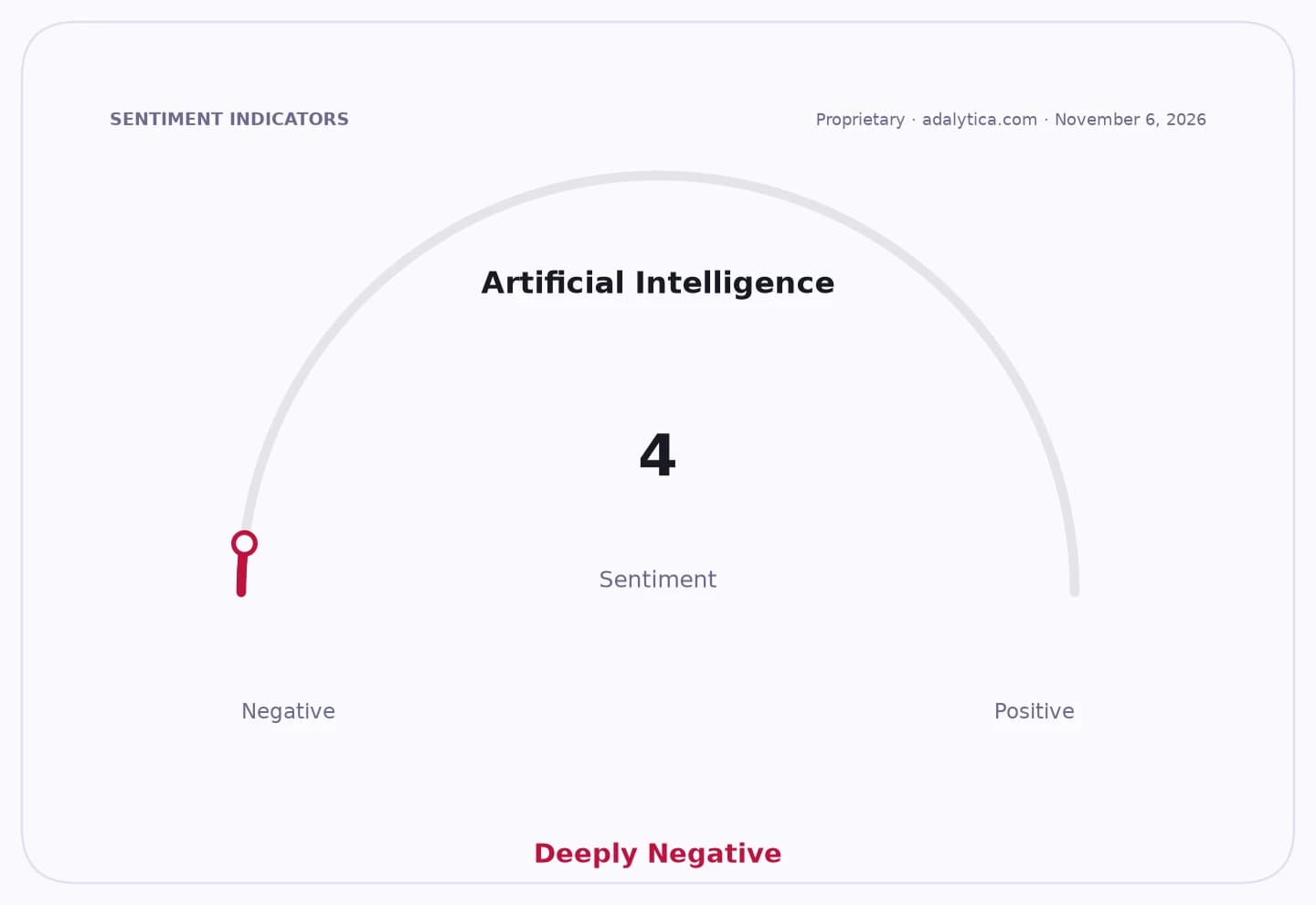
Sentiment Indicators
That gap matters because customer service is one of the clearest proving grounds for enterprise AI: it is high-volume, repetitive and measurable, making it an early test of whether companies can convert model deployment into lower costs, faster resolution and better retention. EY’s survey of more than 100 responses and executive interviews suggests the winners are not simply the biggest spenders, but those with cleaner data, tighter governance and AI embedded across workflows rather than isolated pilots.
The report splits companies into “Achievers,” “Challengers” and “Aspirants.” Achievers, who make up 23% of respondents, typically reported 25% to 50% or higher improvement across multiple metrics, with more than 50% gains in at least three or four core measures. Challengers reported 10% to 25% improvements, while Aspirants said they were seeing less than 10% or had not measured outcomes at all.
The difference is increasingly visible in how firms run their service stacks. EY said 91% of Achievers have scaled voice AI deployments, with 45% using rules-based voice bots and 37% using more advanced systems that can classify and prioritise calls. More than 80% of Challengers and Aspirants still rely on human agents or basic menu-driven IVR systems for intent classification.
Agent support is also diverging. Among Achievers, 45% use conversational AI copilots during diagnosis and resolution and 36% use agentic AI copilots. Just 19% still rely mainly on static knowledge bases and human judgement, compared with 60% of Challengers and 71% of Aspirants.
That has direct implications for software vendors and cloud providers tied to enterprise AI spending, including Microsoft, Salesforce and Nvidia. Microsoft shares have been volatile but remain well above their 200-day moving average, while Nvidia has come under pressure, with the stock recently trading below both its 50-day and 200-day moving averages as investors reassess the pace of AI monetisation beyond infrastructure spending. Salesforce has also weakened sharply, with shares well under their 50-day average, reflecting concern that enterprise buyers are still proving where AI lifts revenue rather than just automates tasks.
EY said the strongest firms are also using AI to improve knowledge management and feedback loops. Seventy-three percent of Achievers use AI-powered dynamic knowledge tools, versus 20% of Challengers and 8% of Aspirants, while 36% use conversational AI-based surveys to capture customer feedback.
The strategic takeaway is that customer experience, not just cost cutting, is becoming the main objective for the best performers. EY said 45% of Achievers identified customer experience as their primary goal for AI-led transformation, and on average they had scaled AI across about 60% of core customer service technology domains.
For investors, the report reinforces a familiar but important market theme: AI spending is still in transition from infrastructure buildout to operating leverage. Companies that can connect data, governance and workflow integration are more likely to show margin benefits and customer retention gains; those stuck in fragmented pilots risk disappointing returns despite continued investment.
The next catalyst will be whether more enterprises can show these service gains in earnings, guidance and margin expansion rather than in pilot announcements. If they can, the value case for enterprise AI broadens well beyond chipmakers and into software, cloud and IT services.
| Entity | Gains | Losses |
|---|---|---|
| Achievers | ▲>50% KPI gains | ▼slower rivals |
| Challengers | ▲partial AI uplift | ▼leaders scaling faster |
| Aspirants | ▲early learnings | ▼value realization gap |
| Microsoft, Salesforce, Nvidia | ▲more enterprise AI demand | ▼slower monetisation debate |