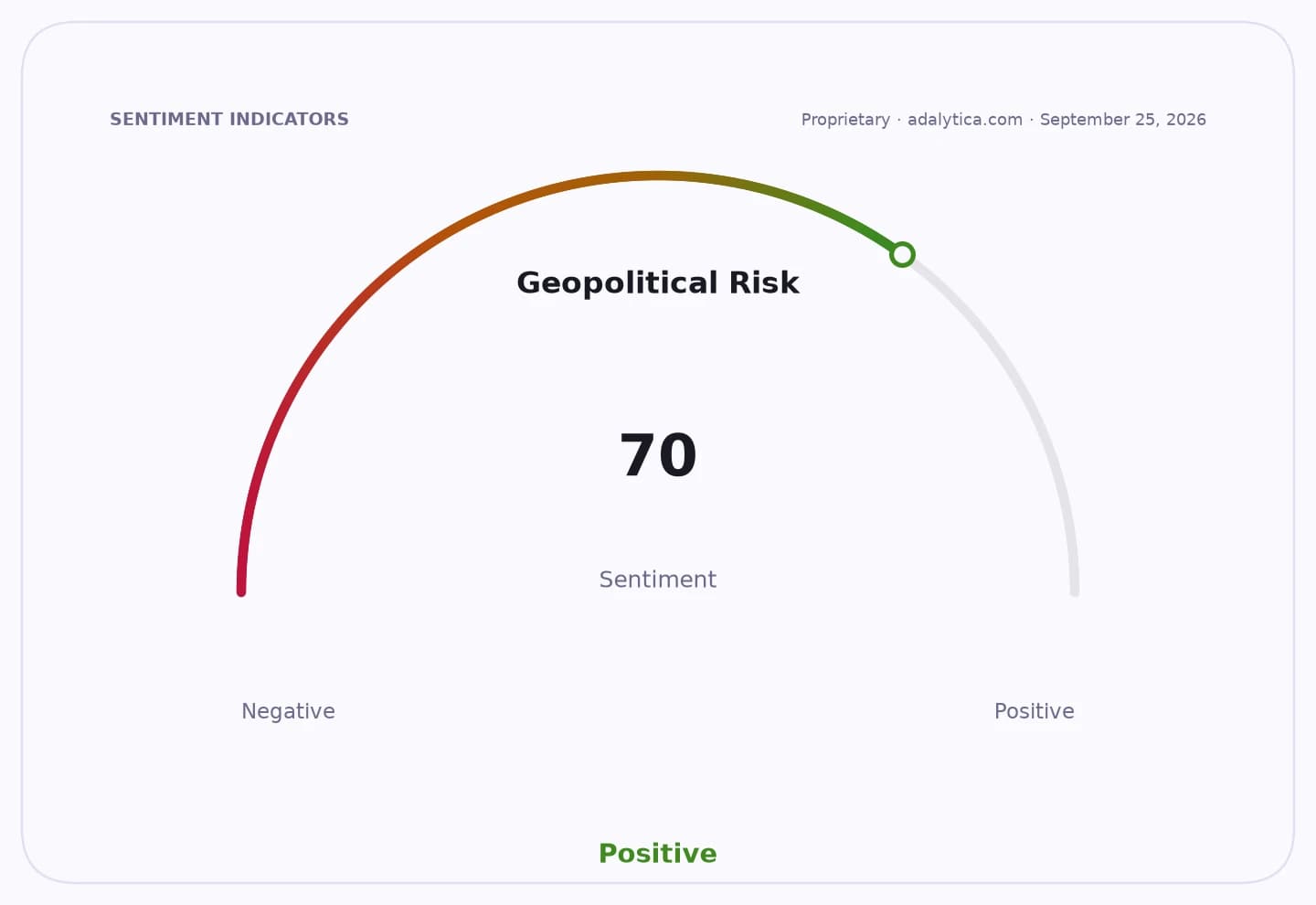
Cement prices are holding near recent highs on Wednesday, July 22, even as U.S. industrial activity and homebuilding soften, a sign that supply discipline is offsetting weaker construction demand for now.
Cement Prices Stay Firm Amid Soft Construction Demand

The benchmark producer price measure for cement and related materials, tracked by the PPIACO series, slipped to 286.8 in June from 290.5 in May after a sharp run-up earlier in the spring. It is still projected to rebound to 295.8 in July, suggesting the market remains tight enough to prevent a broader price break.
Sentiment IndicatorsⓘProprietary · adalytica.com · July 22, 2026
This is a snapshot — live sentiment, awareness and momentum for 130+ markets update continuously in the dashboard.Open AlphaPulse

That stability matters because cement is a core input for roads, bridges, warehouses and housing, and price moves feed directly into margins for producers and costs for contractors. Industrial production rose just 0.08% in June, according to the INDPRO series, while housing starts were volatile at 1,427 in June after 1,199 in May, underscoring uneven end-market demand rather than a strong construction rebound.
For investors, the read-through is mixed but constructive. Big U.S. materials names such as CRH, Vulcan Materials and Martin Marietta have all seen their shares swing sharply in recent weeks, with technical indicators showing the sector coming off overbought levels after earlier rallies. CRH closed at $99.74 on July 21, below its 50-day moving average of $106.13 and 200-day average of $114.18, while VMC ended at $276.75 and MLM at $547.33, both under pressure as traders reassess volume growth and pricing power.
PPIACO vs INDPRO — macro contextadalytica.com
Explore this data interactively — full history, time series and cross-market comparisons.Open AlphaPulse

The broader narrative is one of a market that is not collapsing, but is no longer expanding fast enough to justify aggressive pricing gains. UltraTech Cement’s stronger quarterly profit and bullish broker calls in India contrast with weaker results at JK Cement, while recent technical strength in some regional names shows investors are still willing to reward pricing resilience where demand holds up.
With U.S. construction activity uneven and macro signals still subdued, the key catalyst is the next read on cement pricing and July industrial data. If pricing stays firm into the second half, producers could defend margins even if volume growth stays muted; if demand slips further, the current stability may prove temporary.
| Entity | Gains | Losses |
|---|---|---|
| Cement producers | ▲Margin support | ▼Volume uncertainty |
| Contractors/builders | ▲Cost stability | ▼Less pricing leverage |
| CRH, VMC, MLM longs | ▲Rebound potential | ▼Near-term volatility |
| Short sellers | ▲Weak demand thesis | ▼Sticky prices |