Europe’s biggest AI opportunity may come from China, but the decisive issue for investors is whether the region can use cheaper, fast-improving models without getting trapped by regulation, geopolitics or dependence on foreign infrastructure.
Cheap Chinese AI Could Reshape Europe’s Adoption Market
That is the economic significance behind a shift that is easy to miss: the battle in European AI is moving away from the nationality of the model and toward the cost, accessibility and compliance of the stack. If Chinese systems are good enough for many enterprise uses, they can lower deployment costs, widen adoption and pressure Western pricing. If Europe blocks them outright, it risks slowing the productivity gains it badly needs.
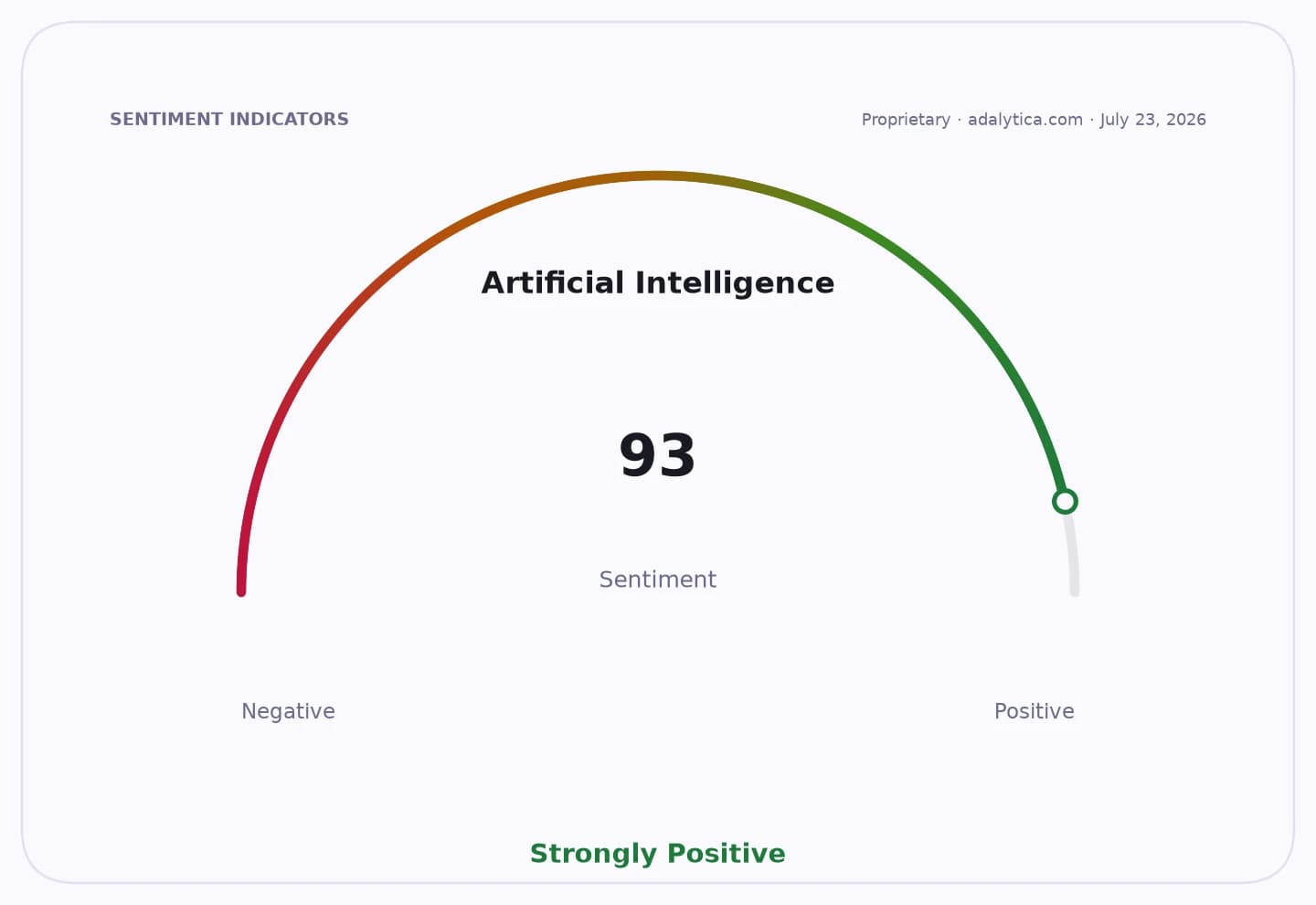
Sentiment IndicatorsⓘProprietary · adalytica.com · July 23, 2026
This is a snapshot — live sentiment, awareness and momentum for 130+ markets update continuously in the dashboard.Open AlphaPulse
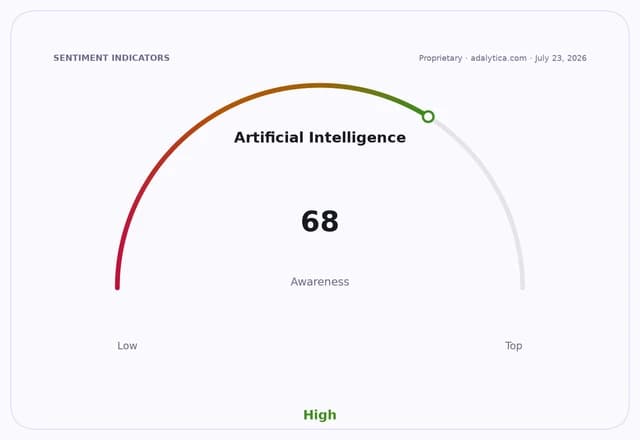
The macro backdrop makes the issue more acute. Long-term U.S. yields around 4.64% show capital remains expensive, while the dollar has strengthened, a combination that tends to reward firms able to deliver AI gains at lower upfront cost. At the same time, the market is still treating AI as a scarce-growth theme: Adalytica’s AI sentiment gauge sits at 93, or “Extreme Greed,” underscoring how quickly capital flows toward perceived winners. In that environment, Europe’s competitive problem is not just access to frontier computing, but access on terms that can survive tighter budgets and weaker growth.
That is why the origin debate is less important than the economics of adoption. Many European companies do not need a sovereign, best-in-class foundation model to automate document workflows, coding assistance, customer support or translation. They need reliability, data controls and low total cost of ownership. Chinese AI providers may be able to compete aggressively on price, particularly if they are willing to bundle models, cloud and services. For European buyers, that could be a blessing: cheaper AI could support margins, accelerate digitalisation and help smaller firms participate in the productivity cycle now concentrated in U.S. megacaps.
The bull case for Chinese AI in Europe is straightforward. It increases competition in a market dominated by U.S. platform companies, gives European customers more bargaining power and could blunt the pricing power of Microsoft, Nvidia and others that currently capture much of the AI value chain. Microsoft shares, which have fallen below their 200-day moving average and remain well under their recent highs, show how sensitive the market is to any challenge to the premium embedded in AI platforms. Nvidia, by contrast, has rebounded sharply and is holding above its 50-day average, reflecting continued investor confidence in demand for AI infrastructure. If cheaper Chinese models accelerate adoption without requiring the same level of imported hardware, some of that value may migrate from infrastructure suppliers to software users and systems integrators.
The bear case is just as important. Europe may decide that the strategic risks outweigh the cost benefits. Data sovereignty, cybersecurity, export controls and the risk of hidden dependency all argue for caution, especially in sectors such as public administration, telecoms, finance and critical infrastructure. A fragmented regulatory response would reduce the practical advantage of Chinese AI, while giving incumbents more time to defend their positions. There is also the risk that low-price AI becomes a loss leader for broader influence over cloud, standards and developer ecosystems, which would make the apparent savings more expensive over time.
For investors, the key implication is that Europe’s AI winners may not be the same as the U.S. winners now dominating headlines. The beneficiaries could include enterprise software firms, systems integrators, cloud providers and industrial companies that can use external models to lift productivity. The losers could be premium AI vendors if Europe becomes a more price-sensitive, multi-vendor market. ASML’s shares, though still far above their 200-day moving average, have been volatile, a reminder that the AI supply chain is not a straight-line trade and that policy or demand shifts can quickly alter sentiment in the hardware complex.
The broader narrative is that AI in Europe is becoming a competition on utility rather than prestige. If Chinese models can deliver acceptable performance at lower cost, they may help Europe close part of its productivity gap. But the more important question is whether policymakers allow the region to capture that benefit without creating new strategic vulnerabilities. That balance will determine whether Chinese AI becomes an economic tool for Europe or another front in a widening technology rivalry.
| Entity | Gains | Losses |
|---|---|---|
| European enterprises | ▲Lower AI costs | ▼Lock-in risk |
| Chinese AI vendors | ▲Market access | ▼Trust barriers |
| U.S. AI incumbents | ▲-- | ▼Pricing pressure |
| European policymakers | ▲Cheaper adoption options | ▼Security concerns |