China’s artificial intelligence strategy matters less for who has the smartest model than for how fast it spreads, and that diffusion is getting harder for Washington to monitor or stop. Beijing is treating AI as an economic operating system for factories, logistics and robotics, with open-weight models that can be copied, customized and deployed far beyond the reach of any shutdown order.
China AI Adoption Rises Across Factories and Robotics
That makes China’s AI push an economic story as much as a technological one. While the United States focuses on frontier benchmarks, chips and data centers, Beijing is using AI to lift manufacturing productivity, offset demographic decline and export Chinese technical standards abroad. The “AI Plus” plan unveiled in August targets a 70% penetration rate for AI agents and smart devices by 2027 and 90% by 2030, underscoring that adoption, not model leadership, is the endgame.
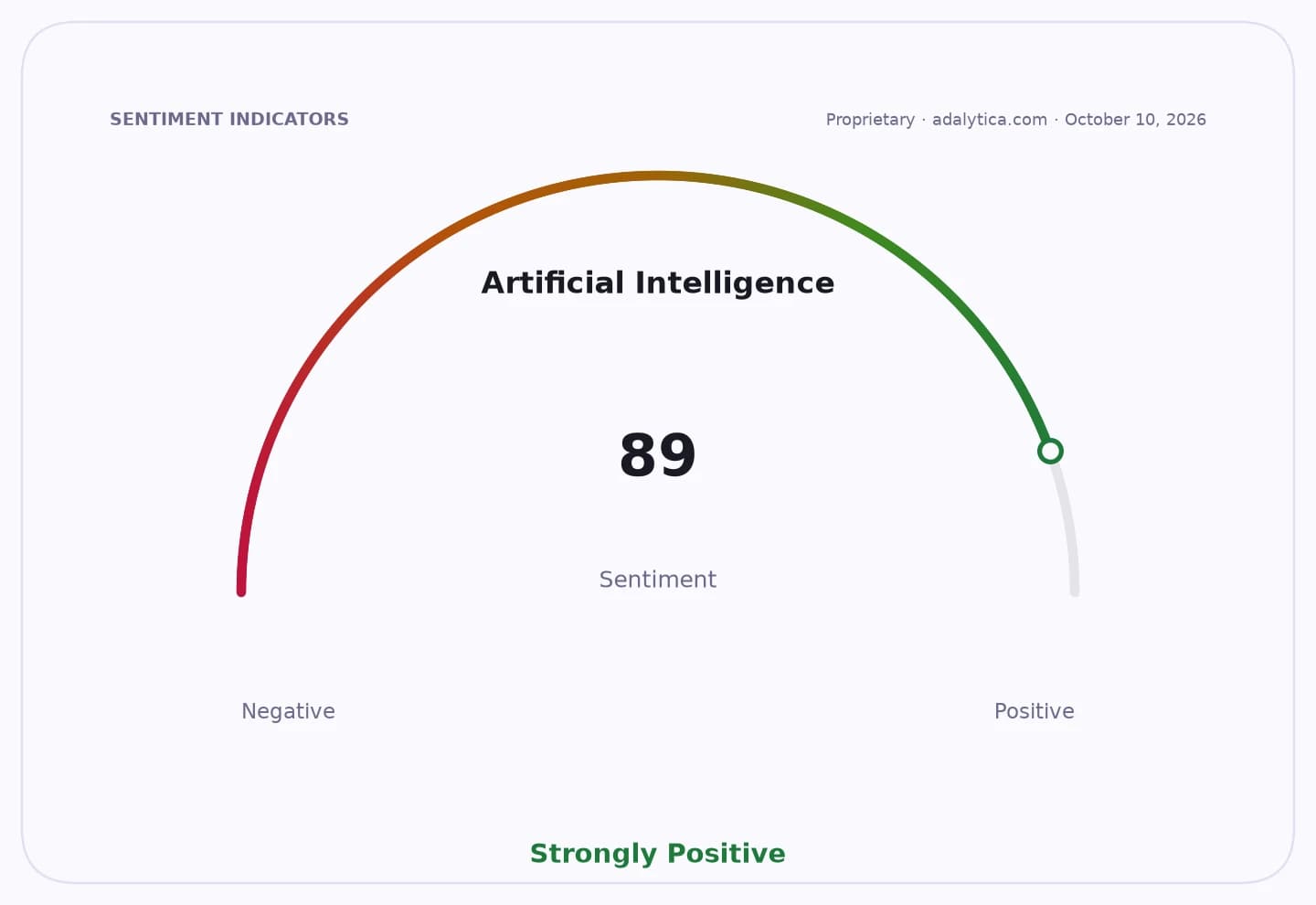
Sentiment IndicatorsⓘProprietary · adalytica.com · October 10, 2026
This is a snapshot — live sentiment, awareness and momentum for 130+ markets update continuously in the dashboard.Open AlphaPulse
The scale is already visible in industry. A U.S. congressional commission said a Guangdong firm used camera data and an AI model to improve quality inspection and save more than $140,000 a year. IDC estimated that nearly half of China’s industrial firms had deployed specialized models or agents by mid-2025, while Beijing has set goals for 1,000 industrial AI agents, 500 application scenarios and 1,000 showcase firms by 2027.
China’s robotics base gives that rollout extra force. The International Federation of Robotics said Chinese firms installed 354,000 industrial robots last year, more than the rest of the world combined, while MERICS data showed China produced 12,800 humanoid robots, about 90% of the global total. That combination of data-rich factories, specialized models and embodied AI gives Chinese industry a scale advantage that can widen even if domestic models remain slightly behind U.S. frontier systems.
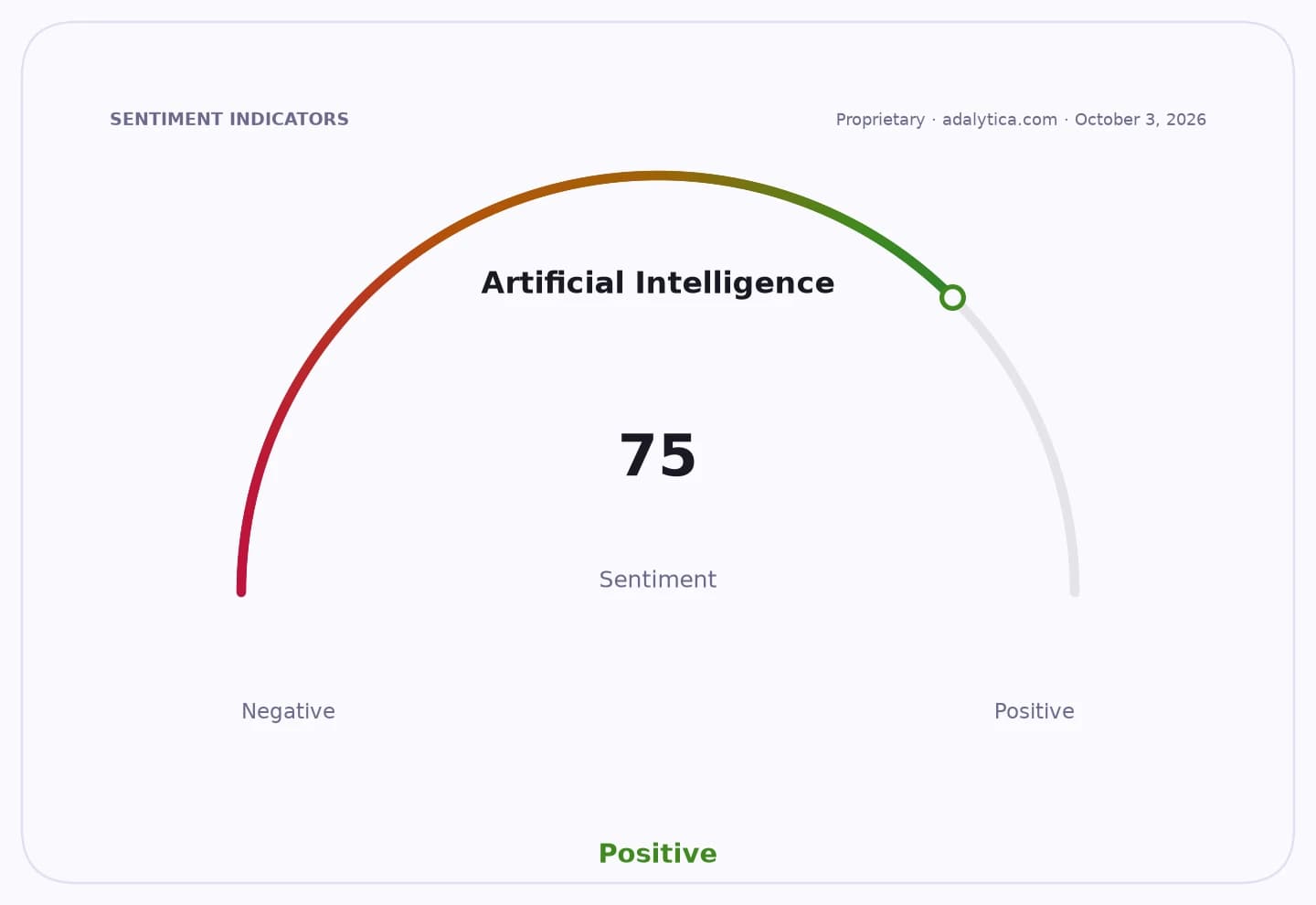
For investors, the implication is that China’s AI opportunity set is shifting from pure software to the broader industrial stack. Alibaba, Baidu and Tencent sit closest to that diffusion story, while Nvidia’s decision to publish a compressed version of Zhipu’s GLM-5.3 highlights how even U.S. chipmakers are already interacting with Chinese open-weight models. Alibaba shares were last at $111.37, below the 50-day moving average of $116.28 and the 200-day average of $129.18, while Baidu closed at $85.33 versus a 50-day average of $94.95 and 200-day average of $118.93, reflecting investor caution even as the AI rollout narrative builds.
The safety issue is what makes the story more than a growth theme. U.S. policymakers are debating kill-switch concepts for closed models, but open-weight systems cannot be recalled once downloaded and copied onto factories and private servers. Zhipu’s GLM-5.3 was downloaded more than 1.4 million times on Hugging Face, and developers produced about 80 variants in just over a month, making the model’s spread impossible to contain in the way Washington imagines.
That is why the policy debate in Washington may be missing the point. Export controls, chip restrictions and shutdown powers all matter at the frontier, but they do little against a model that is cheap, “good enough” and already embedded in industrial workflows across China and overseas. For markets, the next catalyst is whether Beijing’s rollout deepens through more factory deployments, more robotics integration and more use of Chinese models abroad, even as U.S.-China technology tensions keep rising.
| Entity | Gains | Losses |
|---|---|---|
| Chinese industrial firms | ▲Lower costs, higher productivity | ▼Greater dependence on AI rollout |
| Alibaba, Baidu, Tencent | ▲More AI adoption demand | ▼Margin pressure from competition |
| U.S. AI frontier labs | ▲Faster policy attention, funding | ▼Loss of strategic narrative edge |
| U.S. regulators | ▲Stronger case for controls | ▼Weak visibility into open-weight diffusion |