China is tightening oversight of AI companion bots, forcing users back to reality and signaling that one of the fastest-growing corners of artificial intelligence is now a regulatory target.
China Tightens AI Companion Oversight

The move matters because AI “relationships” are no longer just a novelty feature. They are becoming a commercial layer in consumer apps, customer service and digital engagement, which means governments are starting to weigh not only safety and privacy risks but also the social cost of systems designed to mimic attachment.
Sentiment IndicatorsⓘProprietary · adalytica.com · July 21, 2026
This is a snapshot — live sentiment, awareness and momentum for 130+ markets update continuously in the dashboard.Open AlphaPulse
According to the news context, Chinese authorities have suspended services from major players including Alibaba and ByteDance over fears that users could develop unhealthy emotional dependencies on anthropomorphic AI products. That puts a hard ceiling on a category that had been gaining traction precisely because it can keep users engaged longer than conventional chatbots.
For investors, the immediate takeaway is that AI monetization now carries more regulatory friction, especially in consumer-facing products. Companies building companion-style features may face slower rollouts, higher compliance costs and more scrutiny over how aggressively they optimize for engagement, a concern that is already surfacing in filings from large tech groups warning about the legal and reputational risks of AI use cases.

The policy shift also reinforces a broader global theme: regulators are no longer focused only on model quality or misinformation, but on how AI interacts with human behavior. The head of AI at Google has separately called for a U.S. regulatory body to evaluate the most powerful systems before release, underscoring that oversight pressure is building on both sides of the Pacific.
That makes AI governance a market issue, not just an ethics debate. Developers with consumer AI products, platform companies hosting them and chip suppliers funding the broader buildout all face a more uncertain path if rules start limiting high-engagement use cases that have been central to adoption and revenue growth.
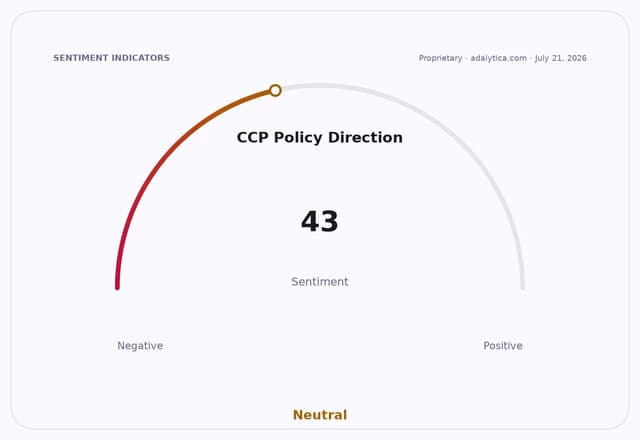
The Adalytica China CCP Policy Direction Sentiment snapshot shows policy sentiment at 43, neutral, while awareness remains in extreme fear at 4, suggesting investors are paying attention to the risk even as the policy direction remains unsettled. Global Stability Sentiment is even weaker at 7, in extreme fear, a backdrop that supports defensiveness around high-beta AI names whenever regulation tightens.
The next catalyst is whether similar limits spread beyond China, especially if U.S. and European regulators begin treating AI companions as a distinct category with disclosure, safety or age-related rules. That would reshape product design, slow some consumer AI launches and force companies to prove that the next wave of AI growth can scale without crossing a line on emotional manipulation.
| Entity | Gains | Losses |
|---|---|---|
| Chinese regulators | ▲More control over AI risks | ▼Slower consumer AI rollout |
| Alibaba and ByteDance | ▲Clearer rules over time | ▼Suspended companion services |
| U.S. and EU lawmakers | ▲Policy template from China | ▼Pressure to act faster |
| AI app makers | ▲Safer long-term standards | ▼Higher compliance costs |