China has unveiled a 19-measure policy package to accelerate so-called new quality productive forces, a state-led push to lift productivity through innovation, advanced manufacturing and AI that Beijing sees as central to its next phase of growth.
China Unveils 19-Measure AI and Growth Policy Package
The guidelines, issued by the Communist Party Central Committee and the State Council, matter because they are not just another industrial slogan: they are a roadmap for redirecting capital, talent and policy support toward sectors Beijing believes can offset a weaker property cycle, tame overcapacity in old industries and improve long-term growth quality. For investors, the message is that policy backing will likely remain strongest for technology, digital infrastructure, green energy, high-end equipment and companies that can translate research into commercial output.
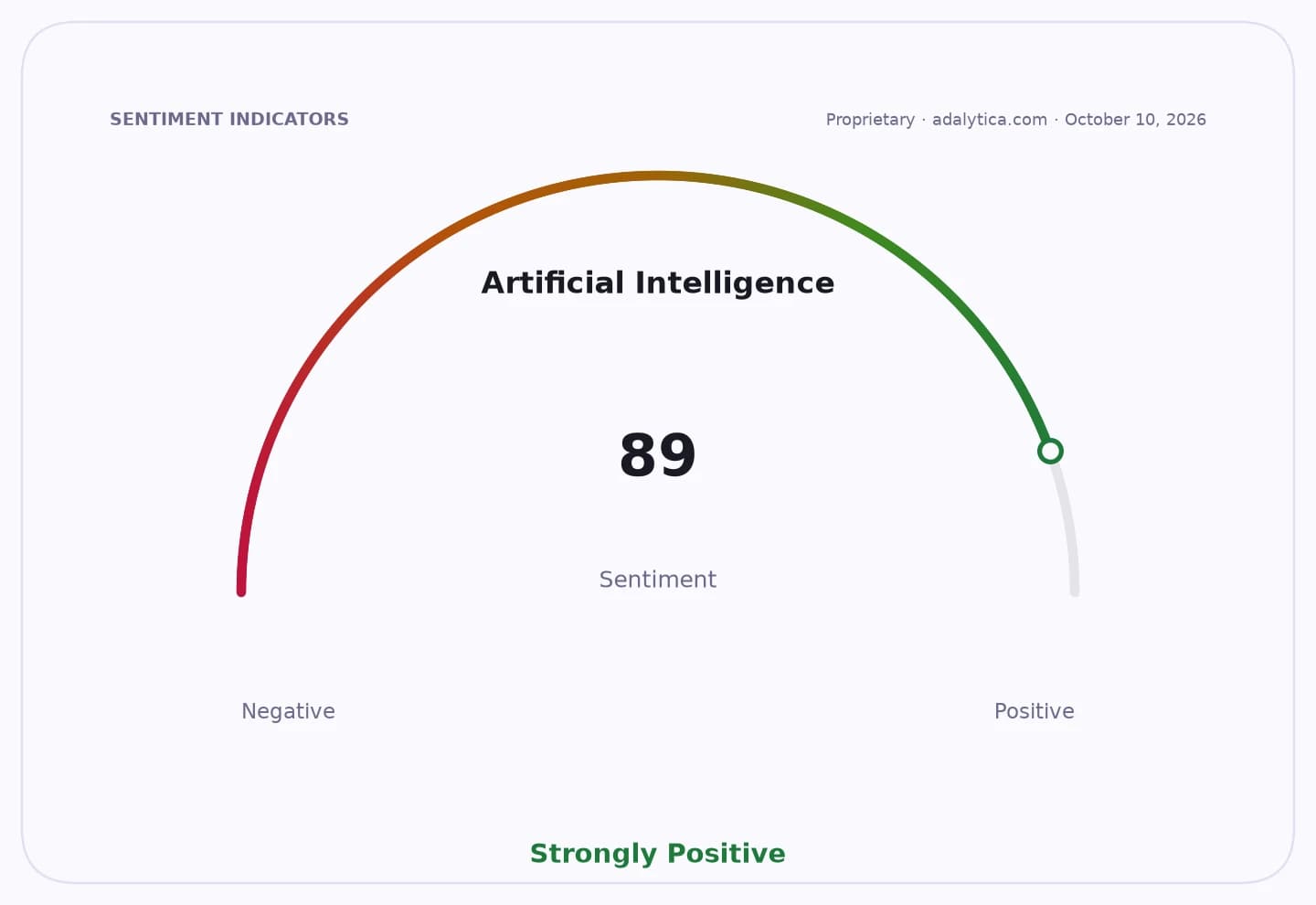
Sentiment IndicatorsⓘProprietary · adalytica.com · October 12, 2026
This is a snapshot — live sentiment, awareness and momentum for 130+ markets update continuously in the dashboard.Open AlphaPulse
The document lays out priorities across five areas, including stronger scientific and technological innovation, tighter integration of science and industry, institutional reform and talent development. It calls for faster breakthroughs in core technologies, more support for national laboratories and research universities, and a larger role for enterprises — including technology-heavy small and mid-sized firms and capable private groups — in major national projects.
That matters economically because Beijing is trying to change the source of growth, not just the rate. The guidelines emphasize upgrading traditional industries with digital, intelligent and green technologies, building digital industrial clusters, and pushing producer services higher up the value chain. They also call for expanding green manufacturing, accelerating the energy transition and improving innovation financing, suggesting a broader attempt to channel credit and fiscal support away from low-return investment and toward higher-productivity uses.
The AI component is especially important for markets. The guidelines call for fully implementing the “AI Plus” initiative, widening AI application across industries and establishing monitoring and risk systems to keep the technology “safe, reliable and controllable.” That language points to continued policy support for domestic AI model makers, industrial software, automation, semiconductors, cloud infrastructure and data-center supply chains, even as Beijing insists on tighter control over strategic technologies.
The plan also underscores China’s effort to avoid what officials call “involution-style” competition, a sign policymakers are increasingly worried about price wars and excess capacity in emerging sectors. That is a key read-through for investors in electric vehicles, batteries, solar, industrial machinery and other industries where aggressive expansion has pressured margins and triggered more scrutiny from regulators.
The market backdrop shows why the message matters. Shares of China-focused funds and exchange-traded products have been under pressure recently, with the iShares MSCI China ETF and the FTSE China ETF both below their 50-day and 200-day moving averages in the latest trading data, reflecting lingering caution about growth, earnings quality and policy execution. Any sustained rotation into the industries favored by the new guidelines would likely depend on whether policy support turns into stronger profitability rather than simply more investment.
The guidelines also fit into Beijing’s broader five-year planning framework. The outline of the 15th Five-Year Plan for 2026-2030 makes new quality productive forces a strategic task and assigns 28 major projects to the goal, showing the concept is moving from rhetoric into the center of economic policy. That gives investors a better sense of where the state wants private capital, foreign capital and local governments to direct spending over the next several years.
For global companies, the opportunity is mixed. Foreign venture capital institutions and international standards bodies are being encouraged to engage in China, and the document stresses high-standard opening up. But the emphasis on self-reliance, secure data markets and controllable AI also means the competitive environment will remain tightly managed, with foreign firms likely to face more pressure to localize, partner or transfer know-how in exchange for market access.
The upshot for investors is that Beijing is doubling down on a familiar but now more operational industrial playbook: use policy, financing and regulation to push the economy up the technology ladder while controlling the social and strategic risks of that transition. The near-term winners are likely to be firms tied to AI deployment, industrial upgrading, green tech and advanced manufacturing; the losers are companies exposed to old-economy sectors, commodity-like competition and industries vulnerable to capacity culls. The key test will be whether the new policy framework can lift productivity and margins fast enough to matter for earnings.
| Entity | Gains | Losses |
|---|---|---|
| AI and industrial tech firms | ▲Policy support, broader adoption | ▼Regulatory scrutiny |
| Advanced manufacturers | ▲Upgrading demand, funding access | ▼Low-end commodity producers |
| Green energy suppliers | ▲Expansion incentives | ▼Fossil-heavy incumbents |
| Investors in old-economy sectors | ▲— | ▼Margin pressure, slower support |