China is turning brain-computer interfaces into a new front in its technology rivalry with the United States, and investors should treat it as more than a science experiment. The race to connect machines directly to the human brain could reshape defense, healthcare, consumer tech and the global contest for computing power, with the winner controlling a platform that sits closer to cognition than any smartphone or social app ever could.
China brain-computer interfaces and tech rivalry

That is why the latest signal from Beijing matters economically as much as geopolitically. A country that can commercialize neural interfaces, even at an early stage, gains leverage over high-value intellectual property, medical device supply chains, chips, sensors and the software stack that interprets brain signals. The market tends to focus on generative AI, data centers and semiconductors, but brain-computer interfaces could become the next layer of the AI infrastructure trade — one that turns neuroscience into a strategic industry.
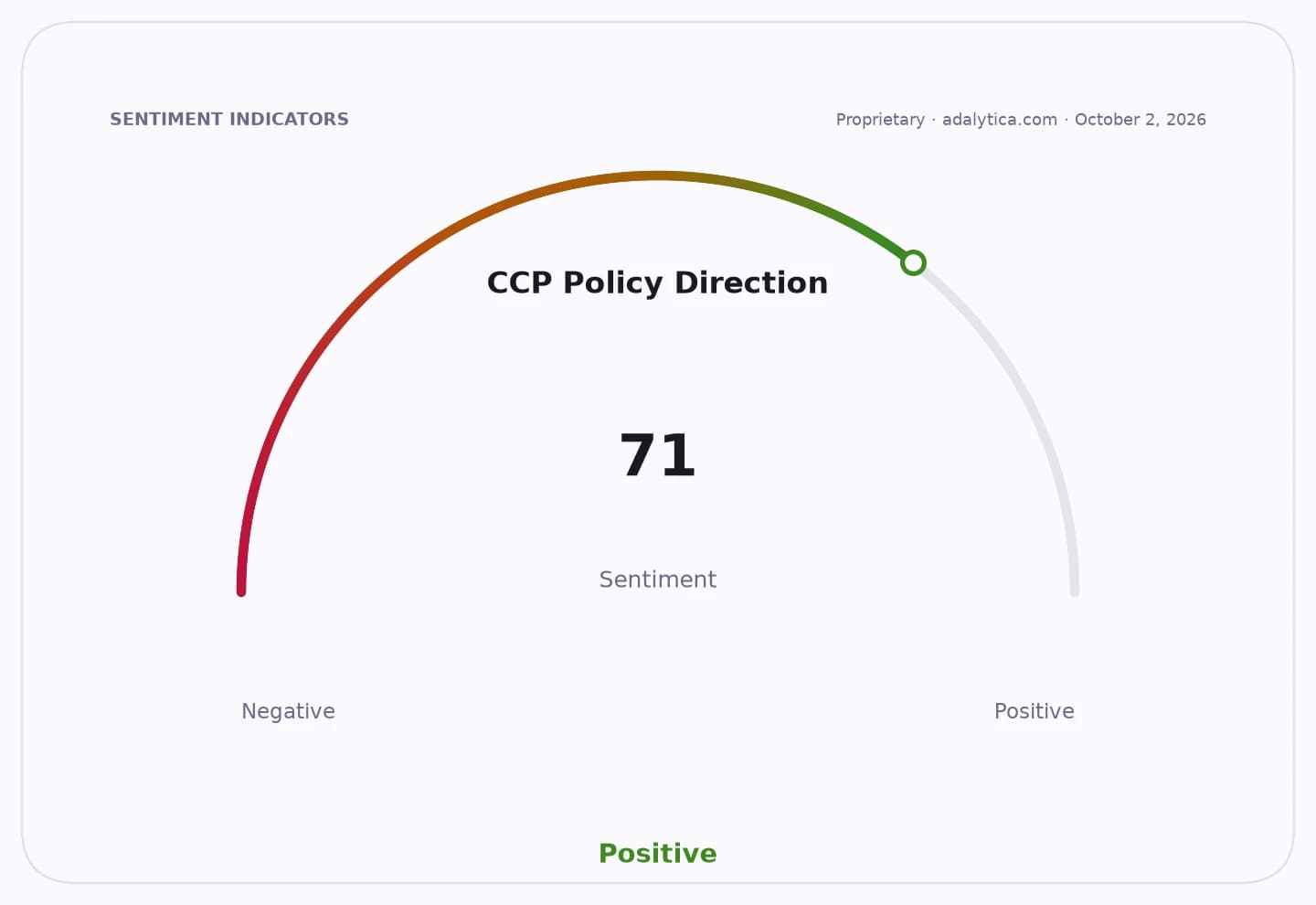
Sentiment IndicatorsⓘProprietary · adalytica.com · October 20, 2026
This is a snapshot — live sentiment, awareness and momentum for 130+ markets update continuously in the dashboard.Open AlphaPulse
The implications go well beyond prestige. For China, dominance in this field would strengthen its bid to move up the value chain and reduce dependence on Western platforms and hardware. For the US, it raises the stakes around export controls, research collaboration and talent retention. The technology also sits at the intersection of national security and digital sovereignty, because systems that decode and respond to neural activity can be adapted for military use, rehabilitation, assistive devices and eventually consumer products.
Investors should also notice the second-order beneficiaries. The real money in the early phase is likely to accrue to the picks-and-shovels suppliers: advanced chipmakers, precision sensor firms, medical device contractors, cloud and edge-compute providers, and software companies that can process noisy biological data in real time. If the sector matures, that ecosystem could expand into robotics, prosthetics and premium healthcare. The broader lesson is familiar: the first winners in a strategic technology race are rarely the headline brands, but the suppliers enabling them to scale.
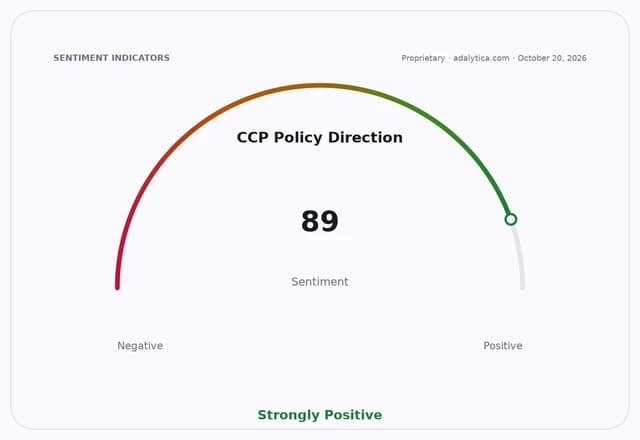
CCP Policy Direction vs METAadalytica.com
Explore this data interactively — full history, time series and cross-market comparisons.Open AlphaPulse
The stock market has already shown how quickly China-linked tech themes can swing. Baidu, often seen as one of the country’s AI proxies, has fallen to about $79.78 from more than $150 earlier this year, leaving the shares well below both the 50-day moving average and the 200-day moving average and with RSI readings around 29. That kind of compression can create opportunity, but only for investors willing to separate tactical weakness from long-term strategic relevance. Google parent Alphabet, by contrast, has held up better, with the shares near $344 and just above both key moving averages, underscoring how the market still assigns the strongest AI monetization to US incumbents.
Meta’s chart tells a different story: the stock has retreated from a recent peak above $777 to roughly $705, but remains far above its 200-day moving average. That matters because the capital race behind AI and adjacent frontier technologies is forcing even the biggest platforms to keep spending. If brain-computer interfaces evolve into a real commercial market, the companies with the balance sheets, cloud capacity and AI models to process neural data will be best positioned to capture it.
Adalytica’s China CCP Policy Direction gauge shows sentiment on Beijing’s policy direction at 89, or “Extreme Greed,” while awareness remains at 4, or “Extreme Fear.” That combination fits the current market setup: policymakers appear increasingly determined to push hard into strategic technologies, while global investors are still underestimating how broad the competitive field could become. In our view, that gap is where the asymmetric opportunity lives.
The trade to own is not a single headline stock, but the enabling layer around neurotech, AI compute and medical-grade hardware. Over the next several years, the market may discover that “China wants to get inside your head” is not just a geopolitical phrase — it is a roadmap for the next investment cycle. The best-positioned investors will be the ones buying the infrastructure before the use case becomes obvious.
| Entity | Gains | Losses |
|---|---|---|
| China neurotech sector | ▲Policy backing, strategic capital | ▼Western tech access limits |
| US chip and cloud suppliers | ▲More AI-neuro compute demand | ▼Higher competition from China |
| Baidu | ▲Potential strategic AI/neuro optionality | ▼Weak share price momentum |
| Meta and Alphabet | ▲Broader AI infrastructure demand | ▼Higher capex and rivalry |