China’s Communist Party is meeting behind closed doors in Beijing this week at a moment when the real question for investors and policymakers is not who succeeds Xi Jinping, but how much further he intends to tighten control over the party, the state and the military.
China CCP Plenum Focuses on Xi Control
The fifth plenary session of the Party’s Central Committee, which runs through Thursday, is expected to reinforce Xi’s campaign for “full and rigorous” party self-governance — a phrase that in practice means more discipline, more surveillance of cadres and a deeper push to ensure orders from the top are carried out. That matters economically because China’s policy transmission has become one of the country’s most important structural problems: a leadership that issues more directives, but local officials and ministries that often delay, reinterpret or ignore them.
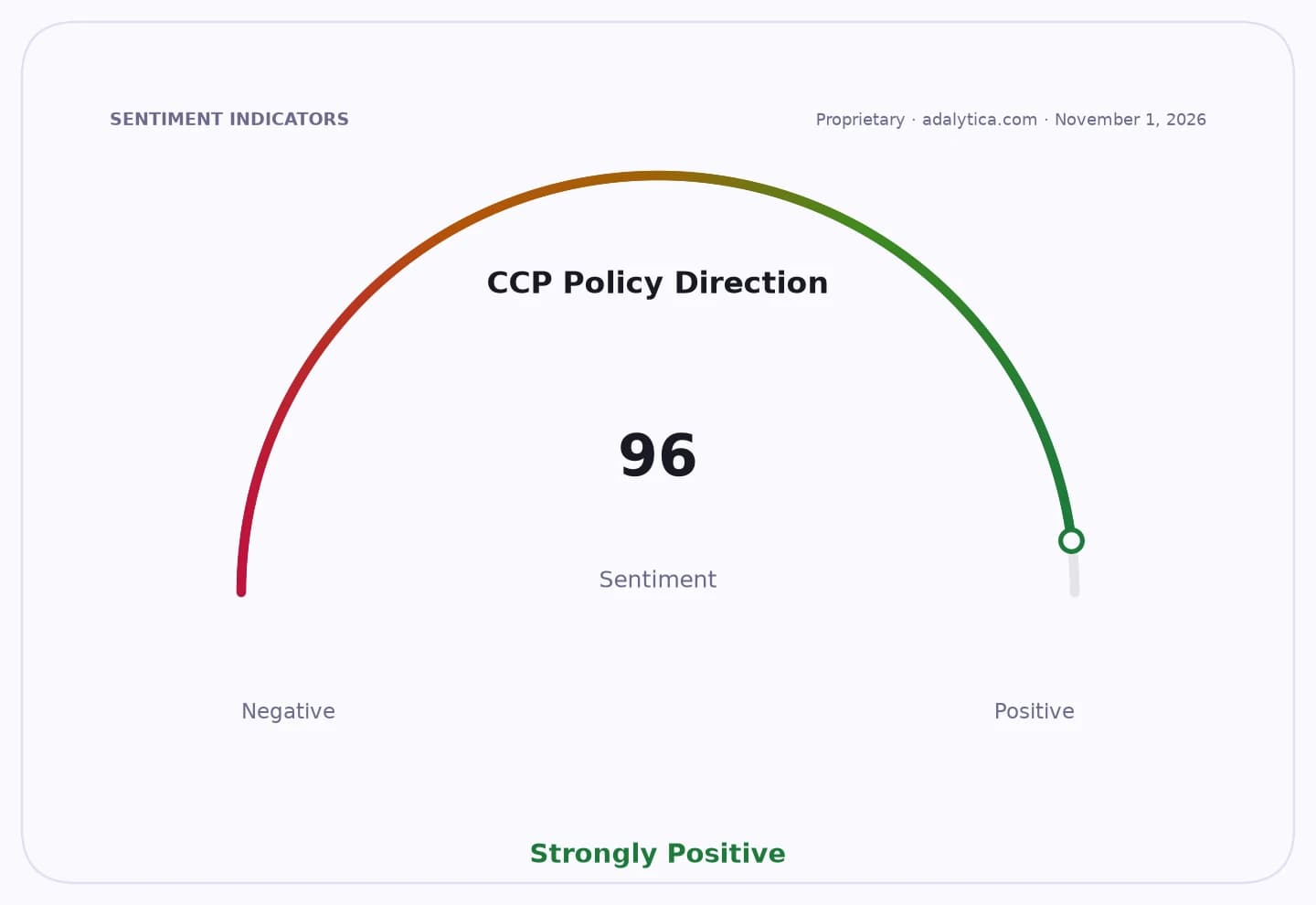
Sentiment Indicators
For markets, the meeting is a reminder that governance risk in China is not receding. Xi’s anti-corruption drive has already removed thousands of officials over 14 years, including dozens of Central Committee members, and the current plenum is likely to have the lowest attendance since Mao’s death in 1976 after a wave of purges. Five of the seven members of the Central Military Commission have been toppled, and only two of 44 military members appointed to the Central Committee in 2022 have not been purged or disappeared, according to the Asia Society Policy Institute. That level of churn can improve discipline at the margins, but it also raises the risk of institutional paralysis, risk aversion and policy execution problems at a time when China is trying to stabilise growth and restore confidence.
The immediate political significance is clear. The plenum is not expected to produce a succession plan, but it will shape the lineup for the 2027 party congress, where Xi is widely expected to secure a fourth term. Analysts will be watching whether the party elevates figures positioned for higher office in 2027, even as the vacancies created by Xi’s purges reduce the pool of contenders. Some observers have also speculated that Xi could seek an even stronger formal status, potentially by reviving the title of party chairman, though that remains conjecture.
The economic significance is more subtle but equally important. Xi’s concern is that officials have been outwardly compliant while inwardly resisting, creating what scholars describe as a classic principal-agent problem: Beijing sets ever more priorities, but local leaders control information, budgets and implementation. His answer — more supervision, more rules and more ideological discipline — may improve obedience, but it can also deepen the bureaucracy’s caution and make growth-supportive policy slower to reach businesses, households and local governments.
That matters for investors because China’s policy mix is already highly sensitive to confidence, credit demand and external pressure. The latest readings from Adalytica’s China CCP Policy Direction Sentiment remain elevated, indicating strong market attention to party policy direction, while China growth-target sentiment has swung sharply lower, underscoring how fragile confidence remains around the economic outlook. Chinese equity products are trading accordingly: the FXI China ETF has slipped to about $33.08, below both its 50-day and 200-day moving averages, while the leveraged YINN fund has dropped to about $22.59 from more than $48 earlier in the year, reflecting a much weaker risk appetite toward Chinese equities. The broader MCHI ETF has also lost ground, trading around $49.07, well under its 50-day and 200-day moving averages.
A more disciplined party could, in theory, give Beijing a better shot at pushing through industrial policy, local debt cleanup and targeted stimulus. But the bear case is that this kind of consolidation further centralises decision-making just as China needs faster, more flexible responses to a slowing economy, property-sector stress and external friction with the US and its allies. The military purge also matters geopolitically: if Xi is restructuring control over the armed forces, that can strengthen deterrence and civilian command, but it also suggests deep mistrust inside the system and a leadership focused on political security over institutional continuity.
For investors, the plenum is less about a single policy announcement than about the direction of travel. If the party doubles down on discipline while offering only limited economic reprieve, China assets may remain trapped between periodic rallies on stimulus hopes and renewed selloffs when governance concerns reassert themselves. If Beijing uses the meeting to signal more practical support for growth and clearer lines of command, markets could get a short-lived relief rally. But the larger message from this plenum is that Xi is still tightening his grip, and that concentration of power remains one of the defining variables for China risk heading into 2027.
| Entity | Gains | Losses |
|---|---|---|
| Xi Jinping | ▲tighter authority | ▼institutional checks |
| CCP leadership | ▲policy discipline | ▼internal autonomy |
| China equities | ▲stimulus hopes | ▼governance risk |
| Military hawks | ▲stronger central command | ▼senior officer corps |