China’s denial that it agreed to sell Iran hundreds of missile systems lands at a moment when already fragile US–China relations are deteriorating further, raising the geopolitical risk premium for oil, defense and broader global markets.
China Denies Iran Missile Deal as Oil Holds Firm
Beijing said it had not struck any deal to supply Iran with missiles, pushing back against allegations that would, if substantiated, deepen concerns over sanctions evasion, Middle East instability and China’s role in supporting states at odds with Washington. The denial matters because even unproven claims of advanced weapons transfers can harden U.S. policy, complicate diplomatic channels and feed expectations of more aggressive enforcement around Chinese trade, shipping and financial networks.
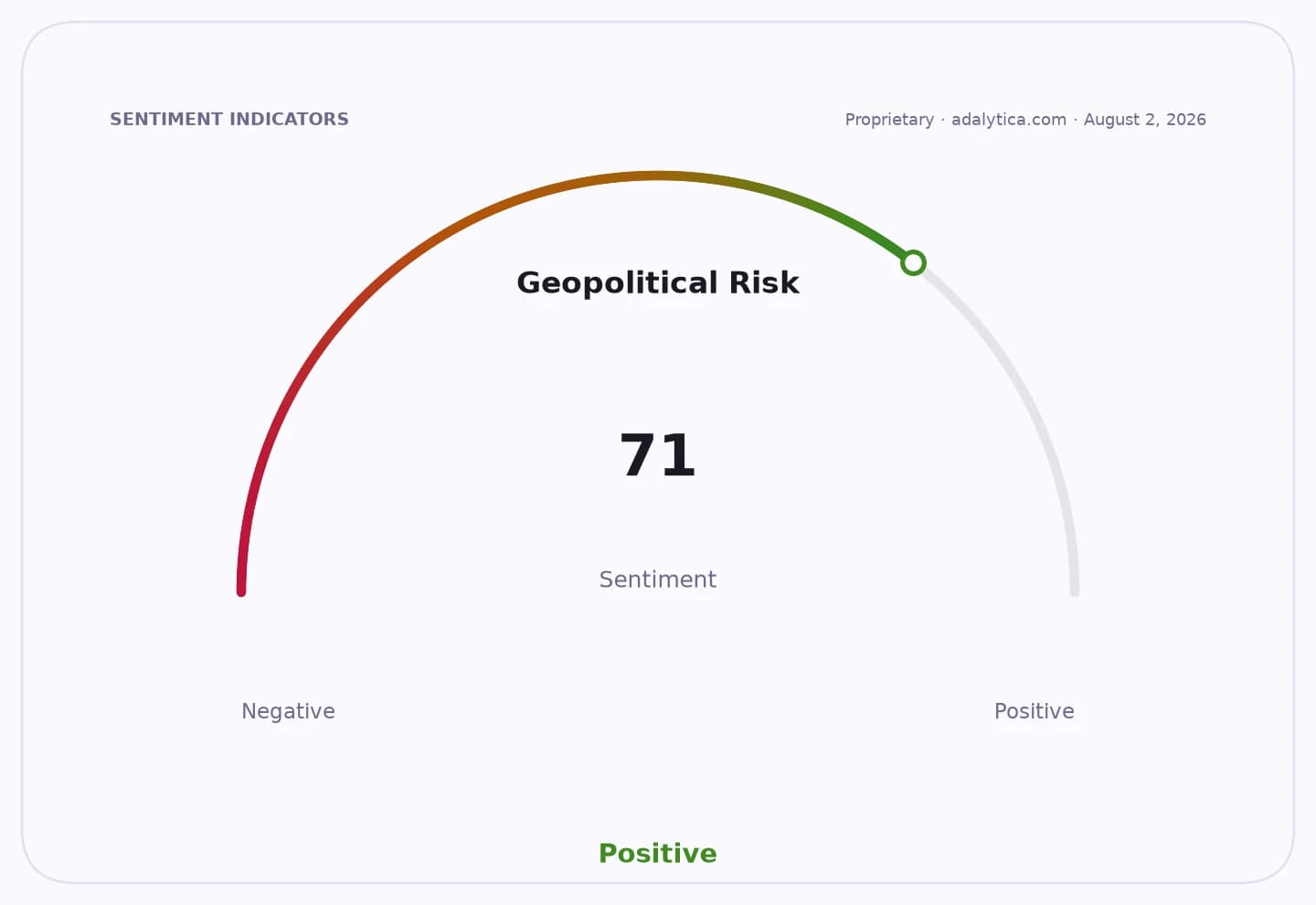
Sentiment IndicatorsⓘProprietary · adalytica.com · August 2, 2026
This is a snapshot — live sentiment, awareness and momentum for 130+ markets update continuously in the dashboard.Open AlphaPulse
The timing is especially sensitive for energy markets. Brent and other crude benchmarks have repeatedly reacted to signs of widening confrontation involving Iran, and the latest move in U.S.–China relations has coincided with a sharp rise in oil. USO, the U.S. oil ETF, closed at $129.17 on July 31 after trading as high as $150.63 on April 29, underscoring how quickly geopolitical shocks and supply-risk fears can drive pricing. Its 50-day moving average at $123.30 and a still-elevated RSI near 60 suggest the fund remains technically firm even after a pullback from spring highs.
Gold is telling a different story. GLD ended July 31 at $371.54, below its 50-day average of $385.28 and under its 200-day average of $411.86, indicating investors have pared some haven exposure even as geopolitical headlines remain intense. That divergence suggests markets are not pricing a full-blown crisis, but they are keeping a bid under oil-linked assets while treating gold more as a tactical hedge than a broad alarm signal.
The broader market backdrop is also unusually cautious. Adalytica’s US–China Relations Sentiment gauge sits at 4.0, labeled “Extreme Fear,” with awareness also at 4.0 and both down sharply over the past month. That matters for investors because a worsening relationship between the world’s two largest economies can spill into trade restrictions, export controls, shipping routes and defense procurement, amplifying volatility well beyond the immediate Iran allegation.
For defense contractors and sanctions-sensitive sectors, the issue is less about one denied transaction than about the policy response it may invite. U.S. companies already face a more restrictive environment around China, with recent SEC filings from major defense groups flagging sanctions, export controls and geopolitical tensions as ongoing business risks. If Washington concludes that Chinese entities are helping Iran militarily, the likely response would include tighter enforcement and possible secondary sanctions, which could raise compliance costs and complicate supply chains across aerospace, industrial and energy markets.
For investors, the key question is whether this is a temporary headline risk or another sign that the Iran–China–U.S. triangle is becoming a more persistent source of market stress. The bull case is that China’s denial limits escalation and leaves oil range-bound once the news cycle fades. The bear case is that even without proof, the allegation feeds a cycle of suspicion that keeps geopolitical risk premiums elevated and sustains demand for energy exposure, defense names and selective hedges.
What to watch next is whether U.S. officials respond with fresh sanctions rhetoric, whether oil extends its recent strength, and whether the latest China–Iran dispute further depresses already frail sentiment in cross-border trade and risk assets.
| Entity | Gains | Losses |
|---|---|---|
| Oil producers | ▲Higher risk premium | ▼Volatility from headlines |
| Defense contractors | ▲More security spending | ▼Compliance scrutiny |
| China | ▲Diplomatic denials | ▼Trust and market access |
| Iran | ▲Strategic ambiguity | ▼Sanctions pressure |