China’s ban on dual-use exports to European entities marks a sharp escalation in the continent’s trade conflict with Beijing, raising the risk of supply-chain disruption just as global investors were already bracing for a broader breakdown in cross-border commerce.
China Export Ban Raises Europe Supply-Chain Risk
The move matters economically because dual-use goods sit at the intersection of civilian industry and strategic technology. Restricting their flow to Europe can slow production in sectors such as semiconductors, machinery, aerospace, defense and advanced manufacturing, while also reducing the flexibility of European firms that rely on Chinese inputs or intermediates. It also signals that China is willing to weaponize export controls in response to EU sanctions, turning what had been a regulatory dispute into a more explicitly geopolitical standoff.
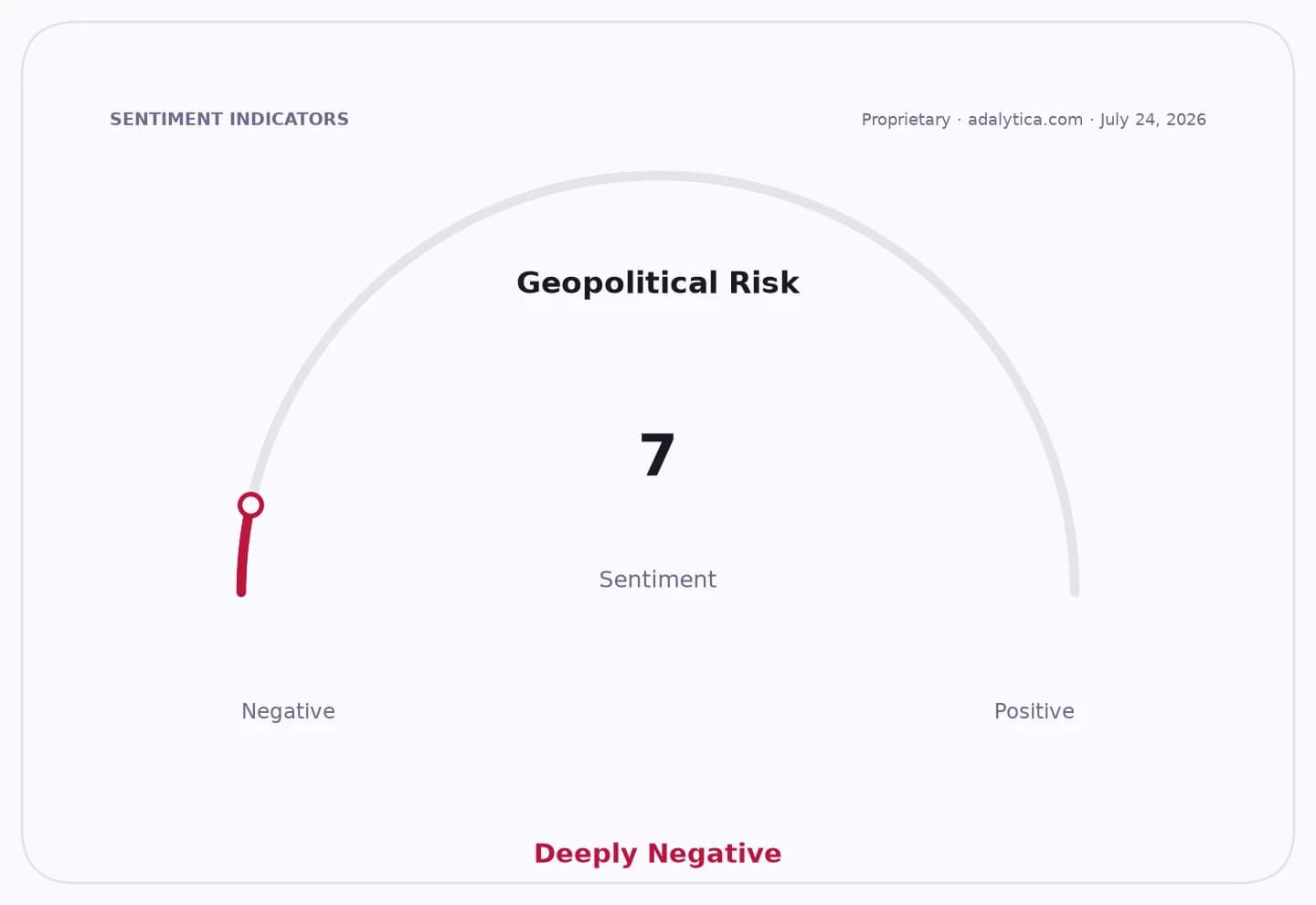
Sentiment IndicatorsⓘProprietary · adalytica.com · July 24, 2026
This is a snapshot — live sentiment, awareness and momentum for 130+ markets update continuously in the dashboard.Open AlphaPulse
For investors, the immediate issue is not only the direct hit to trade volumes but the second-order effect on planning, margins and capital spending. Companies exposed to China-Europe supply chains may face higher procurement costs, longer lead times and greater licensing uncertainty. That tends to favor domestic substitution and alternative sourcing, but it can also compress profitability for manufacturers that cannot quickly reconfigure production. The policy shock also reinforces the premium markets assign to supply-chain resilience, particularly in semiconductors, industrial equipment and defense-related technology.
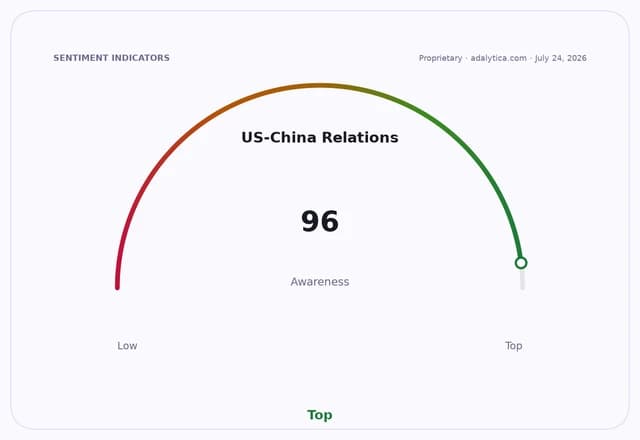
The timing is especially fraught. Sentiment on US-China relations has collapsed to “Extreme Fear” in Adalytica’s gauge, while global stability sentiment has also deteriorated, underscoring how quickly trade disputes are feeding into broader risk aversion. That backdrop helps explain why China-focused equities have been volatile even when headline market moves appear modest. FXI, the iShares China Large-Cap ETF, has been trading around its 50-day moving average after a run of sharp swings, while EWA, the iShares MSCI Australia ETF, has shown relative resilience as investors continue to favor markets seen as less directly exposed to sanctions retaliation.
The economic narrative is straightforward: tariffs and sanctions are no longer isolated policy tools but part of a wider contest over strategic supply chains. China’s latest move suggests it is prepared to answer Western restrictions with its own export leverage, a development that could pressure European industrial output, complicate multinational procurement strategies and deepen fragmentation in global trade.
For investors, the key question now is whether the EU answers with further sanctions, which would invite another round of Chinese retaliation and broaden the damage to exporters on both sides. The bull case is that the episode remains contained and accelerates diversification away from politically sensitive supply chains. The bear case is that it becomes a template for repeated tit-for-tat controls, forcing a lasting re-rating of Europe-linked trade exposures and adding another layer of uncertainty to an already fragile global growth outlook.
| Entity | Gains | Losses |
|---|---|---|
| China | ▲leverage in sanctions fight | ▼access to EU markets |
| European manufacturers | ▲supply-chain diversification | ▼dual-use input access |
| Alternative suppliers | ▲new sourcing demand | ▼higher uncertainty |
| Investors in resilient markets | ▲relative capital inflows | ▼direct China-Europe trade exposure |